

Classification of Hand Motion Using Surface EMG Signals
229
RE = ⎡ ⎣ RE
i , ..., RE
1 , ..., RE
M−1 ⎤ ⎦
(12.14)
where M is the channel number. RE 1 is a 1 × (M–1) vector, and RE i is a 1 ×
M−
(M–i) vector. So RE is a row vector with ∑ M i
i=
( − ) columns.
In our case, there is a total of six channels, and thus RE is a 1 × 15 vector of:
RE = ⎡ ⎣ RE 21 , ..., RE 61 , RE 32 , ..., RE 62 , RE 43 , ..., RE 63 3 , RE 54 , RE 64 , RE 65 ⎤ ⎦ .
Using the above definition and the six-channel sensor ring shown in
Figure 12.2, the seven types of hand movements determined as shown in
Figure 12.3 can be distinguished. For each type of hand movement, thirty
trials were sampled. First, the Bonato method was used to find the onset
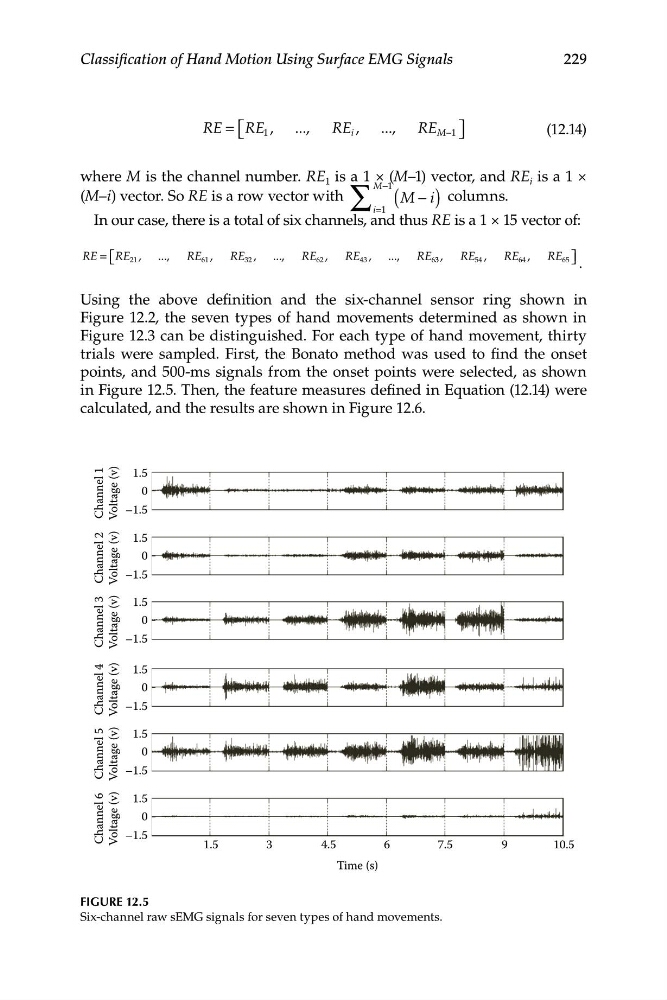
points, and 500-ms signals from the onset points were selected, as shown
in Figure 12.5. Then, the feature measures defined in Equation (12.14) were
calculated, and the results are shown in Figure 12.6.
1.5
3
4.5
6
7.5
9
10.5
Time (s)
1.5
0
Channel 1
Voltage (v)
–1.5
1.5
0
Channel 2
Voltage (v)
–1.5
1.5
0
Channel 3
Voltage (v)
–1.5
1.5
0
Channel 4
Voltage (v)
–1.5
1.5
0
Channel 5
Voltage (v)
–1.5
1.5
0
Channel 6
Voltage (v)
–1.5
FIGURE 12.5
Six-channel raw sEMG signals for seven types of hand movements.
229
RE = ⎡ ⎣ RE
i , ..., RE
1 , ..., RE
M−1 ⎤ ⎦
(12.14)
where M is the channel number. RE 1 is a 1 × (M–1) vector, and RE i is a 1 ×
M−
(M–i) vector. So RE is a row vector with ∑ M i
i=
( − ) columns.
In our case, there is a total of six channels, and thus RE is a 1 × 15 vector of:
RE = ⎡ ⎣ RE 21 , ..., RE 61 , RE 32 , ..., RE 62 , RE 43 , ..., RE 63 3 , RE 54 , RE 64 , RE 65 ⎤ ⎦ .
Using the above definition and the six-channel sensor ring shown in
Figure 12.2, the seven types of hand movements determined as shown in
Figure 12.3 can be distinguished. For each type of hand movement, thirty
trials were sampled. First, the Bonato method was used to find the onset
points, and 500-ms signals from the onset points were selected, as shown
in Figure 12.5. Then, the feature measures defined in Equation (12.14) were
calculated, and the results are shown in Figure 12.6.
1.5
3
4.5
6
7.5
9
10.5
Time (s)
1.5
0
Channel 1
Voltage (v)
–1.5
1.5
0
Channel 2
Voltage (v)
–1.5
1.5
0
Channel 3
Voltage (v)
–1.5
1.5
0
Channel 4
Voltage (v)
–1.5
1.5
0
Channel 5
Voltage (v)
–1.5
1.5
0
Channel 6
Voltage (v)
–1.5
FIGURE 12.5
Six-channel raw sEMG signals for seven types of hand movements.