

228
Biologically Inspired Robotics
where i represents the ith channel, X t
i ( ) is the time-series sEMG signal of
the ith channel, and N is the data number of the time-series sEGM signal
from one channel.
However, there is a limitation when using the spectral integral of the
temporal sEMG signals as the feature. For the same type of the movement,
the square integral values of the temporal signal vary with the movement
force and movement speed. The changes in the feature’s values can affect
the classification results. The ideal case is that classification of the types
of hand movements is not affected by some variances such as movement
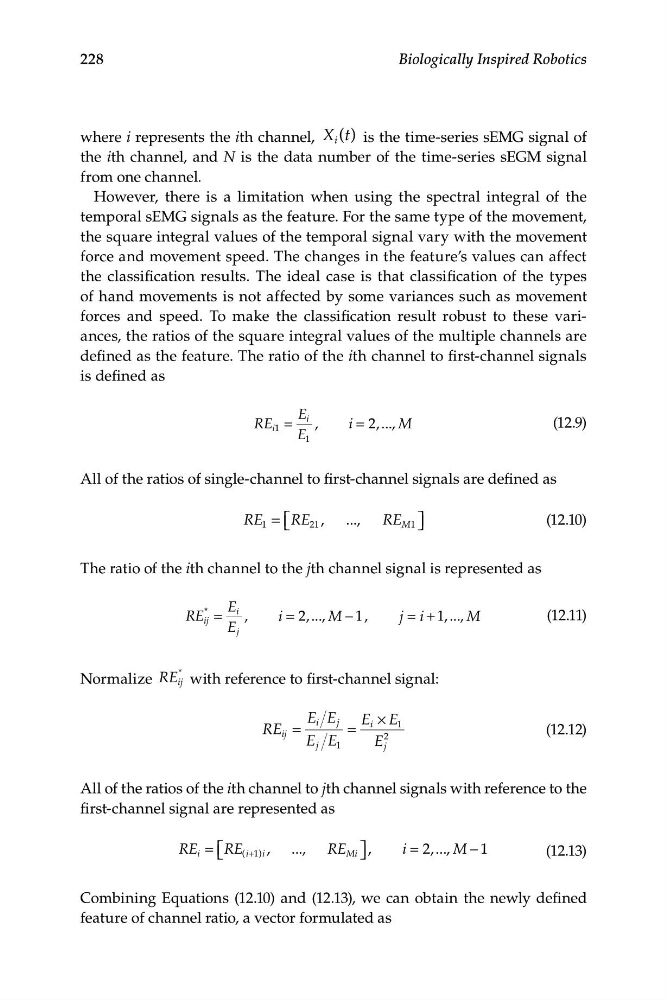
forces and speed. To make the classification result robust to these variances, the ratios of the square integral values of the multiple channels are
defined as the feature. The ratio of the ith channel to first-channel signals
is defined as
E
RE
i
i1 =
,
i = 2,..., M
(12.9)
E 1
All of the ratios of single-channel to first-channel signals are defined as
RE 1 = ⎡ ⎣ RE 2 1 , ..., RE M1 ⎤ ⎦
(12.10)
The ratio of the ith channel to the jth channel signal is represented as
RE
*
E
ij =
i ,
i = 2,..., M − 1 ,
j = i + 1,..., M
(12.11)
E j
Normalize RE
ij with reference to first-channel signal:
E E
RE =
i
j
E i × E 1
ij
=
2
(12.12)
E E
j
1
E j
All of the ratios of the ith channel to jth channel signals with reference to the
first-channel signal are represented as
RE i = ⎡ ⎣ RE (i+1)i , ..., RE M i ⎤ ⎦ ,
i = 2,..., M − 1
(12.13)
Combining Equations (12.10) and (12.13), we can obtain the newly defined
feature of channel ratio, a vector formulated as
Biologically Inspired Robotics
where i represents the ith channel, X t
i ( ) is the time-series sEMG signal of
the ith channel, and N is the data number of the time-series sEGM signal
from one channel.
However, there is a limitation when using the spectral integral of the
temporal sEMG signals as the feature. For the same type of the movement,
the square integral values of the temporal signal vary with the movement
force and movement speed. The changes in the feature’s values can affect
the classification results. The ideal case is that classification of the types
of hand movements is not affected by some variances such as movement
forces and speed. To make the classification result robust to these variances, the ratios of the square integral values of the multiple channels are
defined as the feature. The ratio of the ith channel to first-channel signals
is defined as
E
RE
i
i1 =
,
i = 2,..., M
(12.9)
E 1
All of the ratios of single-channel to first-channel signals are defined as
RE 1 = ⎡ ⎣ RE 2 1 , ..., RE M1 ⎤ ⎦
(12.10)
The ratio of the ith channel to the jth channel signal is represented as
RE
*
E
ij =
i ,
i = 2,..., M − 1 ,
j = i + 1,..., M
(12.11)
E j
Normalize RE
ij with reference to first-channel signal:
E E
RE =
i
j
E i × E 1
ij
=
2
(12.12)
E E
j
1
E j
All of the ratios of the ith channel to jth channel signals with reference to the
first-channel signal are represented as
RE i = ⎡ ⎣ RE (i+1)i , ..., RE M i ⎤ ⎦ ,
i = 2,..., M − 1
(12.13)
Combining Equations (12.10) and (12.13), we can obtain the newly defined
feature of channel ratio, a vector formulated as