

225
Classification of Hand Motion Using Surface EMG Signals
N
σ xy =
∑ (xi − μ x )( y i − μ y )
N
i=
(12.4)
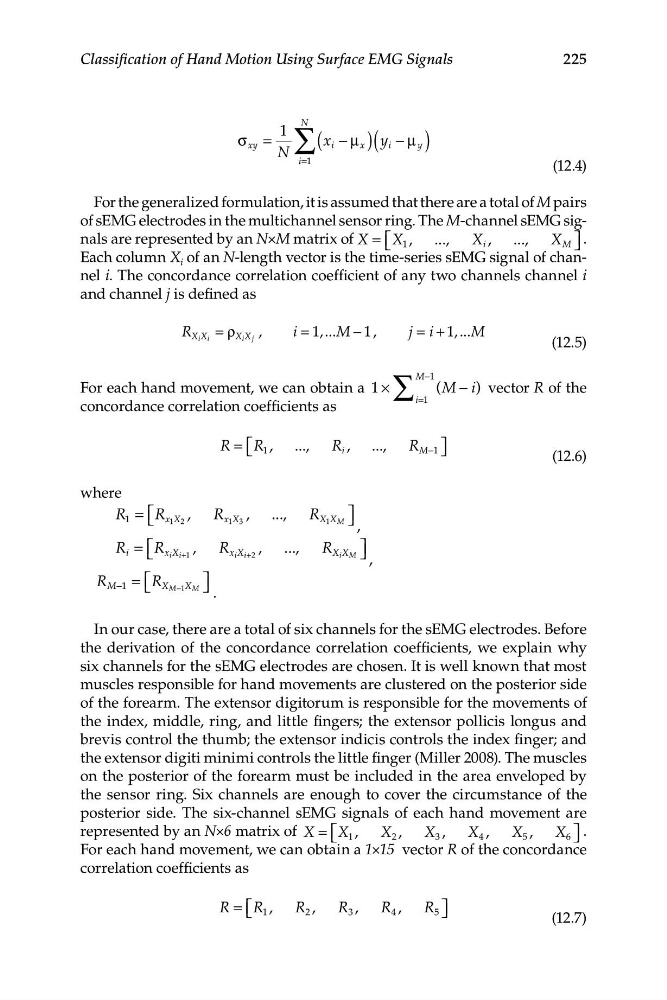
For the generalized formulation, it is assumed that there are a total of M pairs
of sEMG electrodes in the multichannel sensor ring. The M-channel sEMG signals are represented by an N×M matrix of X = ⎡ ⎣ X 1 , ..., X i , ..., X M ⎤ ⎦ .
Each column X i of an N-length vector is the time-series sEMG signal of channel i. The concordance correlation coefficient of any two channels channel i
and channel j is defined as
R X X = ρ X X ,
i = 1,... M − 1 ,
j = i + 1,... M
i i
i j
(12.5)
For each hand movement, we can obtain a 1 × ∑
M−1
(M i
− ) vector R of the
i=1
concordance correlation coefficients as
R = ⎡ ⎣ R , ..., R , ..., R ⎤ ⎦
1
i
M−1
(12.6)
where
R 1 = ⎡ ⎣ R , R x X , ..., R
⎤ ⎦
x X
X X
1 2
1 3
1 M
,
R i = ⎡ ⎣ R x X , R x X +2 , ..., R X X
i M
⎤ ⎦
i i+1
i i
,
R M− = ⎡ ⎣ R X M− X M ⎤ ⎦ .
In our case, there are a total of six channels for the sEMG electrodes. Before
the derivation of the concordance correlation coefficients, we explain why
six channels for the sEMG electrodes are chosen. It is well known that most
muscles responsible for hand movements are clustered on the posterior side
of the forearm. The extensor digitorum is responsible for the movements of
the index, middle, ring, and little fingers; the extensor pollicis longus and
brevis control the thumb; the extensor indicis controls the index finger; and
the extensor digiti minimi controls the little finger (Miller 2008). The muscles
on the posterior of the forearm must be included in the area enveloped by
the sensor ring. Six channels are enough to cover the circumstance of the
posterior side. The six-channel sEMG signals of each hand movement are
represented by an N×6 matrix of ; = ⎡ ⎣ ; 1 , ; 2 , ; 3 , ; 4 , ; 5 , ; 6 ⎤ ⎦ .
For each hand movement, we can obtain a 1×15 vector R of the concordance
correlation coefficients as
5 = ⎡ ⎣ 5 1 , 5 2 , 5 3 , 5 4 , 5 5 ⎤ ⎦
(12.7)
Classification of Hand Motion Using Surface EMG Signals
N
σ xy =
∑ (xi − μ x )( y i − μ y )
N
i=
(12.4)
For the generalized formulation, it is assumed that there are a total of M pairs
of sEMG electrodes in the multichannel sensor ring. The M-channel sEMG signals are represented by an N×M matrix of X = ⎡ ⎣ X 1 , ..., X i , ..., X M ⎤ ⎦ .
Each column X i of an N-length vector is the time-series sEMG signal of channel i. The concordance correlation coefficient of any two channels channel i
and channel j is defined as
R X X = ρ X X ,
i = 1,... M − 1 ,
j = i + 1,... M
i i
i j
(12.5)
For each hand movement, we can obtain a 1 × ∑
M−1
(M i
− ) vector R of the
i=1
concordance correlation coefficients as
R = ⎡ ⎣ R , ..., R , ..., R ⎤ ⎦
1
i
M−1
(12.6)
where
R 1 = ⎡ ⎣ R , R x X , ..., R
⎤ ⎦
x X
X X
1 2
1 3
1 M
,
R i = ⎡ ⎣ R x X , R x X +2 , ..., R X X
i M
⎤ ⎦
i i+1
i i
,
R M− = ⎡ ⎣ R X M− X M ⎤ ⎦ .
In our case, there are a total of six channels for the sEMG electrodes. Before
the derivation of the concordance correlation coefficients, we explain why
six channels for the sEMG electrodes are chosen. It is well known that most
muscles responsible for hand movements are clustered on the posterior side
of the forearm. The extensor digitorum is responsible for the movements of
the index, middle, ring, and little fingers; the extensor pollicis longus and
brevis control the thumb; the extensor indicis controls the index finger; and
the extensor digiti minimi controls the little finger (Miller 2008). The muscles
on the posterior of the forearm must be included in the area enveloped by
the sensor ring. Six channels are enough to cover the circumstance of the
posterior side. The six-channel sEMG signals of each hand movement are
represented by an N×6 matrix of ; = ⎡ ⎣ ; 1 , ; 2 , ; 3 , ; 4 , ; 5 , ; 6 ⎤ ⎦ .
For each hand movement, we can obtain a 1×15 vector R of the concordance
correlation coefficients as
5 = ⎡ ⎣ 5 1 , 5 2 , 5 3 , 5 4 , 5 5 ⎤ ⎦
(12.7)