

226
Biologically Inspired Robotics
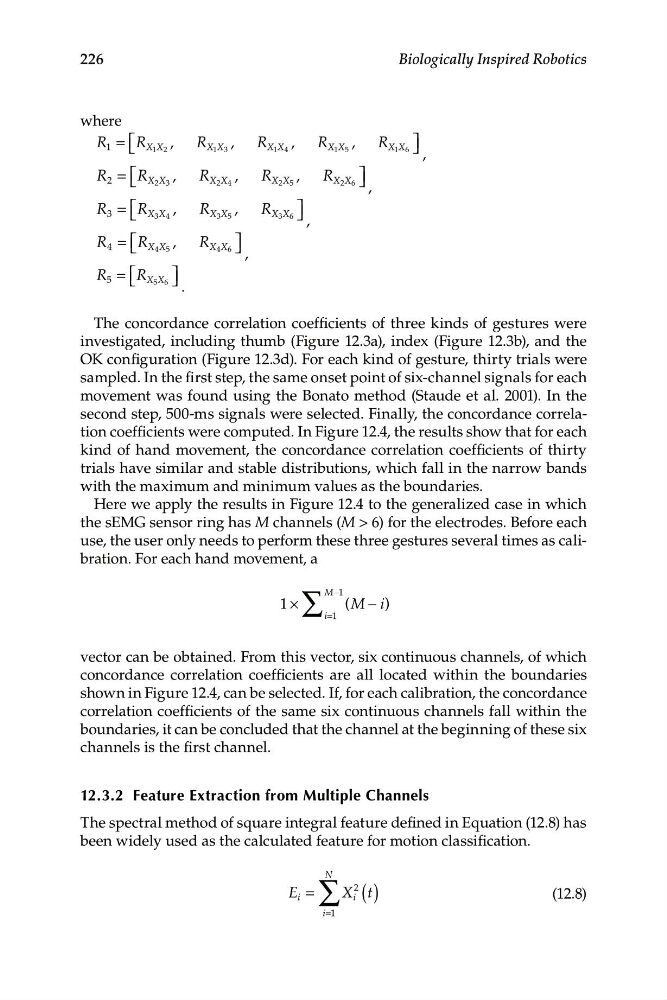
where
R 1 = ⎡R X X
1 2
, R X X , R X X
1 4
, R X X
1 5
, R 1 6 ⎤ ⎦
⎣
1 3
X X
,
R = ⎣ ⎡R X X , R X X
2 4
, R X X , R X X
2 6
⎤
2
2 5
⎦
2 3
,
R 3 = ⎡ ⎣ R X X , R X X
3 5
, R X X
3 6
⎤ ⎦
3 4
,
R 4 = ⎡ ⎣ R X X
4 5
, R X X ⎦ ⎤
4 6
,
R 5 = ⎡R X X ⎤
⎣ 5 6 ⎦ .
The concordance correlation coefficients of three kinds of gestures were
investigated, including thumb (Figure 12.3a), index (Figure 12.3b), and the
OK configuration (Figure 12.3d). For each kind of gesture, thirty trials were
sampled. In the first step, the same onset point of six-channel signals for each
movement was found using the Bonato method (Staude et al. 2001). In the
second step, 500-ms signals were selected. Finally, the concordance correlation coefficients were computed. In Figure 12.4, the results show that for each
kind of hand movement, the concordance correlation coefficients of thirty
trials have similar and stable distributions, which fall in the narrow bands
with the maximum and minimum values as the boundaries.
Here we apply the results in Figure 12.4 to the generalized case in which
the sEMG sensor ring has M channels (M > 6) for the electrodes. Before each
use, the user only needs to perform these three gestures several times as calibration. For each hand movement, a
M−1
1 × ∑ (M i)
−
i=1
vector can be obtained. From this vector, six continuous channels, of which
concordance correlation coefficients are all located within the boundaries
shown in Figure 12.4, can be selected. If, for each calibration, the concordance
correlation coefficients of the same six continuous channels fall within the
boundaries, it can be concluded that the channel at the beginning of these six
channels is the first channel.
12.3.2 Feature Extraction from Multiple Channels
The spectral method of square integral feature defined in Equation (12.8) has
been widely used as the calculated feature for motion classification.
N
E =
X t
i
∑ i
2
( )
(12.8)
i=1
Biologically Inspired Robotics
where
R 1 = ⎡R X X
1 2
, R X X , R X X
1 4
, R X X
1 5
, R 1 6 ⎤ ⎦
⎣
1 3
X X
,
R = ⎣ ⎡R X X , R X X
2 4
, R X X , R X X
2 6
⎤
2
2 5
⎦
2 3
,
R 3 = ⎡ ⎣ R X X , R X X
3 5
, R X X
3 6
⎤ ⎦
3 4
,
R 4 = ⎡ ⎣ R X X
4 5
, R X X ⎦ ⎤
4 6
,
R 5 = ⎡R X X ⎤
⎣ 5 6 ⎦ .
The concordance correlation coefficients of three kinds of gestures were
investigated, including thumb (Figure 12.3a), index (Figure 12.3b), and the
OK configuration (Figure 12.3d). For each kind of gesture, thirty trials were
sampled. In the first step, the same onset point of six-channel signals for each
movement was found using the Bonato method (Staude et al. 2001). In the
second step, 500-ms signals were selected. Finally, the concordance correlation coefficients were computed. In Figure 12.4, the results show that for each
kind of hand movement, the concordance correlation coefficients of thirty
trials have similar and stable distributions, which fall in the narrow bands
with the maximum and minimum values as the boundaries.
Here we apply the results in Figure 12.4 to the generalized case in which
the sEMG sensor ring has M channels (M > 6) for the electrodes. Before each
use, the user only needs to perform these three gestures several times as calibration. For each hand movement, a
M−1
1 × ∑ (M i)
−
i=1
vector can be obtained. From this vector, six continuous channels, of which
concordance correlation coefficients are all located within the boundaries
shown in Figure 12.4, can be selected. If, for each calibration, the concordance
correlation coefficients of the same six continuous channels fall within the
boundaries, it can be concluded that the channel at the beginning of these six
channels is the first channel.
12.3.2 Feature Extraction from Multiple Channels
The spectral method of square integral feature defined in Equation (12.8) has
been widely used as the calculated feature for motion classification.
N
E =
X t
i
∑ i
2
( )
(12.8)
i=1