

224
Biologically Inspired Robotics
of the sEMG electrodes. However, especially for the whole sensor ring, some
channels are redundant. The multichannel sensor ring always has redundant channels, and it is important to determine which channels are meaningful. To ensure that the extracted features are uniform, especially when
the user arbitrarily wears the sensor ring, it is important to determine where
the first-channel electrodes among the selected meaningful channels are
located for every trial.
For multichannel sEMG sensors, the definition of the cross-correlation
coefficient, also called the Pearson’s product-moment coefficient, has been used
to investigate cross-talk among the channels (Mogk and Keir 2003). However,
the cross-correlation only measures the extent of the linear relationship
between two variables. When two variables have a nonlinear relationship, the
value of the cross-correlation coefficient is zero. Thus, the cross-correlation
coefficient has the risk during evaluating the relationship of two variables.
Here, the concordance coefficient is introduced in this chapter to evaluate
the agreement of each two-channel sEMG signal. The concordance correlation coefficient, defined by Lin (1989), measures the agreement between two
variables and has been widely used in studies on data reproducibility (Lin
1989) and image comparison analysis (Lange et al. 1999). In this chapter, we
use the concordance coefficient to investigate the agreement between sEMG
signals for each two-channel signal.
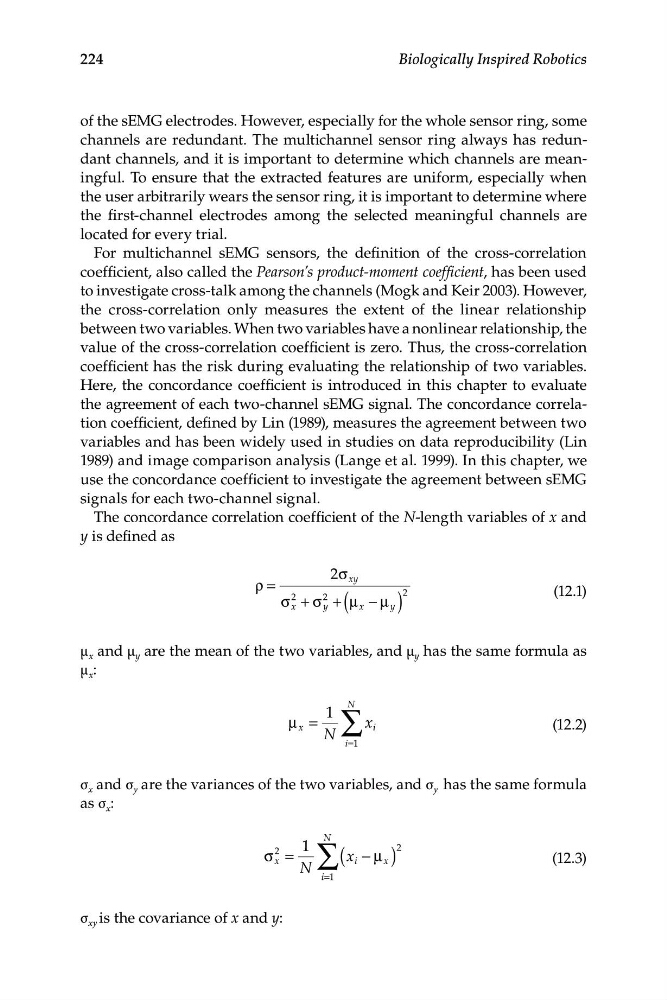
The concordance correlation coefficient of the N-length variables of x and
y is defined as
σ
ρ =
xy
(12.1)
σ x + σ y + ( μ x − μ y )
μ x and μ y are the mean of the two variables, and μ y has the same formula as
μ x :
N
μ x =
∑ x i
(12.2)
N
i=
σ x and σ y are the variances of the two variables, and σ y has the same formula
as σ x :
N
2
σ x
2
=
1
∑ (xi − μ x )
(12.3)
N
i=1
σ xy is the covariance of x and y:
Biologically Inspired Robotics
of the sEMG electrodes. However, especially for the whole sensor ring, some
channels are redundant. The multichannel sensor ring always has redundant channels, and it is important to determine which channels are meaningful. To ensure that the extracted features are uniform, especially when
the user arbitrarily wears the sensor ring, it is important to determine where
the first-channel electrodes among the selected meaningful channels are
located for every trial.
For multichannel sEMG sensors, the definition of the cross-correlation
coefficient, also called the Pearson’s product-moment coefficient, has been used
to investigate cross-talk among the channels (Mogk and Keir 2003). However,
the cross-correlation only measures the extent of the linear relationship
between two variables. When two variables have a nonlinear relationship, the
value of the cross-correlation coefficient is zero. Thus, the cross-correlation
coefficient has the risk during evaluating the relationship of two variables.
Here, the concordance coefficient is introduced in this chapter to evaluate
the agreement of each two-channel sEMG signal. The concordance correlation coefficient, defined by Lin (1989), measures the agreement between two
variables and has been widely used in studies on data reproducibility (Lin
1989) and image comparison analysis (Lange et al. 1999). In this chapter, we
use the concordance coefficient to investigate the agreement between sEMG
signals for each two-channel signal.
The concordance correlation coefficient of the N-length variables of x and
y is defined as
σ
ρ =
xy
(12.1)
σ x + σ y + ( μ x − μ y )
μ x and μ y are the mean of the two variables, and μ y has the same formula as
μ x :
N
μ x =
∑ x i
(12.2)
N
i=
σ x and σ y are the variances of the two variables, and σ y has the same formula
as σ x :
N
2
σ x
2
=
1
∑ (xi − μ x )
(12.3)
N
i=1
σ xy is the covariance of x and y: