

223
Classification of Hand Motion Using Surface EMG Signals
12.2.2 sEMG Signal Preprocessing
The amplitudes of the raw sEMG signals are miniature, at the scale from
several microvolts to millivolts. Moreover, several types of noise are mixed
with the useful sEMG signals; that is, low-frequency cross-talk, 50-Hz AC frequency, and high-frequency noises. Therefore, the differential amplifier and
filters are designed to strengthen and clarify the useful signals. The sEMG
signal is amplified to the scale of V by the differential amplifier. The high-pass
(>20 Hz), notch (50 Hz), and low-pass (<500 Hz) filters eliminate the three types
of noise mentioned above. The amplifier and filters are miniature sized and
are integrated with the sEMG sensor ring to be worn on the human forearm.
The advantage of integration of the sEMG sensor and the analog circuits is that
there is no extra noise introduced during long-distance wire transfer.
After amplification and filtration, the analog voltages of the sEMG signal
are converted digitally by a 10-bit A/D converter. The digital signals are
transferred to the computer via wireless communication using standard
radio frequency (RF) technology.
12.3 Classification of Hand Movements
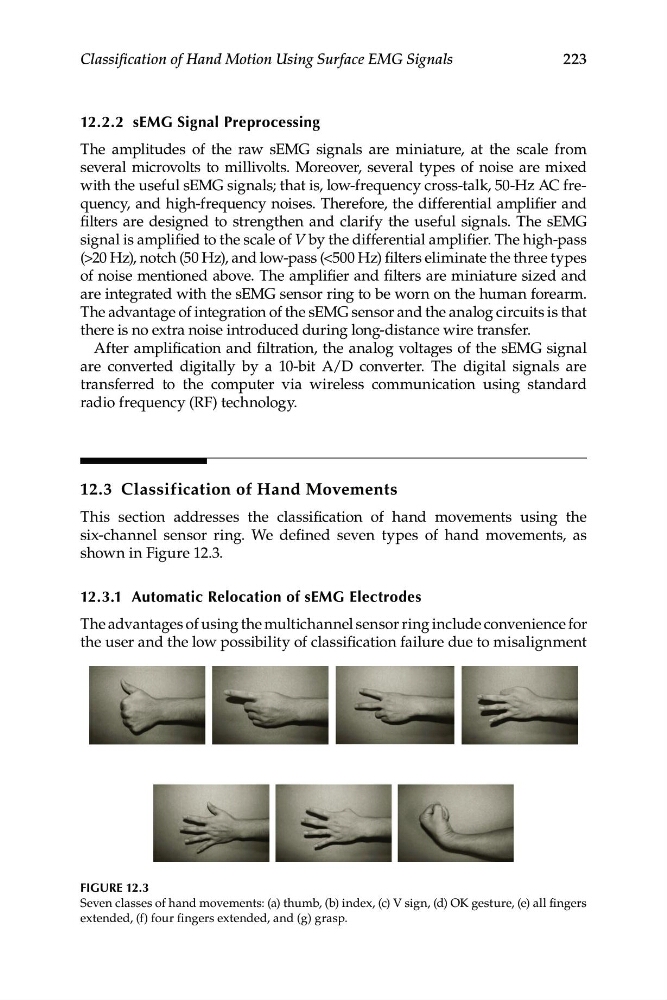
This section addresses the classification of hand movements using the
six-channel sensor ring. We defined seven types of hand movements, as
shown in Figure 12.3.
12.3.1 Automatic Relocation of sEMG Electrodes
The advantages of using the multichannel sensor ring include convenience for
the user and the low possibility of classification failure due to misalignment
FIGURE 12.3
Seven classes of hand movements: (a) thumb, (b) index, (c) V sign, (d) OK gesture, (e) all fingers
extended, (f) four fingers extended, and (g) grasp.
Classification of Hand Motion Using Surface EMG Signals
12.2.2 sEMG Signal Preprocessing
The amplitudes of the raw sEMG signals are miniature, at the scale from
several microvolts to millivolts. Moreover, several types of noise are mixed
with the useful sEMG signals; that is, low-frequency cross-talk, 50-Hz AC frequency, and high-frequency noises. Therefore, the differential amplifier and
filters are designed to strengthen and clarify the useful signals. The sEMG
signal is amplified to the scale of V by the differential amplifier. The high-pass
(>20 Hz), notch (50 Hz), and low-pass (<500 Hz) filters eliminate the three types
of noise mentioned above. The amplifier and filters are miniature sized and
are integrated with the sEMG sensor ring to be worn on the human forearm.
The advantage of integration of the sEMG sensor and the analog circuits is that
there is no extra noise introduced during long-distance wire transfer.
After amplification and filtration, the analog voltages of the sEMG signal
are converted digitally by a 10-bit A/D converter. The digital signals are
transferred to the computer via wireless communication using standard
radio frequency (RF) technology.
12.3 Classification of Hand Movements
This section addresses the classification of hand movements using the
six-channel sensor ring. We defined seven types of hand movements, as
shown in Figure 12.3.
12.3.1 Automatic Relocation of sEMG Electrodes
The advantages of using the multichannel sensor ring include convenience for
the user and the low possibility of classification failure due to misalignment
FIGURE 12.3
Seven classes of hand movements: (a) thumb, (b) index, (c) V sign, (d) OK gesture, (e) all fingers
extended, (f) four fingers extended, and (g) grasp.