

1
2
6
7 15 16 28
3
5
8
14 17 27
4
9
13 18 26
10 12 19 25
11 20 24
21 23
22
212
Biologically Inspired Robotics
coefficients to reduce the number of features to characterize color features.
Through experiments, we found that using only twenty-eight coefficients,
which lie in the upper left corner of the DCT coefficients matrix, worked
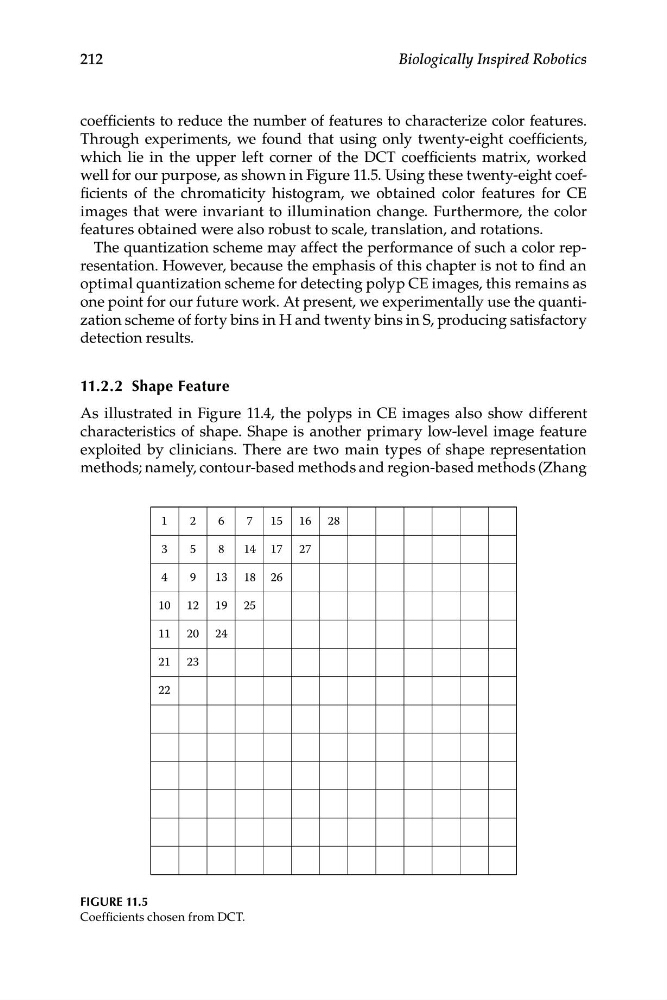
well for our purpose, as shown in Figure 11.5. Using these twenty-eight coefficients of the chromaticity histogram, we obtained color features for CE
images that were invariant to illumination change. Furthermore, the color
features obtained were also robust to scale, translation, and rotations.
The quantization scheme may affect the performance of such a color representation. However, because the emphasis of this chapter is not to find an
optimal quantization scheme for detecting polyp CE images, this remains as
one point for our future work. At present, we experimentally use the quantization scheme of forty bins in H and twenty bins in S, producing satisfactory
detection results.
11.2.2 Shape Feature
As illustrated in Figure 11.4, the polyps in CE images also show different
characteristics of shape. Shape is another primary low-level image feature
exploited by clinicians. There are two main types of shape representation
methods; namely, contour-based methods and region-based methods (Zhang
FIGURE 11.5
Coefficients chosen from DCT.
2
6
7 15 16 28
3
5
8
14 17 27
4
9
13 18 26
10 12 19 25
11 20 24
21 23
22
212
Biologically Inspired Robotics
coefficients to reduce the number of features to characterize color features.
Through experiments, we found that using only twenty-eight coefficients,
which lie in the upper left corner of the DCT coefficients matrix, worked
well for our purpose, as shown in Figure 11.5. Using these twenty-eight coefficients of the chromaticity histogram, we obtained color features for CE
images that were invariant to illumination change. Furthermore, the color
features obtained were also robust to scale, translation, and rotations.
The quantization scheme may affect the performance of such a color representation. However, because the emphasis of this chapter is not to find an
optimal quantization scheme for detecting polyp CE images, this remains as
one point for our future work. At present, we experimentally use the quantization scheme of forty bins in H and twenty bins in S, producing satisfactory
detection results.
11.2.2 Shape Feature
As illustrated in Figure 11.4, the polyps in CE images also show different
characteristics of shape. Shape is another primary low-level image feature
exploited by clinicians. There are two main types of shape representation
methods; namely, contour-based methods and region-based methods (Zhang
FIGURE 11.5
Coefficients chosen from DCT.