

196
Biologically Inspired Robotics
computer or actuators. The microcontroller chosen was powerful enough to
execute simple calculations and basic digital processing techniques. More
advanced software technologies such as neural networks and genetic algorithms require an external PC. The controller analog sampling rate was set
to 1 kHz and A/D conversion resolution was set to 12 bit.
10.4 Experiment
In order to evaluate the hybrid sensor, three experiments were carried out.
The first one was to verify the operation of the hybrid sensor probes. The second experiment was to collect optical data using the hybrid sensor probes.
The third was to control the assistive device using the hybrid sensor probes.
10.4.1 Operation Verification of the Hybrid Sensor Probe
The purpose of this experiment was to verify the operation of the hybrid
sensor probes. In this experiment, two hybrid sensor probes and a reference
electrode were used. One sensor acted as an emitter and the other acted as
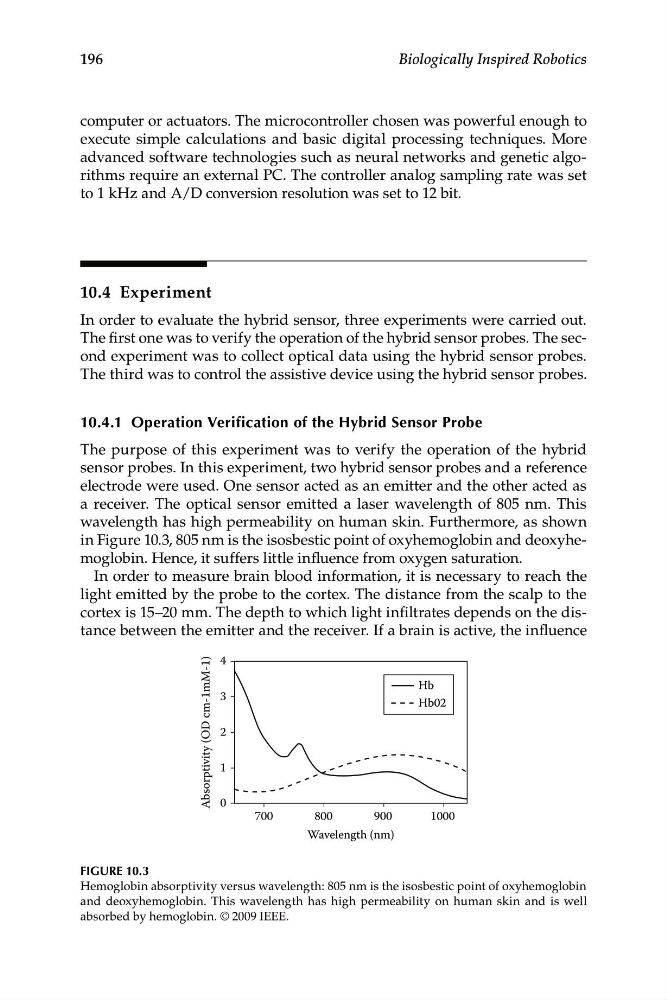
a receiver. The optical sensor emitted a laser wavelength of 805 nm. This
wavelength has high permeability on human skin. Furthermore, as shown
in Figure 10.3, 805 nm is the isosbestic point of oxyhemoglobin and deoxyhemoglobin. Hence, it suffers little influence from oxygen saturation.
In order to measure brain blood information, it is necessary to reach the
light emitted by the probe to the cortex. The distance from the scalp to the
cortex is 15–20 mm. The depth to which light infiltrates depends on the distance between the emitter and the receiver. If a brain is active, the influence
4
3
2
1
0
Wavelength (nm)
Absorptivity (OD cm-1mM-1)
Hb
Hb02
700
800
900
1000
FIGURE 10.3
Hemoglobin absorptivity versus wavelength: 805 nm is the isosbestic point of oxyhemoglobin
and deoxyhemoglobin. This wavelength has high permeability on human skin and is well
absorbed by hemoglobin. © 2009 IEEE.
Biologically Inspired Robotics
computer or actuators. The microcontroller chosen was powerful enough to
execute simple calculations and basic digital processing techniques. More
advanced software technologies such as neural networks and genetic algorithms require an external PC. The controller analog sampling rate was set
to 1 kHz and A/D conversion resolution was set to 12 bit.
10.4 Experiment
In order to evaluate the hybrid sensor, three experiments were carried out.
The first one was to verify the operation of the hybrid sensor probes. The second experiment was to collect optical data using the hybrid sensor probes.
The third was to control the assistive device using the hybrid sensor probes.
10.4.1 Operation Verification of the Hybrid Sensor Probe
The purpose of this experiment was to verify the operation of the hybrid
sensor probes. In this experiment, two hybrid sensor probes and a reference
electrode were used. One sensor acted as an emitter and the other acted as
a receiver. The optical sensor emitted a laser wavelength of 805 nm. This
wavelength has high permeability on human skin. Furthermore, as shown
in Figure 10.3, 805 nm is the isosbestic point of oxyhemoglobin and deoxyhemoglobin. Hence, it suffers little influence from oxygen saturation.
In order to measure brain blood information, it is necessary to reach the
light emitted by the probe to the cortex. The distance from the scalp to the
cortex is 15–20 mm. The depth to which light infiltrates depends on the distance between the emitter and the receiver. If a brain is active, the influence
4
3
2
1
0
Wavelength (nm)
Absorptivity (OD cm-1mM-1)
Hb
Hb02
700
800
900
1000
FIGURE 10.3
Hemoglobin absorptivity versus wavelength: 805 nm is the isosbestic point of oxyhemoglobin
and deoxyhemoglobin. This wavelength has high permeability on human skin and is well
absorbed by hemoglobin. © 2009 IEEE.