

183
Nanorobotic Manipulation for a Single Biological Cell
a
5 μm
4 μm
3 μm
4 μm
b
c
d
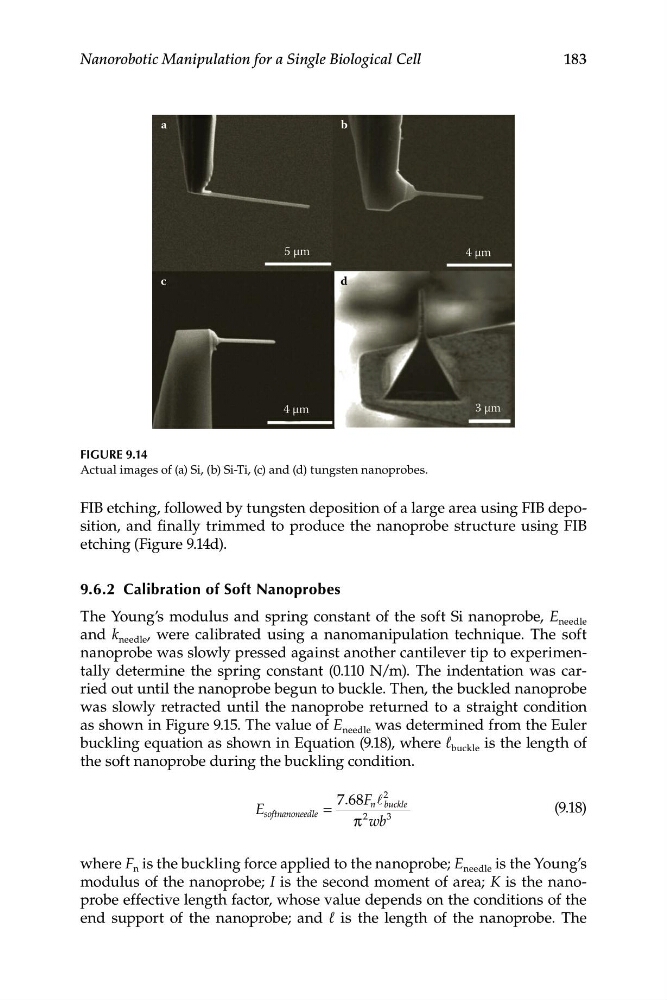
FIGURE 9.14
Actual images of (a) Si, (b) Si-Ti, (c) and (d) tungsten nanoprobes.
FIB etching, followed by tungsten deposition of a large area using FIB deposition, and finally trimmed to produce the nanoprobe structure using FIB
etching (Figure 9.14d).
9.6.2 Calibration of Soft Nanoprobes
The Young’s modulus and spring constant of the soft Si nanoprobe, E needle
and k needle , were calibrated using a nanomanipulation technique. The soft
nanoprobe was slowly pressed against another cantilever tip to experimentally determine the spring constant (0.110 N/m). The indentation was carried out until the nanoprobe begun to buckle. Then, the buckled nanoprobe
was slowly retracted until the nanoprobe returned to a straight condition
as shown in Figure 9.15. The value of E needle was determined from the Euler
buckling equation as shown in Equation (9.18), where ℓ buckle is the length of
the soft nanoprobe during the buckling condition.
7 68 �
2
. F n buckle
E
=
(9.18)
softnanoneedle
π
2 wb
3
where F n is the buckling force applied to the nanoprobe; E needle is the Young’s
modulus of the nanoprobe; I is the second moment of area; K is the nanoprobe effective length factor, whose value depends on the conditions of the
end support of the nanoprobe; and ℓ is the length of the nanoprobe. The
Nanorobotic Manipulation for a Single Biological Cell
a
5 μm
4 μm
3 μm
4 μm
b
c
d
FIGURE 9.14
Actual images of (a) Si, (b) Si-Ti, (c) and (d) tungsten nanoprobes.
FIB etching, followed by tungsten deposition of a large area using FIB deposition, and finally trimmed to produce the nanoprobe structure using FIB
etching (Figure 9.14d).
9.6.2 Calibration of Soft Nanoprobes
The Young’s modulus and spring constant of the soft Si nanoprobe, E needle
and k needle , were calibrated using a nanomanipulation technique. The soft
nanoprobe was slowly pressed against another cantilever tip to experimentally determine the spring constant (0.110 N/m). The indentation was carried out until the nanoprobe begun to buckle. Then, the buckled nanoprobe
was slowly retracted until the nanoprobe returned to a straight condition
as shown in Figure 9.15. The value of E needle was determined from the Euler
buckling equation as shown in Equation (9.18), where ℓ buckle is the length of
the soft nanoprobe during the buckling condition.
7 68 �
2
. F n buckle
E
=
(9.18)
softnanoneedle
π
2 wb
3
where F n is the buckling force applied to the nanoprobe; E needle is the Young’s
modulus of the nanoprobe; I is the second moment of area; K is the nanoprobe effective length factor, whose value depends on the conditions of the
end support of the nanoprobe; and ℓ is the length of the nanoprobe. The