

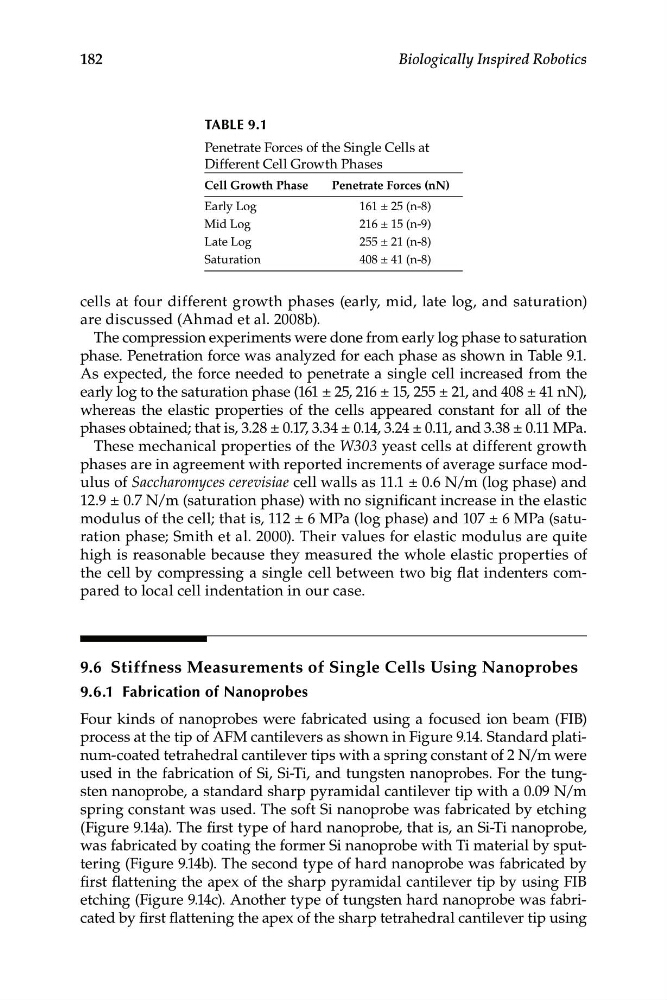
TABLE 9.1
Penetrate Forces of the Single Cells at
Different Cell Growth Phases
Cell Growth Phase
Penetrate Forces (nN)
Early Log
161 ± 25 (n-8)
Mid Log
216 ± 15 (n-9)
Late Log
255 ± 21 (n-8)
Saturation
408 ± 41 (n-8)
182
Biologically Inspired Robotics
cells at four different growth phases (early, mid, late log, and saturation)
are discussed (Ahmad et al. 2008b).
The compression experiments were done from early log phase to saturation
phase. Penetration force was analyzed for each phase as shown in Table 9.1.
As expected, the force needed to penetrate a single cell increased from the
early log to the saturation phase (161 ± 25, 216 ± 15, 255 ± 21, and 408 ± 41 nN),
whereas the elastic properties of the cells appeared constant for all of the
phases obtained; that is, 3.28 ± 0.17, 3.34 ± 0.14, 3.24 ± 0.11, and 3.38 ± 0.11 MPa.
These mechanical properties of the W303 yeast cells at different growth
phases are in agreement with reported increments of average surface modulus of Saccharomyces cerevisiae cell walls as 11.1 ± 0.6 N/m (log phase) and
12.9 ± 0.7 N/m (saturation phase) with no significant increase in the elastic
modulus of the cell; that is, 112 ± 6 MPa (log phase) and 107 ± 6 MPa (saturation phase; Smith et al. 2000). Their values for elastic modulus are quite
high is reasonable because they measured the whole elastic properties of
the cell by compressing a single cell between two big flat indenters compared to local cell indentation in our case.
9.6 Stiffness Measurements of Single Cells Using Nanoprobes
9.6.1 Fabrication of Nanoprobes
Four kinds of nanoprobes were fabricated using a focused ion beam (FIB)
process at the tip of AFM cantilevers as shown in Figure 9.14. Standard platinum-coated tetrahedral cantilever tips with a spring constant of 2 N/m were
used in the fabrication of Si, Si-Ti, and tungsten nanoprobes. For the tungsten nanoprobe, a standard sharp pyramidal cantilever tip with a 0.09 N/m
spring constant was used. The soft Si nanoprobe was fabricated by etching
(Figure 9.14a). The first type of hard nanoprobe, that is, an Si-Ti nanoprobe,
was fabricated by coating the former Si nanoprobe with Ti material by sputtering (Figure 9.14b). The second type of hard nanoprobe was fabricated by
first flattening the apex of the sharp pyramidal cantilever tip by using FIB
etching (Figure 9.14c). Another type of tungsten hard nanoprobe was fabricated by first flattening the apex of the sharp tetrahedral cantilever tip using