

181
Hertz Mode 1 (cell size: 3(1))
Hertz Mode 1 (cell size: 3(2))
Hertz Mode 1 (cell size: 3(3))
Hertz Mode 1 (cell size: 3(4))
Hertz Mode 1 (cell size: 3(5))
Hertz Mode 1 (cell size: 4(1))
Hertz Mode 1 (cell size: 4(2))
Hertz Mode 1 (cell size: 4(3))
Hertz Mode 1 (cell size: 4(4))
Hertz Mode 1 (cell size: 4(5))
Hertz Mode 1 (cell size: 5(1))
Hertz Mode 1 (cell size: 5(2))
Hertz Mode 1 (cell size: 5(3))
Hertz Mode 1 (cell size: 5(4))
Hertz Mode 1 (cell size: 6(1))
Hertz Mode 1 (cell size: 6(2))
Hertz Mode 1 (cell size: 6(3))
234 ± 14 nN
163 ± 1 nN
124 ± 10 nN
96 ± 2 nN
Penetration forces at
different cell sizes
Compression Force (nN)
250
200
150
100
50
0
0.00
0.10
0.20
0.30
0.40
0.50
Cantilever Indentation (μm)
Nanorobotic Manipulation for a Single Biological Cell
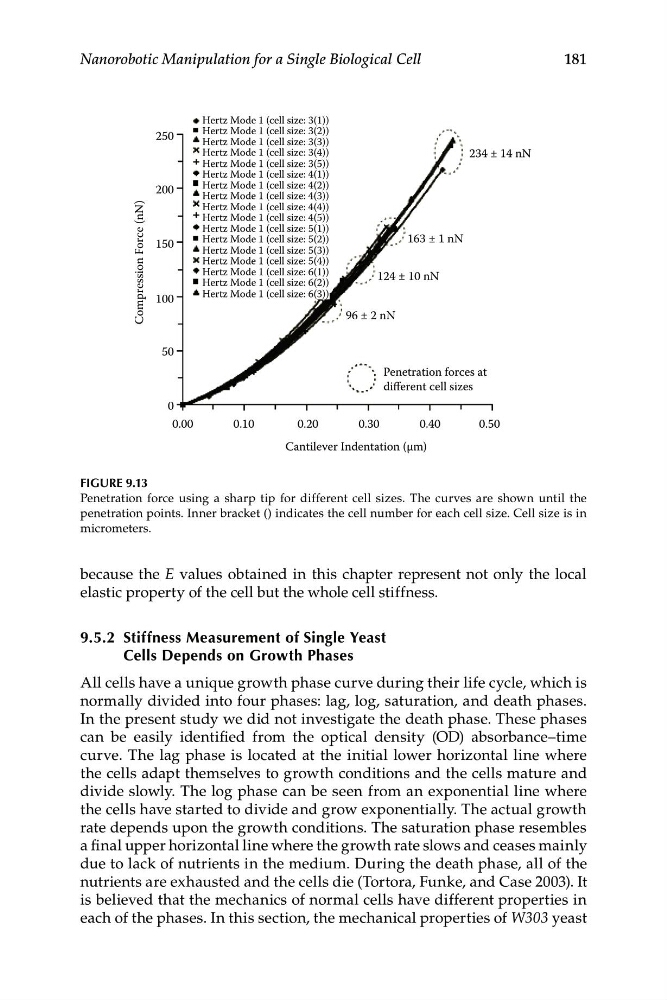
FIGURE 9.13
Penetration force using a sharp tip for different cell sizes. The curves are shown until the
penetration points. Inner bracket () indicates the cell number for each cell size. Cell size is in
micrometers.
because the E values obtained in this chapter represent not only the local
elastic property of the cell but the whole cell stiffness.
9.5.2 Stiffness Measurement of Single Yeast
Cells Depends on Growth Phases
All cells have a unique growth phase curve during their life cycle, which is
normally divided into four phases: lag, log, saturation, and death phases.
In the present study we did not investigate the death phase. These phases
can be easily identified from the optical density (OD) absorbance–time
curve. The lag phase is located at the initial lower horizontal line where
the cells adapt themselves to growth conditions and the cells mature and
divide slowly. The log phase can be seen from an exponential line where
the cells have started to divide and grow exponentially. The actual growth
rate depends upon the growth conditions. The saturation phase resembles
a final upper horizontal line where the growth rate slows and ceases mainly
due to lack of nutrients in the medium. During the death phase, all of the
nutrients are exhausted and the cells die (Tortora, Funke, and Case 2003). It
is believed that the mechanics of normal cells have different properties in
each of the phases. In this section, the mechanical properties of W303 yeast
Hertz Mode 1 (cell size: 3(1))
Hertz Mode 1 (cell size: 3(2))
Hertz Mode 1 (cell size: 3(3))
Hertz Mode 1 (cell size: 3(4))
Hertz Mode 1 (cell size: 3(5))
Hertz Mode 1 (cell size: 4(1))
Hertz Mode 1 (cell size: 4(2))
Hertz Mode 1 (cell size: 4(3))
Hertz Mode 1 (cell size: 4(4))
Hertz Mode 1 (cell size: 4(5))
Hertz Mode 1 (cell size: 5(1))
Hertz Mode 1 (cell size: 5(2))
Hertz Mode 1 (cell size: 5(3))
Hertz Mode 1 (cell size: 5(4))
Hertz Mode 1 (cell size: 6(1))
Hertz Mode 1 (cell size: 6(2))
Hertz Mode 1 (cell size: 6(3))
234 ± 14 nN
163 ± 1 nN
124 ± 10 nN
96 ± 2 nN
Penetration forces at
different cell sizes
Compression Force (nN)
250
200
150
100
50
0
0.00
0.10
0.20
0.30
0.40
0.50
Cantilever Indentation (μm)
Nanorobotic Manipulation for a Single Biological Cell
FIGURE 9.13
Penetration force using a sharp tip for different cell sizes. The curves are shown until the
penetration points. Inner bracket () indicates the cell number for each cell size. Cell size is in
micrometers.
because the E values obtained in this chapter represent not only the local
elastic property of the cell but the whole cell stiffness.
9.5.2 Stiffness Measurement of Single Yeast
Cells Depends on Growth Phases
All cells have a unique growth phase curve during their life cycle, which is
normally divided into four phases: lag, log, saturation, and death phases.
In the present study we did not investigate the death phase. These phases
can be easily identified from the optical density (OD) absorbance–time
curve. The lag phase is located at the initial lower horizontal line where
the cells adapt themselves to growth conditions and the cells mature and
divide slowly. The log phase can be seen from an exponential line where
the cells have started to divide and grow exponentially. The actual growth
rate depends upon the growth conditions. The saturation phase resembles
a final upper horizontal line where the growth rate slows and ceases mainly
due to lack of nutrients in the medium. During the death phase, all of the
nutrients are exhausted and the cells die (Tortora, Funke, and Case 2003). It
is believed that the mechanics of normal cells have different properties in
each of the phases. In this section, the mechanical properties of W303 yeast