

177
Nanorobotic Manipulation for a Single Biological Cell
Microscopes
TEM
Real-time
observation
2D
observation
3D
observation
3D
manipulation
2D
manipulation
SEM
STM
AFM
SNOM
0.1
1
10
100 1000
Scale of Objects [nm]
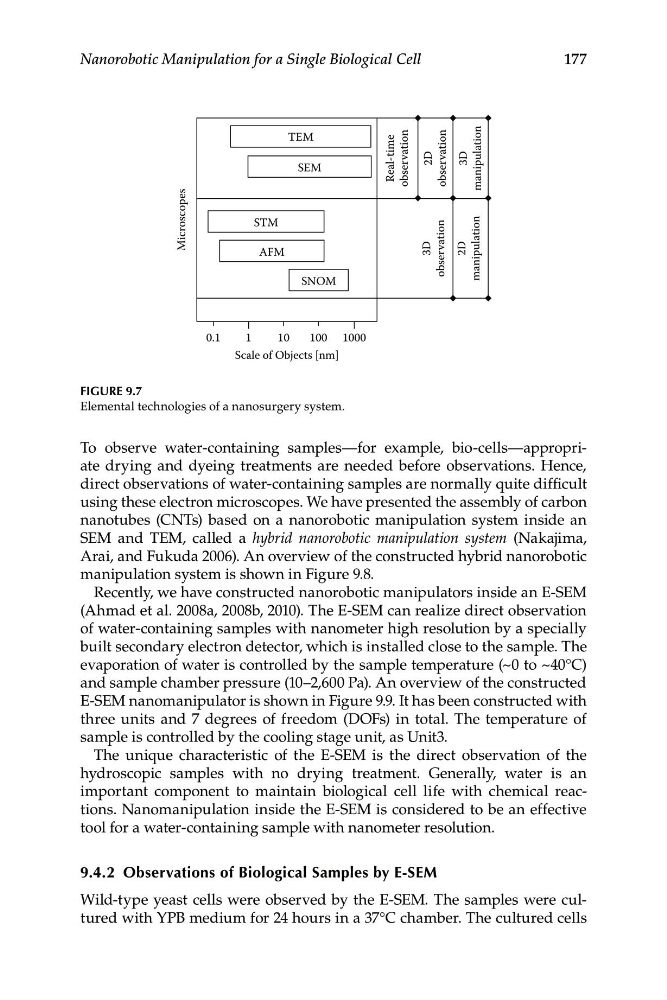
FIGURE 9.7
Elemental technologies of a nanosurgery system.
To observe water-containing samples—for example, bio-cells—appropriate drying and dyeing treatments are needed before observations. Hence,
direct observations of water-containing samples are normally quite difficult
using these electron microscopes. We have presented the assembly of carbon
nanotubes (CNTs) based on a nanorobotic manipulation system inside an
SEM and TEM, called a hybrid nanorobotic manipulation system (Nakajima,
Arai, and Fukuda 2006). An overview of the constructed hybrid nanorobotic
manipulation system is shown in Figure 9.8.
Recently, we have constructed nanorobotic manipulators inside an E-SEM
(Ahmad et al. 2008a, 2008b, 2010). The E-SEM can realize direct observation
of water-containing samples with nanometer high resolution by a specially
built secondary electron detector, which is installed close to the sample. The
evaporation of water is controlled by the sample temperature (~0 to ~40°C)
and sample chamber pressure (10–2,600 Pa). An overview of the constructed
E-SEM nanomanipulator is shown in Figure 9.9. It has been constructed with
three units and 7 degrees of freedom (DOFs) in total. The temperature of
sample is controlled by the cooling stage unit, as Unit3.
The unique characteristic of the E-SEM is the direct observation of the
hydroscopic samples with no drying treatment. Generally, water is an
important component to maintain biological cell life with chemical reactions. Nanomanipulation inside the E-SEM is considered to be an effective
tool for a water-containing sample with nanometer resolution.
9.4.2 Observations of Biological Samples by E-SEM
Wild-type yeast cells were observed by the E-SEM. The samples were cultured with YPB medium for 24 hours in a 37°C chamber. The cultured cells
Nanorobotic Manipulation for a Single Biological Cell
Microscopes
TEM
Real-time
observation
2D
observation
3D
observation
3D
manipulation
2D
manipulation
SEM
STM
AFM
SNOM
0.1
1
10
100 1000
Scale of Objects [nm]
FIGURE 9.7
Elemental technologies of a nanosurgery system.
To observe water-containing samples—for example, bio-cells—appropriate drying and dyeing treatments are needed before observations. Hence,
direct observations of water-containing samples are normally quite difficult
using these electron microscopes. We have presented the assembly of carbon
nanotubes (CNTs) based on a nanorobotic manipulation system inside an
SEM and TEM, called a hybrid nanorobotic manipulation system (Nakajima,
Arai, and Fukuda 2006). An overview of the constructed hybrid nanorobotic
manipulation system is shown in Figure 9.8.
Recently, we have constructed nanorobotic manipulators inside an E-SEM
(Ahmad et al. 2008a, 2008b, 2010). The E-SEM can realize direct observation
of water-containing samples with nanometer high resolution by a specially
built secondary electron detector, which is installed close to the sample. The
evaporation of water is controlled by the sample temperature (~0 to ~40°C)
and sample chamber pressure (10–2,600 Pa). An overview of the constructed
E-SEM nanomanipulator is shown in Figure 9.9. It has been constructed with
three units and 7 degrees of freedom (DOFs) in total. The temperature of
sample is controlled by the cooling stage unit, as Unit3.
The unique characteristic of the E-SEM is the direct observation of the
hydroscopic samples with no drying treatment. Generally, water is an
important component to maintain biological cell life with chemical reactions. Nanomanipulation inside the E-SEM is considered to be an effective
tool for a water-containing sample with nanometer resolution.
9.4.2 Observations of Biological Samples by E-SEM
Wild-type yeast cells were observed by the E-SEM. The samples were cultured with YPB medium for 24 hours in a 37°C chamber. The cultured cells