

176
Biologically Inspired Robotics
where k, φ, and L are the spring constant, the displacement angle in radians, and the length of the cantilever, respectively. It should be noted
here, however, that the spring constant obtained from the manufacturer’s
specifications might not be accurate. Possible calibration methods can be
performed to determine the exact spring constant of the cantilever prior to
the application of the cantilever on the cell stiffness measurement such as a
parallel beam approximation approach (Sader 1995), a scanning vibrometry
method (Mendels et al. 2006), or a reference piezolever approach (Aksu and
Turner 2007). Equation (9.10) was derived from Hooke’s law; that is, F = kδ,
where δ is the displacement of the cantilever, which was obtained by using
δ = φ(2/3)L.
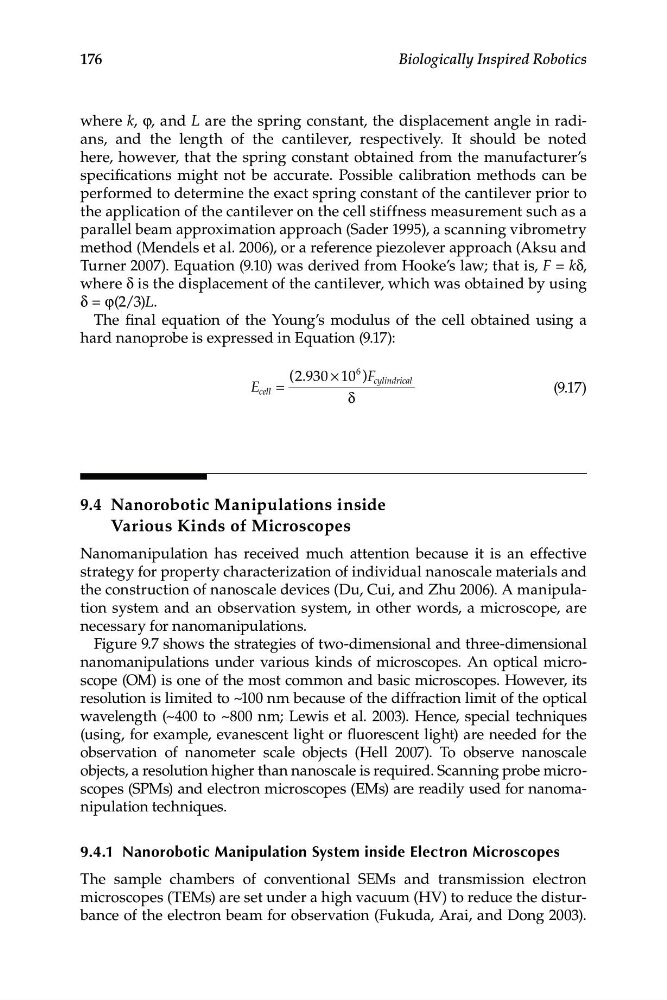
The final equation of the Young’s modulus of the cell obtained using a
hard nanoprobe is expressed in Equation (9.17):
2 930 × 10
6 )F cylindrical
( .
E cell =
(9.17)
δ
9.4 N anorobotic Manipulations inside
Various Kinds of Microscopes
Nanomanipulation has received much attention because it is an effective
strategy for property characterization of individual nanoscale materials and
the construction of nanoscale devices (Du, Cui, and Zhu 2006). A manipulation system and an observation system, in other words, a microscope, are
necessary for nanomanipulations.
Figure 9.7 shows the strategies of two-dimensional and three-dimensional
nanomanipulations under various kinds of microscopes. An optical microscope (OM) is one of the most common and basic microscopes. However, its
resolution is limited to ~100 nm because of the diffraction limit of the optical
wavelength (~400 to ~800 nm; Lewis et al. 2003). Hence, special techniques
(using, for example, evanescent light or fluorescent light) are needed for the
observation of nanometer scale objects (Hell 2007). To observe nanoscale
objects, a resolution higher than nanoscale is required. Scanning probe microscopes (SPMs) and electron microscopes (EMs) are readily used for nanomanipulation techniques.
9.4.1 Nanorobotic Manipulation System inside Electron Microscopes
The sample chambers of conventional SEMs and transmission electron
microscopes (TEMs) are set under a high vacuum (HV) to reduce the disturbance of the electron beam for observation (Fukuda, Arai, and Dong 2003).