

Elemental Techniques
Diagnosis
Embedded
Cutting
Extraction
Injection
Single
cell level
Tissue
level
Animal
level
mm~μm scale
Nanosurgery system
nm scale
components
Nucleus
Mitochondria
DNA
Cell wall
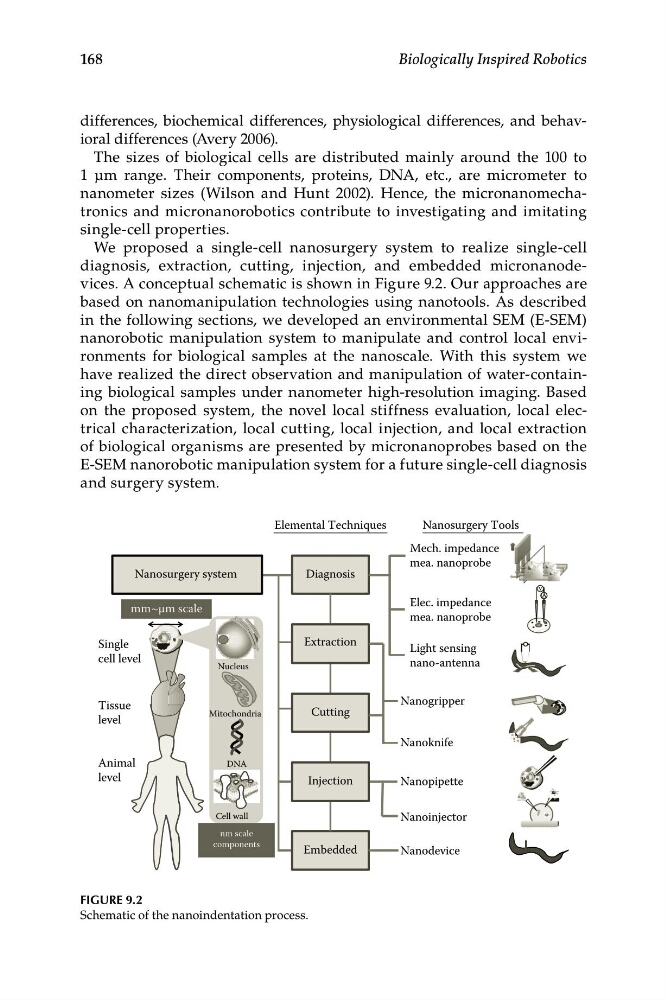
FIGURE 9.2
Schematic of the nanoindentation process.
Nanosurgery Tools
Mech. impedance
mea. nanoprobe
Elec. impedance
mea. nanoprobe
Light sensing
nano-antenna
Nanogripper
Nanoknife
Nanopipette
Nanoinjector
Nanodevice
~
168
Biologically Inspired Robotics
differences, biochemical differences, physiological differences, and behavioral differences (Avery 2006).
The sizes of biological cells are distributed mainly around the 100 to
1 μm range. Their components, proteins, DNA, etc., are micrometer to
nanometer sizes (Wilson and Hunt 2002). Hence, the micronanomechatronics and micronanorobotics contribute to investigating and imitating
single-cell properties.
We proposed a single-cell nanosurgery system to realize single-cell
diagnosis, extraction, cutting, injection, and embedded micronanodevices. A conceptual schematic is shown in Figure 9.2. Our approaches are
based on nanomanipulation technologies using nanotools. As described
in the following sections, we developed an environmental SEM (E-SEM)
nanorobotic manipulation system to manipulate and control local environments for biological samples at the nanoscale. With this system we
have realized the direct observation and manipulation of water-containing biological samples under nanometer high-resolution imaging. Based
on the proposed system, the novel local stiffness evaluation, local electrical characterization, local cutting, local injection, and local extraction
of biological organisms are presented by micronanoprobes based on the
E-SEM nanorobotic manipulation system for a future single-cell diagnosis
and surgery system.
Diagnosis
Embedded
Cutting
Extraction
Injection
Single
cell level
Tissue
level
Animal
level
mm~μm scale
Nanosurgery system
nm scale
components
Nucleus
Mitochondria
DNA
Cell wall
FIGURE 9.2
Schematic of the nanoindentation process.
Nanosurgery Tools
Mech. impedance
mea. nanoprobe
Elec. impedance
mea. nanoprobe
Light sensing
nano-antenna
Nanogripper
Nanoknife
Nanopipette
Nanoinjector
Nanodevice
~
168
Biologically Inspired Robotics
differences, biochemical differences, physiological differences, and behavioral differences (Avery 2006).
The sizes of biological cells are distributed mainly around the 100 to
1 μm range. Their components, proteins, DNA, etc., are micrometer to
nanometer sizes (Wilson and Hunt 2002). Hence, the micronanomechatronics and micronanorobotics contribute to investigating and imitating
single-cell properties.
We proposed a single-cell nanosurgery system to realize single-cell
diagnosis, extraction, cutting, injection, and embedded micronanodevices. A conceptual schematic is shown in Figure 9.2. Our approaches are
based on nanomanipulation technologies using nanotools. As described
in the following sections, we developed an environmental SEM (E-SEM)
nanorobotic manipulation system to manipulate and control local environments for biological samples at the nanoscale. With this system we
have realized the direct observation and manipulation of water-containing biological samples under nanometer high-resolution imaging. Based
on the proposed system, the novel local stiffness evaluation, local electrical characterization, local cutting, local injection, and local extraction
of biological organisms are presented by micronanoprobes based on the
E-SEM nanorobotic manipulation system for a future single-cell diagnosis
and surgery system.