

167
Nanorobotic Manipulation for a Single Biological Cell
Scale
10 mm
1 mm
100 μm
10 μm
1 μm
100 nm
10 nm
1 nm
1å
Nanotechnology
T o p - d o w n a p p r o a c h
B o tt o m - u p a p p r o a c h
Material examples
Pen, tweezers...
Cell, yarn...
Hairs, blood capillary...
Protein, micro-machine...
DNA, carbon nanotubes...
Molecule, fullerene...
Atoms...
1950 1970 1990 2010
Date
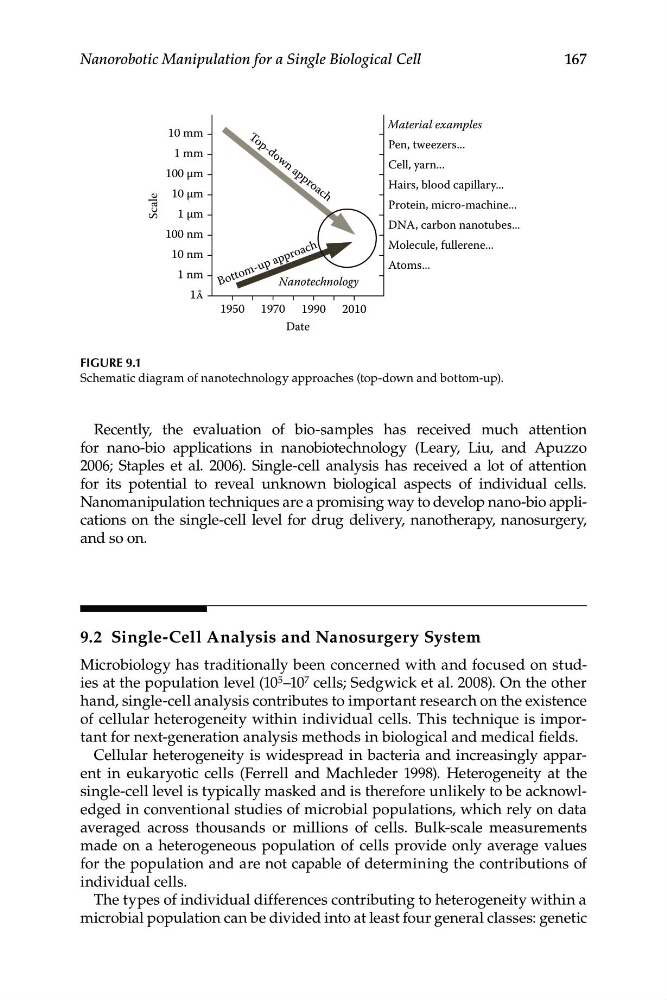
FIGURE 9.1
Schematic diagram of nanotechnology approaches (top-down and bottom-up).
Recently, the evaluation of bio-samples has received much attention
for nano-bio applications in nanobiotechnology (Leary, Liu, and Apuzzo
2006; Staples et al. 2006). Single-cell analysis has received a lot of attention
for its potential to reveal unknown biological aspects of individual cells.
Nanomanipulation techniques are a promising way to develop nano-bio applications on the single-cell level for drug delivery, nanotherapy, nanosurgery,
and so on.
9.2 Single-Cell Analysis and Nanosurgery System
Microbiology has traditionally been concerned with and focused on studies at the population level (10 5 –10 7 cells; Sedgwick et al. 2008). On the other
hand, single-cell analysis contributes to important research on the existence
of cellular heterogeneity within individual cells. This technique is important for next-generation analysis methods in biological and medical fields.
Cellular heterogeneity is widespread in bacteria and increasingly apparent in eukaryotic cells (Ferrell and Machleder 1998). Heterogeneity at the
single-cell level is typically masked and is therefore unlikely to be acknowledged in conventional studies of microbial populations, which rely on data
averaged across thousands or millions of cells. Bulk-scale measurements
made on a heterogeneous population of cells provide only average values
for the population and are not capable of determining the contributions of
individual cells.
The types of individual differences contributing to heterogeneity within a
microbial population can be divided into at least four general classes: genetic
Nanorobotic Manipulation for a Single Biological Cell
Scale
10 mm
1 mm
100 μm
10 μm
1 μm
100 nm
10 nm
1 nm
1å
Nanotechnology
T o p - d o w n a p p r o a c h
B o tt o m - u p a p p r o a c h
Material examples
Pen, tweezers...
Cell, yarn...
Hairs, blood capillary...
Protein, micro-machine...
DNA, carbon nanotubes...
Molecule, fullerene...
Atoms...
1950 1970 1990 2010
Date
FIGURE 9.1
Schematic diagram of nanotechnology approaches (top-down and bottom-up).
Recently, the evaluation of bio-samples has received much attention
for nano-bio applications in nanobiotechnology (Leary, Liu, and Apuzzo
2006; Staples et al. 2006). Single-cell analysis has received a lot of attention
for its potential to reveal unknown biological aspects of individual cells.
Nanomanipulation techniques are a promising way to develop nano-bio applications on the single-cell level for drug delivery, nanotherapy, nanosurgery,
and so on.
9.2 Single-Cell Analysis and Nanosurgery System
Microbiology has traditionally been concerned with and focused on studies at the population level (10 5 –10 7 cells; Sedgwick et al. 2008). On the other
hand, single-cell analysis contributes to important research on the existence
of cellular heterogeneity within individual cells. This technique is important for next-generation analysis methods in biological and medical fields.
Cellular heterogeneity is widespread in bacteria and increasingly apparent in eukaryotic cells (Ferrell and Machleder 1998). Heterogeneity at the
single-cell level is typically masked and is therefore unlikely to be acknowledged in conventional studies of microbial populations, which rely on data
averaged across thousands or millions of cells. Bulk-scale measurements
made on a heterogeneous population of cells provide only average values
for the population and are not capable of determining the contributions of
individual cells.
The types of individual differences contributing to heterogeneity within a
microbial population can be divided into at least four general classes: genetic