

116
Biologically Inspired Robotics
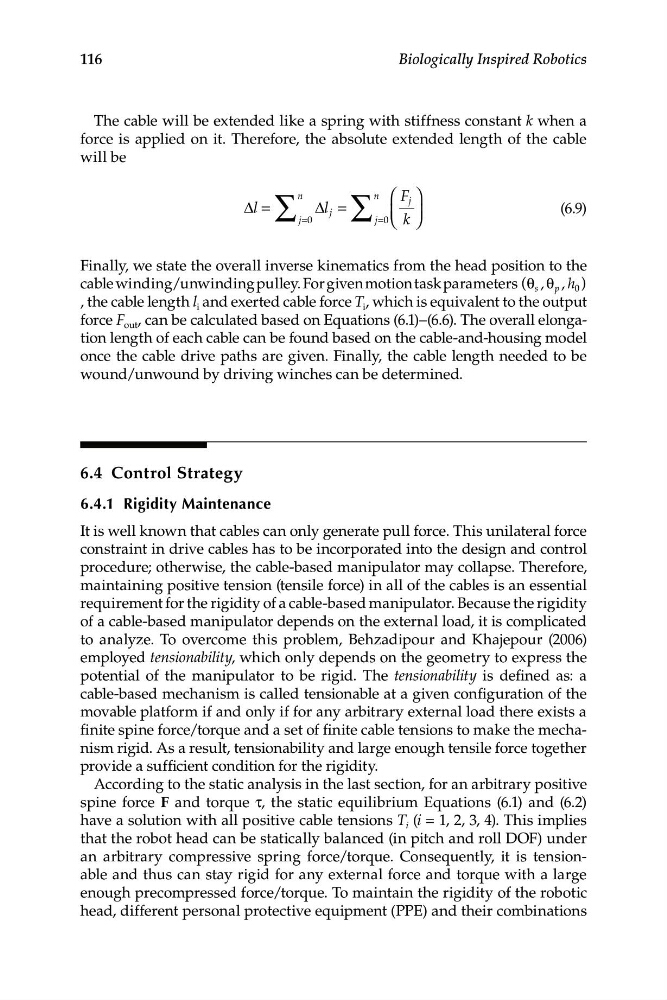
The cable will be extended like a spring with stiffness constant k when a
force is applied on it. Therefore, the absolute extended length of the cable
will be
n
n ⎛ F j ⎞
Δl = ∑ Δl j = ∑ ⎝ ⎜ k ⎠ ⎟
(6.9)
j=
j=
Finally, we state the overall inverse kinematics from the head position to the
cable winding/unwinding pulley. For given motion task parameters ( , , )
θ θ h 0
s
p
, the cable length l i and exerted cable force T i , which is equivalent to the output
force F out , can be calculated based on Equations (6.1)–(6.6). The overall elongation length of each cable can be found based on the cable-and-housing model
once the cable drive paths are given. Finally, the cable length needed to be
wound/unwound by driving winches can be determined.
6.4 Control Strategy
6.4.1 Rigidity Maintenance
It is well known that cables can only generate pull force. This unilateral force
constraint in drive cables has to be incorporated into the design and control
procedure; otherwise, the cable-based manipulator may collapse. Therefore,
maintaining positive tension (tensile force) in all of the cables is an essential
requirement for the rigidity of a cable-based manipulator. Because the rigidity
of a cable-based manipulator depends on the external load, it is complicated
to analyze. To overcome this problem, Behzadipour and Khajepour (2006)
employed tensionability, which only depends on the geometry to express the
potential of the manipulator to be rigid. The tensionability is defined as: a
cable-based mechanism is called tensionable at a given configuration of the
movable platform if and only if for any arbitrary external load there exists a
finite spine force/torque and a set of finite cable tensions to make the mechanism rigid. As a result, tensionability and large enough tensile force together
provide a sufficient condition for the rigidity.
According to the static analysis in the last section, for an arbitrary positive
spine force F and torque τ, the static equilibrium Equations (6.1) and (6.2)
have a solution with all positive cable tensions T i (i = 1, 2, 3, 4). This implies
that the robot head can be statically balanced (in pitch and roll DOF) under
an arbitrary compressive spring force/torque. Consequently, it is tensionable and thus can stay rigid for any external force and torque with a large
enough precompressed force/torque. To maintain the rigidity of the robotic
head, different personal protective equipment (PPE) and their combinations
Biologically Inspired Robotics
The cable will be extended like a spring with stiffness constant k when a
force is applied on it. Therefore, the absolute extended length of the cable
will be
n
n ⎛ F j ⎞
Δl = ∑ Δl j = ∑ ⎝ ⎜ k ⎠ ⎟
(6.9)
j=
j=
Finally, we state the overall inverse kinematics from the head position to the
cable winding/unwinding pulley. For given motion task parameters ( , , )
θ θ h 0
s
p
, the cable length l i and exerted cable force T i , which is equivalent to the output
force F out , can be calculated based on Equations (6.1)–(6.6). The overall elongation length of each cable can be found based on the cable-and-housing model
once the cable drive paths are given. Finally, the cable length needed to be
wound/unwound by driving winches can be determined.
6.4 Control Strategy
6.4.1 Rigidity Maintenance
It is well known that cables can only generate pull force. This unilateral force
constraint in drive cables has to be incorporated into the design and control
procedure; otherwise, the cable-based manipulator may collapse. Therefore,
maintaining positive tension (tensile force) in all of the cables is an essential
requirement for the rigidity of a cable-based manipulator. Because the rigidity
of a cable-based manipulator depends on the external load, it is complicated
to analyze. To overcome this problem, Behzadipour and Khajepour (2006)
employed tensionability, which only depends on the geometry to express the
potential of the manipulator to be rigid. The tensionability is defined as: a
cable-based mechanism is called tensionable at a given configuration of the
movable platform if and only if for any arbitrary external load there exists a
finite spine force/torque and a set of finite cable tensions to make the mechanism rigid. As a result, tensionability and large enough tensile force together
provide a sufficient condition for the rigidity.
According to the static analysis in the last section, for an arbitrary positive
spine force F and torque τ, the static equilibrium Equations (6.1) and (6.2)
have a solution with all positive cable tensions T i (i = 1, 2, 3, 4). This implies
that the robot head can be statically balanced (in pitch and roll DOF) under
an arbitrary compressive spring force/torque. Consequently, it is tensionable and thus can stay rigid for any external force and torque with a large
enough precompressed force/torque. To maintain the rigidity of the robotic
head, different personal protective equipment (PPE) and their combinations