

117
Development of a Low-Noise Bio-Inspired Humanoid Robot Neck
as an external payload were studied together with the robotic head itself to
derive the potential maximum spine force/torque (compressive force/torque
of the spring). In other words, the length of the spring needed to be precompressed by the drive cables is enough to maintain the rigidity of the robotic
head when different PPEs or their combinations are put on the head. In this
way, we decide h 0 as in Figure 6.4 during the implementation. A bang-bang
control algorithm is employed to achieve the precompressive process at the
beginning of the robotic system’s operation.
6.4.2 Motion Control
Although 3-DOF human head motions are always coupled, we divided the
robotic head motions into two categories depending on the number of active
axes in a motion: single axis motion and multi-axis motion, such as looking
down and forward (flexion) and down and to the left (flexion and rotation
left). We divided the robotic head motions into two categories based on the
motion continuity: single motion and continuous motion, such as looking
down and forward (flexion) and nodding (flexion back and forth). Before
the motion execution, it is necessary to transform a continuous motion to
a series of single motions and map a multi-axis motion into simultaneous
single-axis motions.
Based on the movement characteristics of the human head, moving
smoothly other than positioning accuracy is the first priority of the each
movement. Because the robot will be used to collect the noises generated by
the PPE during human head/neck movements, continuous motion is performed more frequently. For each single movement, two parameters are given
as described in Section 6.2; that is, range of movement and movement time.
By considering the initial position of the robotic head, trapezoidal velocities
of the robotic head movement can be generated. According to the analysis in
Section 6.3, these trapezoidal velocities are transformed into the cable length
needed to be wound or unwound. Using this open-loop control, it is hard to
achieve accurate positioning control due to the unmodeled parameters and
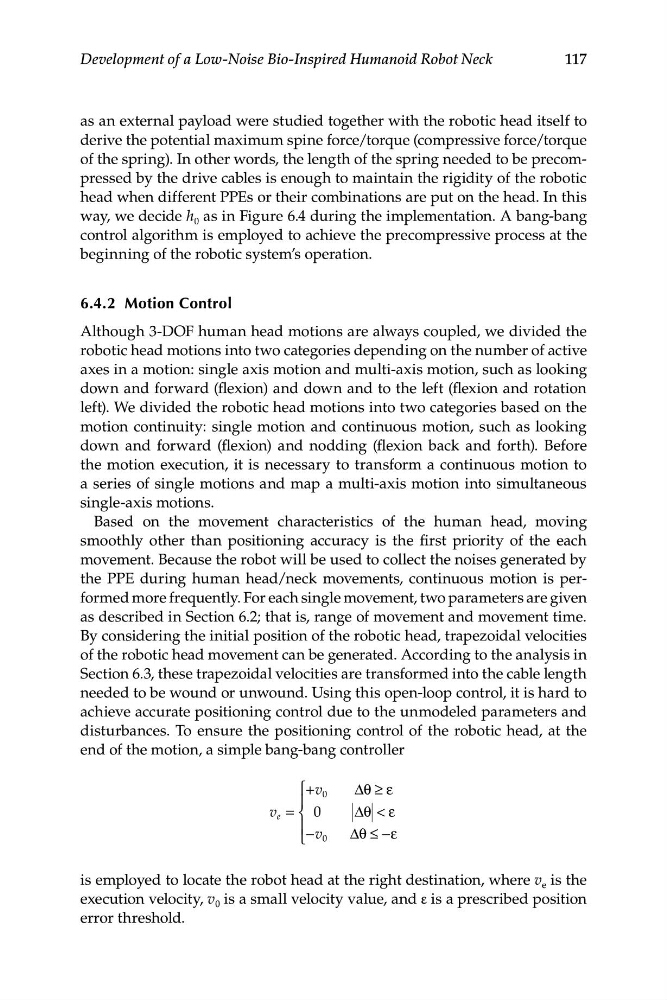
disturbances. To ensure the positioning control of the robotic head, at the
end of the motion, a simple bang-bang controller
⎧+v
Δ ≥
θ ε
⎪
v e = ⎨
Δ <
θ ε
⎪ −v
θ
ε
−
Δ ≤
⎩
is employed to locate the robot head at the right destination, where v e is the
execution velocity, v 0 is a small velocity value, and ε is a prescribed position
error threshold.
Development of a Low-Noise Bio-Inspired Humanoid Robot Neck
as an external payload were studied together with the robotic head itself to
derive the potential maximum spine force/torque (compressive force/torque
of the spring). In other words, the length of the spring needed to be precompressed by the drive cables is enough to maintain the rigidity of the robotic
head when different PPEs or their combinations are put on the head. In this
way, we decide h 0 as in Figure 6.4 during the implementation. A bang-bang
control algorithm is employed to achieve the precompressive process at the
beginning of the robotic system’s operation.
6.4.2 Motion Control
Although 3-DOF human head motions are always coupled, we divided the
robotic head motions into two categories depending on the number of active
axes in a motion: single axis motion and multi-axis motion, such as looking
down and forward (flexion) and down and to the left (flexion and rotation
left). We divided the robotic head motions into two categories based on the
motion continuity: single motion and continuous motion, such as looking
down and forward (flexion) and nodding (flexion back and forth). Before
the motion execution, it is necessary to transform a continuous motion to
a series of single motions and map a multi-axis motion into simultaneous
single-axis motions.
Based on the movement characteristics of the human head, moving
smoothly other than positioning accuracy is the first priority of the each
movement. Because the robot will be used to collect the noises generated by
the PPE during human head/neck movements, continuous motion is performed more frequently. For each single movement, two parameters are given
as described in Section 6.2; that is, range of movement and movement time.
By considering the initial position of the robotic head, trapezoidal velocities
of the robotic head movement can be generated. According to the analysis in
Section 6.3, these trapezoidal velocities are transformed into the cable length
needed to be wound or unwound. Using this open-loop control, it is hard to
achieve accurate positioning control due to the unmodeled parameters and
disturbances. To ensure the positioning control of the robotic head, at the
end of the motion, a simple bang-bang controller
⎧+v
Δ ≥
θ ε
⎪
v e = ⎨
Δ <
θ ε
⎪ −v
θ
ε
−
Δ ≤
⎩
is employed to locate the robot head at the right destination, where v e is the
execution velocity, v 0 is a small velocity value, and ε is a prescribed position
error threshold.