

102
(a)
(b)
(c)
(d)
Biologically Inspired Robotics
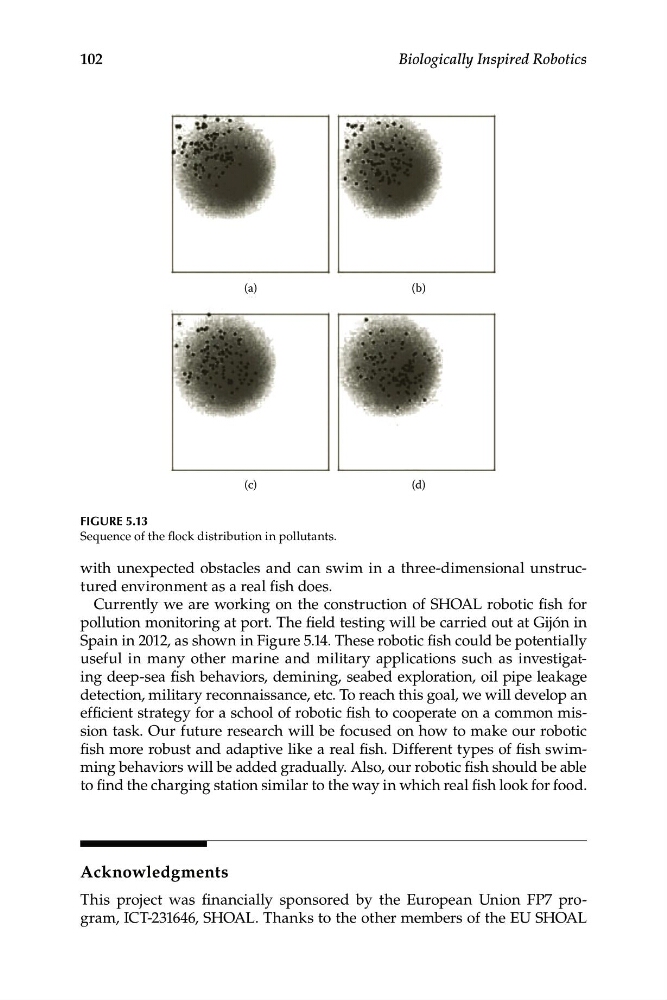
FIGURE 5.13
Sequence of the flock distribution in pollutants.
with unexpected obstacles and can swim in a three-dimensional unstructured environment as a real fish does.
Currently we are working on the construction of SHOAL robotic fish for
pollution monitoring at port. The field testing will be carried out at Gijón in
Spain in 2012, as shown in Figure 5.14. These robotic fish could be potentially
useful in many other marine and military applications such as investigating deep-sea fish behaviors, demining, seabed exploration, oil pipe leakage
detection, military reconnaissance, etc. To reach this goal, we will develop an
efficient strategy for a school of robotic fish to cooperate on a common mission task. Our future research will be focused on how to make our robotic
fish more robust and adaptive like a real fish. Different types of fish swimming behaviors will be added gradually. Also, our robotic fish should be able
to find the charging station similar to the way in which real fish look for food.
Acknowledgments
This project was financially sponsored by the European Union FP7 program, ICT-231646, SHOAL. Thanks to the other members of the EU SHOAL
(a)
(b)
(c)
(d)
Biologically Inspired Robotics
FIGURE 5.13
Sequence of the flock distribution in pollutants.
with unexpected obstacles and can swim in a three-dimensional unstructured environment as a real fish does.
Currently we are working on the construction of SHOAL robotic fish for
pollution monitoring at port. The field testing will be carried out at Gijón in
Spain in 2012, as shown in Figure 5.14. These robotic fish could be potentially
useful in many other marine and military applications such as investigating deep-sea fish behaviors, demining, seabed exploration, oil pipe leakage
detection, military reconnaissance, etc. To reach this goal, we will develop an
efficient strategy for a school of robotic fish to cooperate on a common mission task. Our future research will be focused on how to make our robotic
fish more robust and adaptive like a real fish. Different types of fish swimming behaviors will be added gradually. Also, our robotic fish should be able
to find the charging station similar to the way in which real fish look for food.
Acknowledgments
This project was financially sponsored by the European Union FP7 program, ICT-231646, SHOAL. Thanks to the other members of the EU SHOAL