

80
4 Reactive Thin Polymer Films as Platforms for the Immobilization …
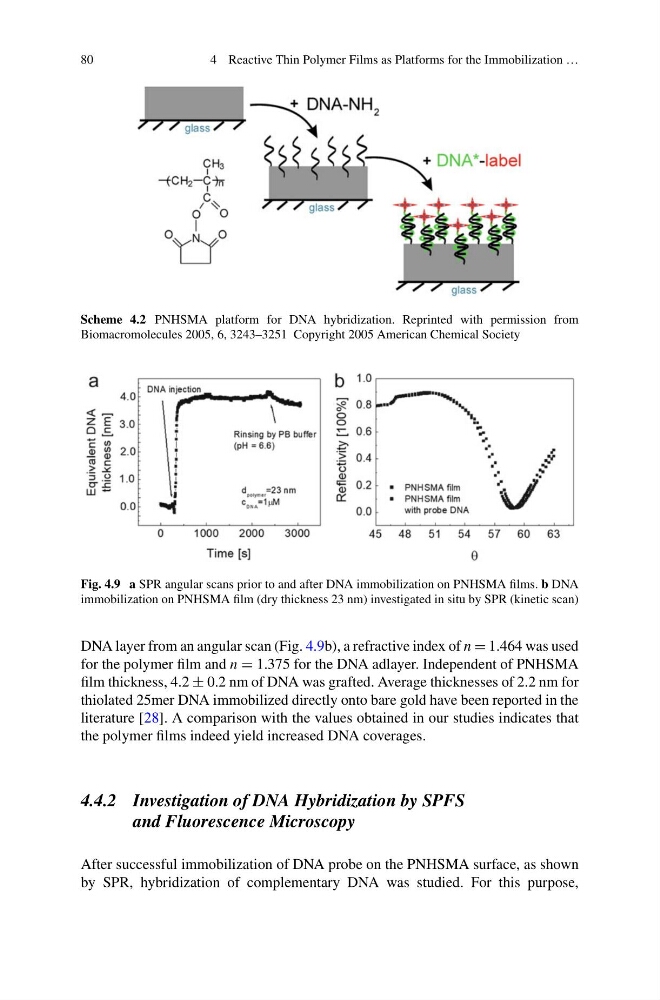
Scheme 4.2 PNHSMA platform for DNA hybridization. Reprinted with permission from
Biomacromolecules 2005, 6, 3243–3251 Copyright 2005 American Chemical Society
Fig. 4.9 a SPR angular scans prior to and after DNA immobilization on PNHSMA films. b DNA
immobilization on PNHSMA film (dry thickness 23 nm) investigated in situ by SPR (kinetic scan)
DNA layer from an angular scan (Fig. 4.9b), a refractive index of n = 1.464 was used
for the polymer film and n = 1.375 for the DNA adlayer. Independent of PNHSMA
film thickness, 4.2 ± 0.2 nm of DNA was grafted. Average thicknesses of 2.2 nm for
thiolated 25mer DNA immobilized directly onto bare gold have been reported in the
literature [28]. A comparison with the values obtained in our studies indicates that
the polymer films indeed yield increased DNA coverages.
4.4.2 Investigation of DNA Hybridization by SPFS
and Fluorescence Microscopy
After successful immobilization of DNA probe on the PNHSMA surface, as shown
by SPR, hybridization of complementary DNA was studied. For this purpose,
4 Reactive Thin Polymer Films as Platforms for the Immobilization …
Scheme 4.2 PNHSMA platform for DNA hybridization. Reprinted with permission from
Biomacromolecules 2005, 6, 3243–3251 Copyright 2005 American Chemical Society
Fig. 4.9 a SPR angular scans prior to and after DNA immobilization on PNHSMA films. b DNA
immobilization on PNHSMA film (dry thickness 23 nm) investigated in situ by SPR (kinetic scan)
DNA layer from an angular scan (Fig. 4.9b), a refractive index of n = 1.464 was used
for the polymer film and n = 1.375 for the DNA adlayer. Independent of PNHSMA
film thickness, 4.2 ± 0.2 nm of DNA was grafted. Average thicknesses of 2.2 nm for
thiolated 25mer DNA immobilized directly onto bare gold have been reported in the
literature [28]. A comparison with the values obtained in our studies indicates that
the polymer films indeed yield increased DNA coverages.
4.4.2 Investigation of DNA Hybridization by SPFS
and Fluorescence Microscopy
After successful immobilization of DNA probe on the PNHSMA surface, as shown
by SPR, hybridization of complementary DNA was studied. For this purpose,