

4.4 Immobilization of DNA and Surface-Based Hybridization
81
PNHSMA films were prepared on glass and gold substrates, respectively, and the
DNA immobilization on these films was carried out as described above.
We employed SPFS as a very sensitive technique to detect the hybridization of
target DNA on probe DNA-modified PNHSMA films (Fig. 4.10) [29]. Upon the
addition of the target DNA solution the fluorescence intensity rises very rapidly and
reaches a stable, constant value. Rinsing with pure buffer affects the intensity only
little, leading to a very slow decrease with time, which can be attributed to desorption
of unbound excess target DNA and dehybridization of target DNA.
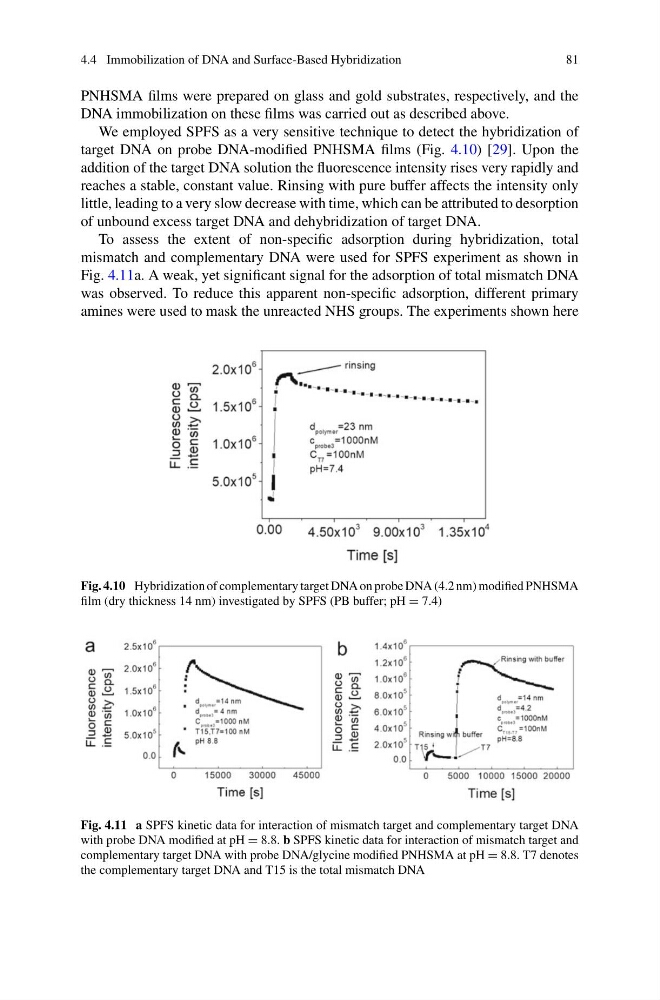
To assess the extent of non-specific adsorption during hybridization, total
mismatch and complementary DNA were used for SPFS experiment as shown in
Fig. 4.11a. A weak, yet significant signal for the adsorption of total mismatch DNA
was observed. To reduce this apparent non-specific adsorption, different primary
amines were used to mask the unreacted NHS groups. The experiments shown here
Fig. 4.10 Hybridization of complementary target DNA on probe DNA (4.2 nm) modified PNHSMA
film (dry thickness 14 nm) investigated by SPFS (PB buffer; pH = 7.4)
Fig. 4.11 a SPFS kinetic data for interaction of mismatch target and complementary target DNA
with probe DNA modified at pH = 8.8. b SPFS kinetic data for interaction of mismatch target and
complementary target DNA with probe DNA/glycine modified PNHSMA at pH = 8.8. T7 denotes
the complementary target DNA and T15 is the total mismatch DNA
81
PNHSMA films were prepared on glass and gold substrates, respectively, and the
DNA immobilization on these films was carried out as described above.
We employed SPFS as a very sensitive technique to detect the hybridization of
target DNA on probe DNA-modified PNHSMA films (Fig. 4.10) [29]. Upon the
addition of the target DNA solution the fluorescence intensity rises very rapidly and
reaches a stable, constant value. Rinsing with pure buffer affects the intensity only
little, leading to a very slow decrease with time, which can be attributed to desorption
of unbound excess target DNA and dehybridization of target DNA.
To assess the extent of non-specific adsorption during hybridization, total
mismatch and complementary DNA were used for SPFS experiment as shown in
Fig. 4.11a. A weak, yet significant signal for the adsorption of total mismatch DNA
was observed. To reduce this apparent non-specific adsorption, different primary
amines were used to mask the unreacted NHS groups. The experiments shown here
Fig. 4.10 Hybridization of complementary target DNA on probe DNA (4.2 nm) modified PNHSMA
film (dry thickness 14 nm) investigated by SPFS (PB buffer; pH = 7.4)
Fig. 4.11 a SPFS kinetic data for interaction of mismatch target and complementary target DNA
with probe DNA modified at pH = 8.8. b SPFS kinetic data for interaction of mismatch target and
complementary target DNA with probe DNA/glycine modified PNHSMA at pH = 8.8. T7 denotes
the complementary target DNA and T15 is the total mismatch DNA