

78
4 Reactive Thin Polymer Films as Platforms for the Immobilization …
a formal grafting density of PEG of ~2.4 PEG molecules per nm
2 can be calculated.
This value is in very good agreement with the grafting density calculated based
on ellipsometry/FTIR data (see above) and confirms that PNHSMA films possess
a quasi-3D reactive structure with more accessible NHS ester groups per unit area
compared to corresponding SAMs on gold.
4.3 Swelling Behavior and Stability of PNHSMA Films
For possible applications the swelling behavior and stability of the PNHSMA films in
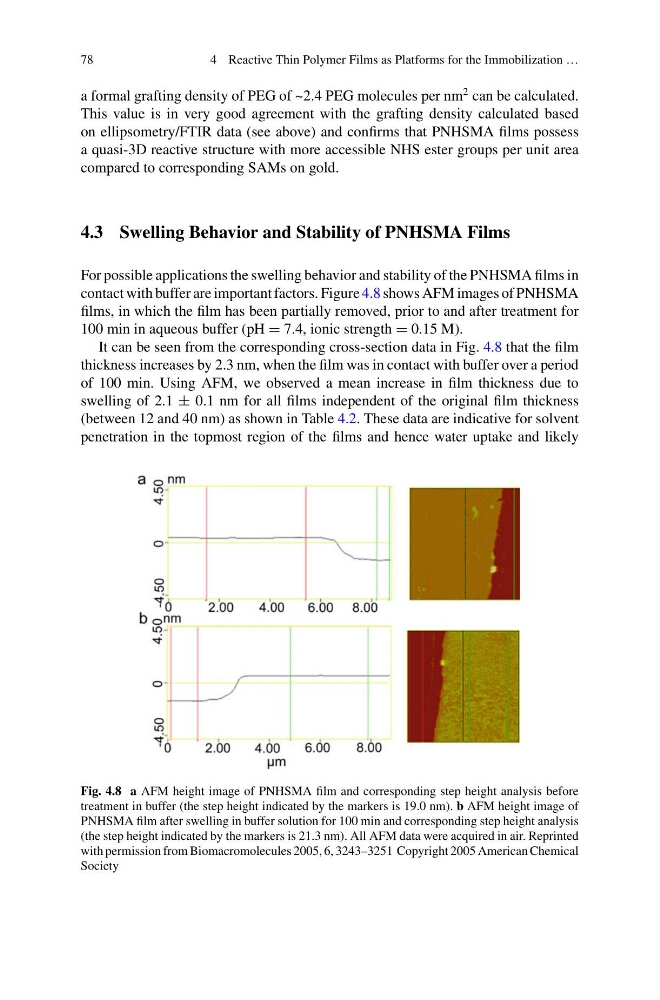
contact with buffer are important factors. Figure 4.8 shows AFM images of PNHSMA
films, in which the film has been partially removed, prior to and after treatment for
100 min in aqueous buffer (pH = 7.4, ionic strength = 0.15 M).
It can be seen from the corresponding cross-section data in Fig. 4.8 that the film
thickness increases by 2.3 nm, when the film was in contact with buffer over a period
of 100 min. Using AFM, we observed a mean increase in film thickness due to
swelling of 2.1 ± 0.1 nm for all films independent of the original film thickness
(between 12 and 40 nm) as shown in Table 4.2. These data are indicative for solvent
penetration in the topmost region of the films and hence water uptake and likely
Fig. 4.8 a AFM height image of PNHSMA film and corresponding step height analysis before
treatment in buffer (the step height indicated by the markers is 19.0 nm). b AFM height image of
PNHSMA film after swelling in buffer solution for 100 min and corresponding step height analysis
(the step height indicated by the markers is 21.3 nm). All AFM data were acquired in air. Reprinted
with permission from Biomacromolecules 2005, 6, 3243–3251 Copyright 2005 American Chemical
Society
4 Reactive Thin Polymer Films as Platforms for the Immobilization …
a formal grafting density of PEG of ~2.4 PEG molecules per nm
2 can be calculated.
This value is in very good agreement with the grafting density calculated based
on ellipsometry/FTIR data (see above) and confirms that PNHSMA films possess
a quasi-3D reactive structure with more accessible NHS ester groups per unit area
compared to corresponding SAMs on gold.
4.3 Swelling Behavior and Stability of PNHSMA Films
For possible applications the swelling behavior and stability of the PNHSMA films in
contact with buffer are important factors. Figure 4.8 shows AFM images of PNHSMA
films, in which the film has been partially removed, prior to and after treatment for
100 min in aqueous buffer (pH = 7.4, ionic strength = 0.15 M).
It can be seen from the corresponding cross-section data in Fig. 4.8 that the film
thickness increases by 2.3 nm, when the film was in contact with buffer over a period
of 100 min. Using AFM, we observed a mean increase in film thickness due to
swelling of 2.1 ± 0.1 nm for all films independent of the original film thickness
(between 12 and 40 nm) as shown in Table 4.2. These data are indicative for solvent
penetration in the topmost region of the films and hence water uptake and likely
Fig. 4.8 a AFM height image of PNHSMA film and corresponding step height analysis before
treatment in buffer (the step height indicated by the markers is 19.0 nm). b AFM height image of
PNHSMA film after swelling in buffer solution for 100 min and corresponding step height analysis
(the step height indicated by the markers is 21.3 nm). All AFM data were acquired in air. Reprinted
with permission from Biomacromolecules 2005, 6, 3243–3251 Copyright 2005 American Chemical
Society