

76
4 Reactive Thin Polymer Films as Platforms for the Immobilization …
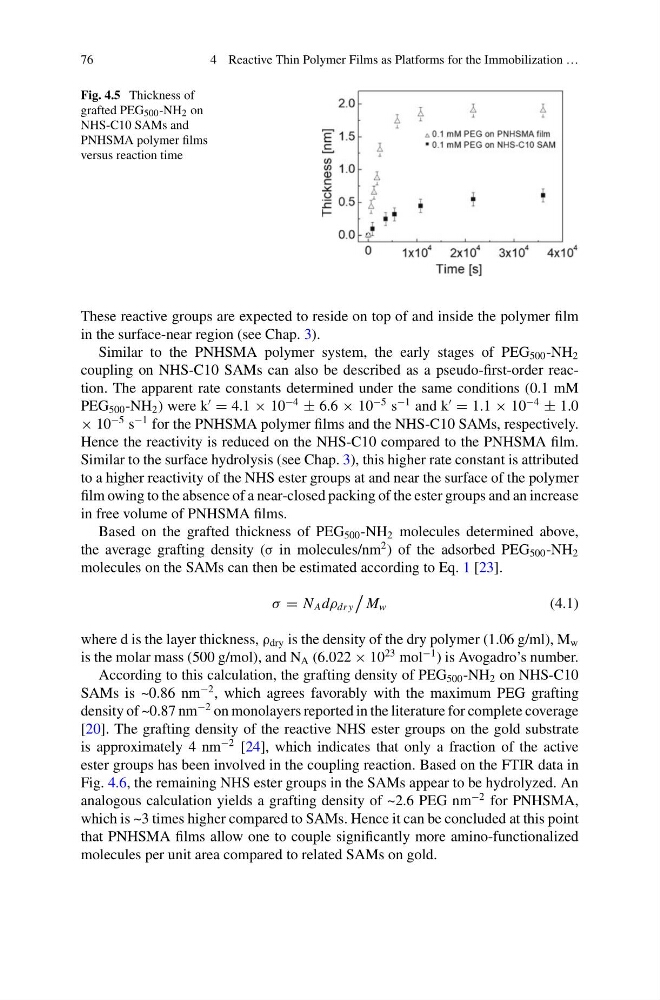
Fig. 4.5 Thickness of
grafted PEG 500 -NH 2 on
NHS-C10 SAMs and
PNHSMA polymer films
versus reaction time
These reactive groups are expected to reside on top of and inside the polymer film
in the surface-near region (see Chap. 3).
Similar to the PNHSMA polymer system, the early stages of PEG 500 -NH 2
coupling on NHS-C10 SAMs can also be described as a pseudo-first-order reaction. The apparent rate constants determined under the same conditions (0.1 mM
PEG 500 -NH 2 ) were k
= 4.1 × 10
−4
± 6.6 × 10
−5 s
−1 and k
= 1.1 × 10
−4
± 1.0
× 10
−5 s
−1 for the PNHSMA polymer films and the NHS-C10 SAMs, respectively.
Hence the reactivity is reduced on the NHS-C10 compared to the PNHSMA film.
Similar to the surface hydrolysis (see Chap. 3), this higher rate constant is attributed
to a higher reactivity of the NHS ester groups at and near the surface of the polymer
film owing to the absence of a near-closed packing of the ester groups and an increase
in free volume of PNHSMA films.
Based on the grafted thickness of PEG 500 -NH 2 molecules determined above,
the average grafting density (σ in molecules/nm
2 ) of the adsorbed PEG 500 -NH 2
molecules on the SAMs can then be estimated according to Eq. 1 [23].
σ = N A dρ dr y
M w
(4.1)
where d is the layer thickness, ρ dry is the density of the dry polymer (1.06 g/ml), M w
is the molar mass (500 g/mol), and N A (6.022 × 10
23 mol
−1 ) is Avogadro’s number.
According to this calculation, the grafting density of PEG 500 -NH 2 on NHS-C10
SAMs is ~0.86 nm
−2 , which agrees favorably with the maximum PEG grafting
density of ~0.87 nm
−2 on monolayers reported in the literature for complete coverage
[20]. The grafting density of the reactive NHS ester groups on the gold substrate
is approximately 4 nm
−2 [24], which indicates that only a fraction of the active
ester groups has been involved in the coupling reaction. Based on the FTIR data in
Fig. 4.6, the remaining NHS ester groups in the SAMs appear to be hydrolyzed. An
analogous calculation yields a grafting density of ~2.6 PEG nm
−2 for PNHSMA,
which is ~3 times higher compared to SAMs. Hence it can be concluded at this point
that PNHSMA films allow one to couple significantly more amino-functionalized
molecules per unit area compared to related SAMs on gold.
4 Reactive Thin Polymer Films as Platforms for the Immobilization …
Fig. 4.5 Thickness of
grafted PEG 500 -NH 2 on
NHS-C10 SAMs and
PNHSMA polymer films
versus reaction time
These reactive groups are expected to reside on top of and inside the polymer film
in the surface-near region (see Chap. 3).
Similar to the PNHSMA polymer system, the early stages of PEG 500 -NH 2
coupling on NHS-C10 SAMs can also be described as a pseudo-first-order reaction. The apparent rate constants determined under the same conditions (0.1 mM
PEG 500 -NH 2 ) were k
= 4.1 × 10
−4
± 6.6 × 10
−5 s
−1 and k
= 1.1 × 10
−4
± 1.0
× 10
−5 s
−1 for the PNHSMA polymer films and the NHS-C10 SAMs, respectively.
Hence the reactivity is reduced on the NHS-C10 compared to the PNHSMA film.
Similar to the surface hydrolysis (see Chap. 3), this higher rate constant is attributed
to a higher reactivity of the NHS ester groups at and near the surface of the polymer
film owing to the absence of a near-closed packing of the ester groups and an increase
in free volume of PNHSMA films.
Based on the grafted thickness of PEG 500 -NH 2 molecules determined above,
the average grafting density (σ in molecules/nm
2 ) of the adsorbed PEG 500 -NH 2
molecules on the SAMs can then be estimated according to Eq. 1 [23].
σ = N A dρ dr y
M w
(4.1)
where d is the layer thickness, ρ dry is the density of the dry polymer (1.06 g/ml), M w
is the molar mass (500 g/mol), and N A (6.022 × 10
23 mol
−1 ) is Avogadro’s number.
According to this calculation, the grafting density of PEG 500 -NH 2 on NHS-C10
SAMs is ~0.86 nm
−2 , which agrees favorably with the maximum PEG grafting
density of ~0.87 nm
−2 on monolayers reported in the literature for complete coverage
[20]. The grafting density of the reactive NHS ester groups on the gold substrate
is approximately 4 nm
−2 [24], which indicates that only a fraction of the active
ester groups has been involved in the coupling reaction. Based on the FTIR data in
Fig. 4.6, the remaining NHS ester groups in the SAMs appear to be hydrolyzed. An
analogous calculation yields a grafting density of ~2.6 PEG nm
−2 for PNHSMA,
which is ~3 times higher compared to SAMs. Hence it can be concluded at this point
that PNHSMA films allow one to couple significantly more amino-functionalized
molecules per unit area compared to related SAMs on gold.