

74
4 Reactive Thin Polymer Films as Platforms for the Immobilization …
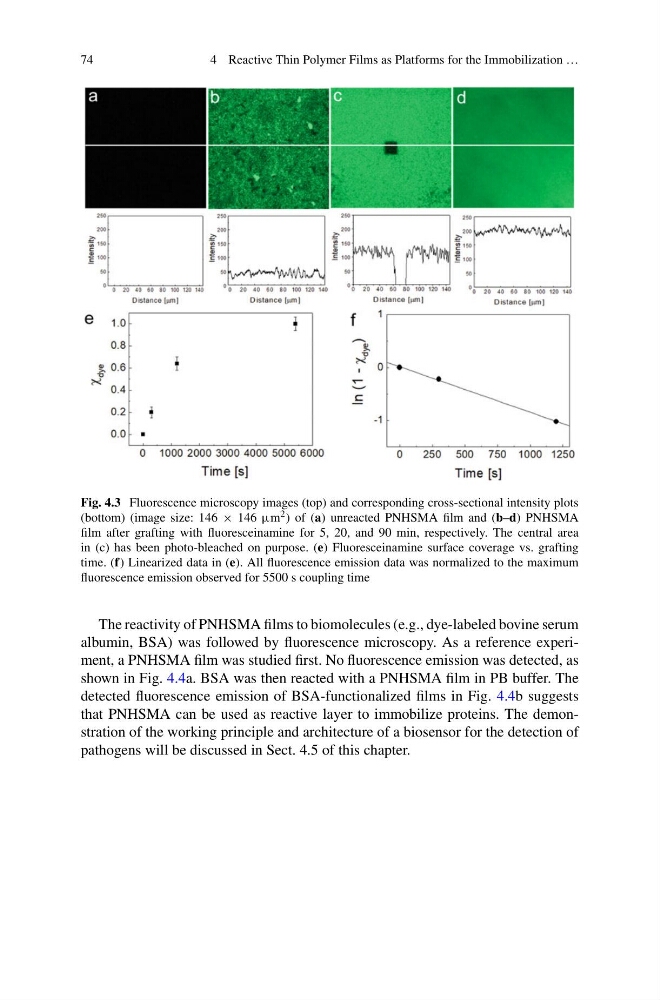
Fig. 4.3 Fluorescence microscopy images (top) and corresponding cross-sectional intensity plots
(bottom) (image size: 146 × 146 μm 2 ) of (a) unreacted PNHSMA film and (b–d) PNHSMA
film after grafting with fluoresceinamine for 5, 20, and 90 min, respectively. The central area
in (c) has been photo-bleached on purpose. (e) Fluoresceinamine surface coverage vs. grafting
time. (f) Linearized data in (e). All fluorescence emission data was normalized to the maximum
fluorescence emission observed for 5500 s coupling time
The reactivity of PNHSMA films to biomolecules (e.g., dye-labeled bovine serum
albumin, BSA) was followed by fluorescence microscopy. As a reference experiment, a PNHSMA film was studied first. No fluorescence emission was detected, as
shown in Fig. 4.4a. BSA was then reacted with a PNHSMA film in PB buffer. The
detected fluorescence emission of BSA-functionalized films in Fig. 4.4b suggests
that PNHSMA can be used as reactive layer to immobilize proteins. The demonstration of the working principle and architecture of a biosensor for the detection of
pathogens will be discussed in Sect. 4.5 of this chapter.
4 Reactive Thin Polymer Films as Platforms for the Immobilization …
Fig. 4.3 Fluorescence microscopy images (top) and corresponding cross-sectional intensity plots
(bottom) (image size: 146 × 146 μm 2 ) of (a) unreacted PNHSMA film and (b–d) PNHSMA
film after grafting with fluoresceinamine for 5, 20, and 90 min, respectively. The central area
in (c) has been photo-bleached on purpose. (e) Fluoresceinamine surface coverage vs. grafting
time. (f) Linearized data in (e). All fluorescence emission data was normalized to the maximum
fluorescence emission observed for 5500 s coupling time
The reactivity of PNHSMA films to biomolecules (e.g., dye-labeled bovine serum
albumin, BSA) was followed by fluorescence microscopy. As a reference experiment, a PNHSMA film was studied first. No fluorescence emission was detected, as
shown in Fig. 4.4a. BSA was then reacted with a PNHSMA film in PB buffer. The
detected fluorescence emission of BSA-functionalized films in Fig. 4.4b suggests
that PNHSMA can be used as reactive layer to immobilize proteins. The demonstration of the working principle and architecture of a biosensor for the detection of
pathogens will be discussed in Sect. 4.5 of this chapter.