

72
4 Reactive Thin Polymer Films as Platforms for the Immobilization …
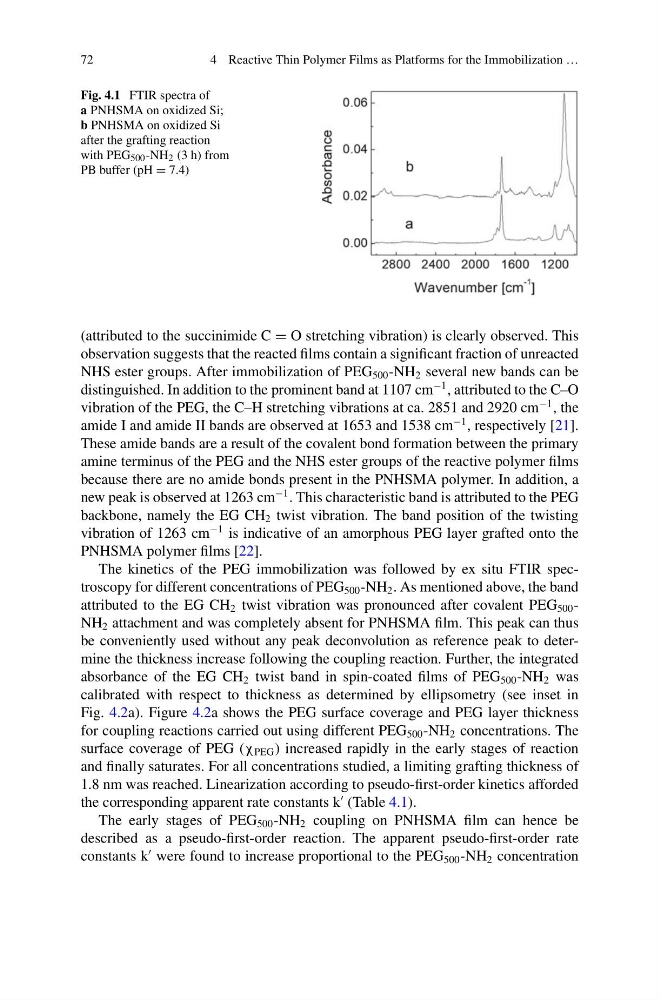
Fig. 4.1 FTIR spectra of
a PNHSMA on oxidized Si;
b PNHSMA on oxidized Si
after the grafting reaction
with PEG 500 -NH 2 (3 h) from
PB buffer (pH = 7.4)
(attributed to the succinimide C = O stretching vibration) is clearly observed. This
observation suggests that the reacted films contain a significant fraction of unreacted
NHS ester groups. After immobilization of PEG 500 -NH 2 several new bands can be
distinguished. In addition to the prominent band at 1107 cm
−1 , attributed to the C–O
vibration of the PEG, the C–H stretching vibrations at ca. 2851 and 2920 cm
−1 , the
amide I and amide II bands are observed at 1653 and 1538 cm
−1 , respectively [21].
These amide bands are a result of the covalent bond formation between the primary
amine terminus of the PEG and the NHS ester groups of the reactive polymer films
because there are no amide bonds present in the PNHSMA polymer. In addition, a
new peak is observed at 1263 cm
−1 . This characteristic band is attributed to the PEG
backbone, namely the EG CH 2 twist vibration. The band position of the twisting
vibration of 1263 cm
−1 is indicative of an amorphous PEG layer grafted onto the
PNHSMA polymer films [22].
The kinetics of the PEG immobilization was followed by ex situ FTIR spectroscopy for different concentrations of PEG 500 -NH 2 . As mentioned above, the band
attributed to the EG CH 2 twist vibration was pronounced after covalent PEG 500 -
NH 2 attachment and was completely absent for PNHSMA film. This peak can thus
be conveniently used without any peak deconvolution as reference peak to determine the thickness increase following the coupling reaction. Further, the integrated
absorbance of the EG CH 2 twist band in spin-coated films of PEG 500 -NH 2 was
calibrated with respect to thickness as determined by ellipsometry (see inset in
Fig. 4.2a). Figure 4.2a shows the PEG surface coverage and PEG layer thickness
for coupling reactions carried out using different PEG 500 -NH 2 concentrations. The
surface coverage of PEG (χ PEG ) increased rapidly in the early stages of reaction
and finally saturates. For all concentrations studied, a limiting grafting thickness of
1.8 nm was reached. Linearization according to pseudo-first-order kinetics afforded
the corresponding apparent rate constants k
(Table 4.1).
The early stages of PEG 500 -NH 2 coupling on PNHSMA film can hence be
described as a pseudo-first-order reaction. The apparent pseudo-first-order rate
constants k
were found to increase proportional to the PEG 500 -NH 2 concentration
4 Reactive Thin Polymer Films as Platforms for the Immobilization …
Fig. 4.1 FTIR spectra of
a PNHSMA on oxidized Si;
b PNHSMA on oxidized Si
after the grafting reaction
with PEG 500 -NH 2 (3 h) from
PB buffer (pH = 7.4)
(attributed to the succinimide C = O stretching vibration) is clearly observed. This
observation suggests that the reacted films contain a significant fraction of unreacted
NHS ester groups. After immobilization of PEG 500 -NH 2 several new bands can be
distinguished. In addition to the prominent band at 1107 cm
−1 , attributed to the C–O
vibration of the PEG, the C–H stretching vibrations at ca. 2851 and 2920 cm
−1 , the
amide I and amide II bands are observed at 1653 and 1538 cm
−1 , respectively [21].
These amide bands are a result of the covalent bond formation between the primary
amine terminus of the PEG and the NHS ester groups of the reactive polymer films
because there are no amide bonds present in the PNHSMA polymer. In addition, a
new peak is observed at 1263 cm
−1 . This characteristic band is attributed to the PEG
backbone, namely the EG CH 2 twist vibration. The band position of the twisting
vibration of 1263 cm
−1 is indicative of an amorphous PEG layer grafted onto the
PNHSMA polymer films [22].
The kinetics of the PEG immobilization was followed by ex situ FTIR spectroscopy for different concentrations of PEG 500 -NH 2 . As mentioned above, the band
attributed to the EG CH 2 twist vibration was pronounced after covalent PEG 500 -
NH 2 attachment and was completely absent for PNHSMA film. This peak can thus
be conveniently used without any peak deconvolution as reference peak to determine the thickness increase following the coupling reaction. Further, the integrated
absorbance of the EG CH 2 twist band in spin-coated films of PEG 500 -NH 2 was
calibrated with respect to thickness as determined by ellipsometry (see inset in
Fig. 4.2a). Figure 4.2a shows the PEG surface coverage and PEG layer thickness
for coupling reactions carried out using different PEG 500 -NH 2 concentrations. The
surface coverage of PEG (χ PEG ) increased rapidly in the early stages of reaction
and finally saturates. For all concentrations studied, a limiting grafting thickness of
1.8 nm was reached. Linearization according to pseudo-first-order kinetics afforded
the corresponding apparent rate constants k
(Table 4.1).
The early stages of PEG 500 -NH 2 coupling on PNHSMA film can hence be
described as a pseudo-first-order reaction. The apparent pseudo-first-order rate
constants k
were found to increase proportional to the PEG 500 -NH 2 concentration