

3.3 Ultrathin PS n -b-PtBA m Polymer Films
63
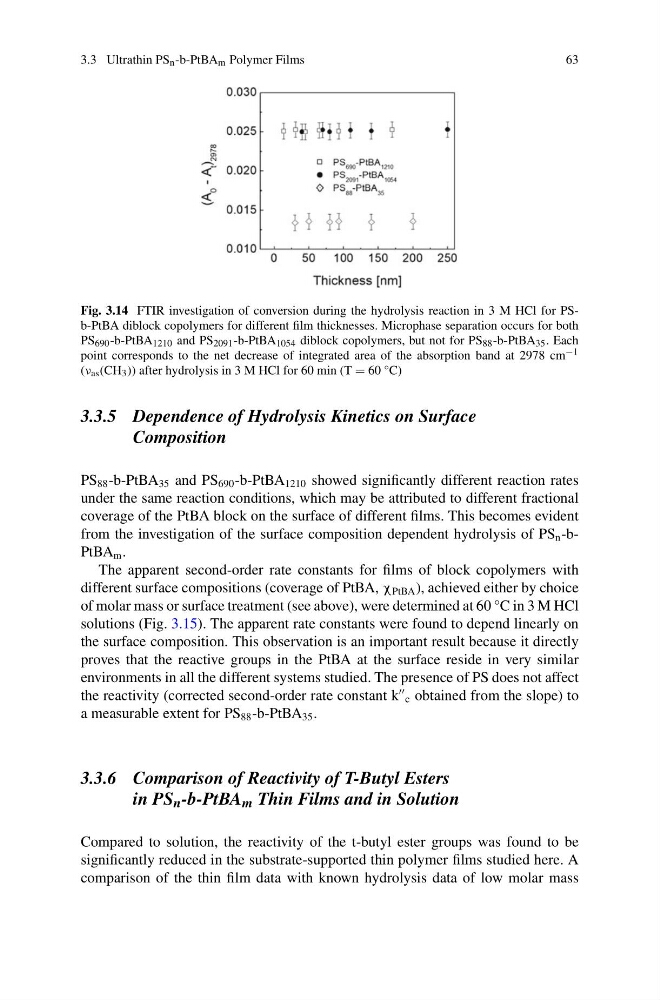
Fig. 3.14 FTIR investigation of conversion during the hydrolysis reaction in 3 M HCl for PSb-PtBA diblock copolymers for different film thicknesses. Microphase separation occurs for both
PS 690 -b-PtBA 1210 and PS 2091 -b-PtBA 1054 diblock copolymers, but not for PS 88 -b-PtBA 35 . Each
point corresponds to the net decrease of integrated area of the absorption band at 2978 cm −1
(ν as (CH 3 )) after hydrolysis in 3 M HCl for 60 min (T = 60 °C)
3.3.5 Dependence of Hydrolysis Kinetics on Surface
Composition
PS 88 -b-PtBA 35 and PS 690 -b-PtBA 1210 showed significantly different reaction rates
under the same reaction conditions, which may be attributed to different fractional
coverage of the PtBA block on the surface of different films. This becomes evident
from the investigation of the surface composition dependent hydrolysis of PS n -bPtBA m .
The apparent second-order rate constants for films of block copolymers with
different surface compositions (coverage of PtBA, χ PtBA ), achieved either by choice
of molar mass or surface treatment (see above), were determined at 60 °C in 3 M HCl
solutions (Fig. 3.15). The apparent rate constants were found to depend linearly on
the surface composition. This observation is an important result because it directly
proves that the reactive groups in the PtBA at the surface reside in very similar
environments in all the different systems studied. The presence of PS does not affect
the reactivity (corrected second-order rate constant k
c obtained from the slope) to
a measurable extent for PS 88 -b-PtBA 35 .
3.3.6 Comparison of Reactivity of T-Butyl Esters
in PS n -b-PtBA m Thin Films and in Solution
Compared to solution, the reactivity of the t-butyl ester groups was found to be
significantly reduced in the substrate-supported thin polymer films studied here. A
comparison of the thin film data with known hydrolysis data of low molar mass
63
Fig. 3.14 FTIR investigation of conversion during the hydrolysis reaction in 3 M HCl for PSb-PtBA diblock copolymers for different film thicknesses. Microphase separation occurs for both
PS 690 -b-PtBA 1210 and PS 2091 -b-PtBA 1054 diblock copolymers, but not for PS 88 -b-PtBA 35 . Each
point corresponds to the net decrease of integrated area of the absorption band at 2978 cm −1
(ν as (CH 3 )) after hydrolysis in 3 M HCl for 60 min (T = 60 °C)
3.3.5 Dependence of Hydrolysis Kinetics on Surface
Composition
PS 88 -b-PtBA 35 and PS 690 -b-PtBA 1210 showed significantly different reaction rates
under the same reaction conditions, which may be attributed to different fractional
coverage of the PtBA block on the surface of different films. This becomes evident
from the investigation of the surface composition dependent hydrolysis of PS n -bPtBA m .
The apparent second-order rate constants for films of block copolymers with
different surface compositions (coverage of PtBA, χ PtBA ), achieved either by choice
of molar mass or surface treatment (see above), were determined at 60 °C in 3 M HCl
solutions (Fig. 3.15). The apparent rate constants were found to depend linearly on
the surface composition. This observation is an important result because it directly
proves that the reactive groups in the PtBA at the surface reside in very similar
environments in all the different systems studied. The presence of PS does not affect
the reactivity (corrected second-order rate constant k
c obtained from the slope) to
a measurable extent for PS 88 -b-PtBA 35 .
3.3.6 Comparison of Reactivity of T-Butyl Esters
in PS n -b-PtBA m Thin Films and in Solution
Compared to solution, the reactivity of the t-butyl ester groups was found to be
significantly reduced in the substrate-supported thin polymer films studied here. A
comparison of the thin film data with known hydrolysis data of low molar mass