

62
3 Confinement Effects on the Reactivity in Ultrathin …
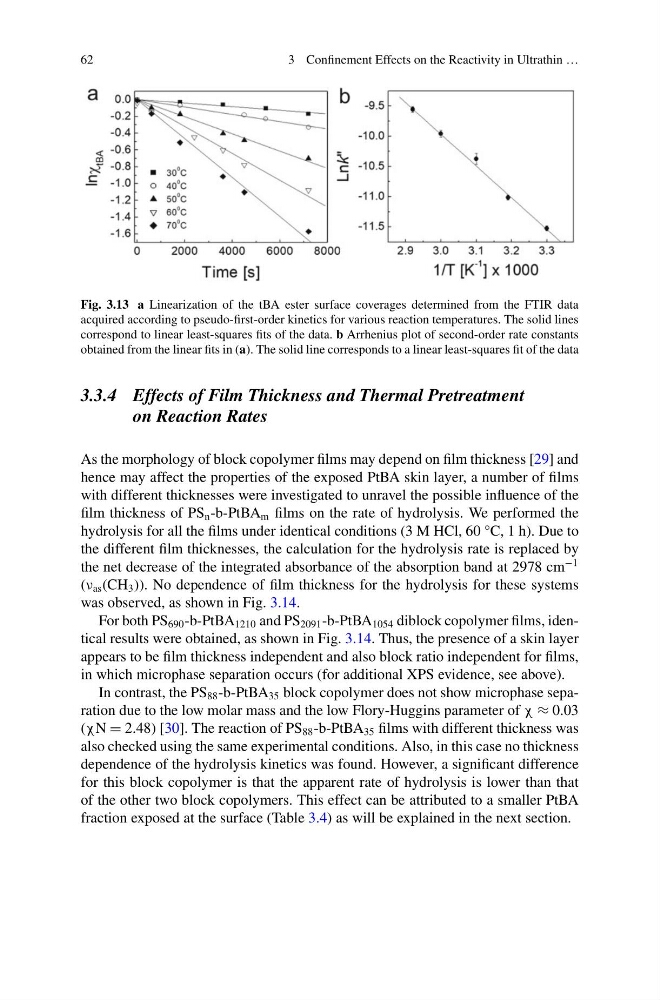
Fig. 3.13 a Linearization of the tBA ester surface coverages determined from the FTIR data
acquired according to pseudo-first-order kinetics for various reaction temperatures. The solid lines
correspond to linear least-squares fits of the data. b Arrhenius plot of second-order rate constants
obtained from the linear fits in (a). The solid line corresponds to a linear least-squares fit of the data
3.3.4 Effects of Film Thickness and Thermal Pretreatment
on Reaction Rates
As the morphology of block copolymer films may depend on film thickness [29] and
hence may affect the properties of the exposed PtBA skin layer, a number of films
with different thicknesses were investigated to unravel the possible influence of the
film thickness of PS n -b-PtBA m films on the rate of hydrolysis. We performed the
hydrolysis for all the films under identical conditions (3 M HCl, 60 °C, 1 h). Due to
the different film thicknesses, the calculation for the hydrolysis rate is replaced by
the net decrease of the integrated absorbance of the absorption band at 2978 cm
−1
(ν as (CH 3 )). No dependence of film thickness for the hydrolysis for these systems
was observed, as shown in Fig. 3.14.
For both PS 690 -b-PtBA 1210 and PS 2091 -b-PtBA 1054 diblock copolymer films, identical results were obtained, as shown in Fig. 3.14. Thus, the presence of a skin layer
appears to be film thickness independent and also block ratio independent for films,
in which microphase separation occurs (for additional XPS evidence, see above).
In contrast, the PS 88 -b-PtBA 35 block copolymer does not show microphase separation due to the low molar mass and the low Flory-Huggins parameter of χ ≈ 0.03
(χN = 2.48) [30]. The reaction of PS 88 -b-PtBA 35 films with different thickness was
also checked using the same experimental conditions. Also, in this case no thickness
dependence of the hydrolysis kinetics was found. However, a significant difference
for this block copolymer is that the apparent rate of hydrolysis is lower than that
of the other two block copolymers. This effect can be attributed to a smaller PtBA
fraction exposed at the surface (Table 3.4) as will be explained in the next section.
3 Confinement Effects on the Reactivity in Ultrathin …
Fig. 3.13 a Linearization of the tBA ester surface coverages determined from the FTIR data
acquired according to pseudo-first-order kinetics for various reaction temperatures. The solid lines
correspond to linear least-squares fits of the data. b Arrhenius plot of second-order rate constants
obtained from the linear fits in (a). The solid line corresponds to a linear least-squares fit of the data
3.3.4 Effects of Film Thickness and Thermal Pretreatment
on Reaction Rates
As the morphology of block copolymer films may depend on film thickness [29] and
hence may affect the properties of the exposed PtBA skin layer, a number of films
with different thicknesses were investigated to unravel the possible influence of the
film thickness of PS n -b-PtBA m films on the rate of hydrolysis. We performed the
hydrolysis for all the films under identical conditions (3 M HCl, 60 °C, 1 h). Due to
the different film thicknesses, the calculation for the hydrolysis rate is replaced by
the net decrease of the integrated absorbance of the absorption band at 2978 cm
−1
(ν as (CH 3 )). No dependence of film thickness for the hydrolysis for these systems
was observed, as shown in Fig. 3.14.
For both PS 690 -b-PtBA 1210 and PS 2091 -b-PtBA 1054 diblock copolymer films, identical results were obtained, as shown in Fig. 3.14. Thus, the presence of a skin layer
appears to be film thickness independent and also block ratio independent for films,
in which microphase separation occurs (for additional XPS evidence, see above).
In contrast, the PS 88 -b-PtBA 35 block copolymer does not show microphase separation due to the low molar mass and the low Flory-Huggins parameter of χ ≈ 0.03
(χN = 2.48) [30]. The reaction of PS 88 -b-PtBA 35 films with different thickness was
also checked using the same experimental conditions. Also, in this case no thickness
dependence of the hydrolysis kinetics was found. However, a significant difference
for this block copolymer is that the apparent rate of hydrolysis is lower than that
of the other two block copolymers. This effect can be attributed to a smaller PtBA
fraction exposed at the surface (Table 3.4) as will be explained in the next section.