

3.3 Ultrathin PS n -b-PtBA m Polymer Films
61
It is known that the PAA block is hydrophilic as the water CA of PAA is below
10°. The surface coverage of exposed PAA will increase with the progress of the
reaction on the top surface of the film, which will result in swelling of the surface
owing to uptake of water from the reaction solution. Hence, we attribute the observed
particle and worm-like features to swollen PAA-rich globules on the film surface.
3.3.3 Investigation of the Temperature Dependence
of Reaction Kinetics
Using FTIR spectroscopy, we observed an exponential decrease of the t-butyl ester
surface coverage for reaction time shorter than 2 h. This behavior is consistent with
pseudo-first-order reaction kinetics at the early stage for a homogeneous reaction.
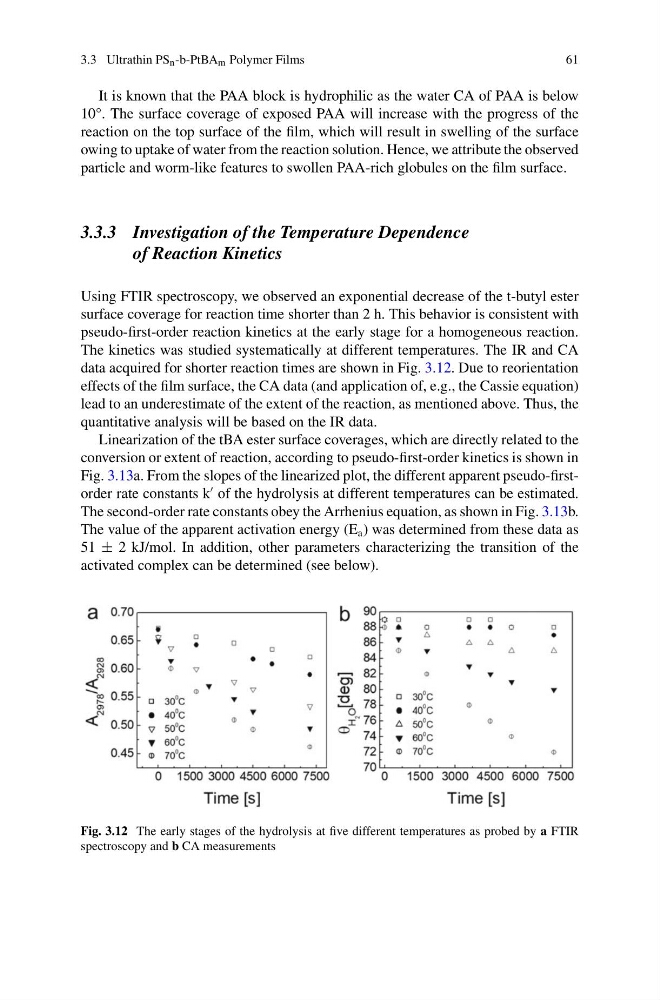
The kinetics was studied systematically at different temperatures. The IR and CA
data acquired for shorter reaction times are shown in Fig. 3.12. Due to reorientation
effects of the film surface, the CA data (and application of, e.g., the Cassie equation)
lead to an underestimate of the extent of the reaction, as mentioned above. Thus, the
quantitative analysis will be based on the IR data.
Linearization of the tBA ester surface coverages, which are directly related to the
conversion or extent of reaction, according to pseudo-first-order kinetics is shown in
Fig. 3.13a. From the slopes of the linearized plot, the different apparent pseudo-firstorder rate constants k
of the hydrolysis at different temperatures can be estimated.
The second-order rate constants obey the Arrhenius equation, as shown in Fig. 3.13b.
The value of the apparent activation energy (E a ) was determined from these data as
51 ± 2 kJ/mol. In addition, other parameters characterizing the transition of the
activated complex can be determined (see below).
Fig. 3.12 The early stages of the hydrolysis at five different temperatures as probed by a FTIR
spectroscopy and b CA measurements
61
It is known that the PAA block is hydrophilic as the water CA of PAA is below
10°. The surface coverage of exposed PAA will increase with the progress of the
reaction on the top surface of the film, which will result in swelling of the surface
owing to uptake of water from the reaction solution. Hence, we attribute the observed
particle and worm-like features to swollen PAA-rich globules on the film surface.
3.3.3 Investigation of the Temperature Dependence
of Reaction Kinetics
Using FTIR spectroscopy, we observed an exponential decrease of the t-butyl ester
surface coverage for reaction time shorter than 2 h. This behavior is consistent with
pseudo-first-order reaction kinetics at the early stage for a homogeneous reaction.
The kinetics was studied systematically at different temperatures. The IR and CA
data acquired for shorter reaction times are shown in Fig. 3.12. Due to reorientation
effects of the film surface, the CA data (and application of, e.g., the Cassie equation)
lead to an underestimate of the extent of the reaction, as mentioned above. Thus, the
quantitative analysis will be based on the IR data.
Linearization of the tBA ester surface coverages, which are directly related to the
conversion or extent of reaction, according to pseudo-first-order kinetics is shown in
Fig. 3.13a. From the slopes of the linearized plot, the different apparent pseudo-firstorder rate constants k
of the hydrolysis at different temperatures can be estimated.
The second-order rate constants obey the Arrhenius equation, as shown in Fig. 3.13b.
The value of the apparent activation energy (E a ) was determined from these data as
51 ± 2 kJ/mol. In addition, other parameters characterizing the transition of the
activated complex can be determined (see below).
Fig. 3.12 The early stages of the hydrolysis at five different temperatures as probed by a FTIR
spectroscopy and b CA measurements