

64
3 Confinement Effects on the Reactivity in Ultrathin …
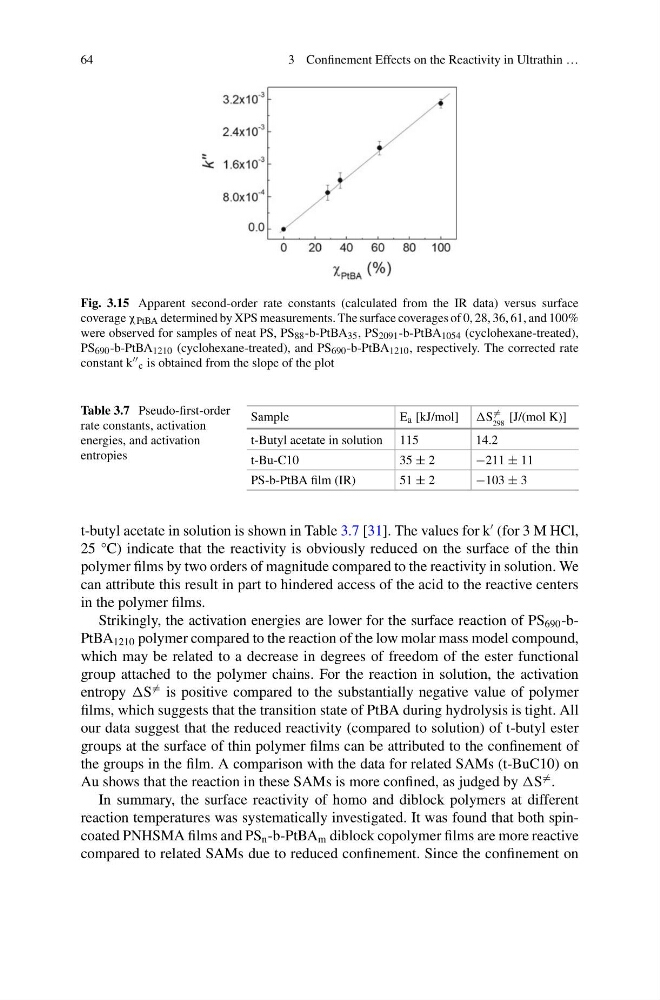
Fig. 3.15 Apparent second-order rate constants (calculated from the IR data) versus surface
coverage χ PtBA determined by XPS measurements. The surface coverages of 0, 28, 36, 61, and 100%
were observed for samples of neat PS, PS 88 -b-PtBA 35 , PS 2091 -b-PtBA 1054 (cyclohexane-treated),
PS 690 -b-PtBA 1210 (cyclohexane-treated), and PS 690 -b-PtBA 1210 , respectively. The corrected rate
constant k c is obtained from the slope of the plot
Table 3.7 Pseudo-first-order
rate constants, activation
energies, and activation
entropies
Sample
E a [kJ/mol] S =
298
[J/(mol K)]
t-Butyl acetate in solution 115
14.2
t-Bu-C10
35 ± 2
−211 ± 11
PS-b-PtBA film (IR)
51 ± 2
−103 ± 3
t-butyl acetate in solution is shown in Table 3.7 [31]. The values for k
(for 3 M HCl,
25 °C) indicate that the reactivity is obviously reduced on the surface of the thin
polymer films by two orders of magnitude compared to the reactivity in solution. We
can attribute this result in part to hindered access of the acid to the reactive centers
in the polymer films.
Strikingly, the activation energies are lower for the surface reaction of PS 690 -bPtBA 1210 polymer compared to the reaction of the low molar mass model compound,
which may be related to a decrease in degrees of freedom of the ester functional
group attached to the polymer chains. For the reaction in solution, the activation
entropy S
= is positive compared to the substantially negative value of polymer
films, which suggests that the transition state of PtBA during hydrolysis is tight. All
our data suggest that the reduced reactivity (compared to solution) of t-butyl ester
groups at the surface of thin polymer films can be attributed to the confinement of
the groups in the film. A comparison with the data for related SAMs (t-BuC10) on
Au shows that the reaction in these SAMs is more confined, as judged by S
= .
In summary, the surface reactivity of homo and diblock polymers at different
reaction temperatures was systematically investigated. It was found that both spincoated PNHSMA films and PS n -b-PtBA m diblock copolymer films are more reactive
compared to related SAMs due to reduced confinement. Since the confinement on
3 Confinement Effects on the Reactivity in Ultrathin …
Fig. 3.15 Apparent second-order rate constants (calculated from the IR data) versus surface
coverage χ PtBA determined by XPS measurements. The surface coverages of 0, 28, 36, 61, and 100%
were observed for samples of neat PS, PS 88 -b-PtBA 35 , PS 2091 -b-PtBA 1054 (cyclohexane-treated),
PS 690 -b-PtBA 1210 (cyclohexane-treated), and PS 690 -b-PtBA 1210 , respectively. The corrected rate
constant k c is obtained from the slope of the plot
Table 3.7 Pseudo-first-order
rate constants, activation
energies, and activation
entropies
Sample
E a [kJ/mol] S =
298
[J/(mol K)]
t-Butyl acetate in solution 115
14.2
t-Bu-C10
35 ± 2
−211 ± 11
PS-b-PtBA film (IR)
51 ± 2
−103 ± 3
t-butyl acetate in solution is shown in Table 3.7 [31]. The values for k
(for 3 M HCl,
25 °C) indicate that the reactivity is obviously reduced on the surface of the thin
polymer films by two orders of magnitude compared to the reactivity in solution. We
can attribute this result in part to hindered access of the acid to the reactive centers
in the polymer films.
Strikingly, the activation energies are lower for the surface reaction of PS 690 -bPtBA 1210 polymer compared to the reaction of the low molar mass model compound,
which may be related to a decrease in degrees of freedom of the ester functional
group attached to the polymer chains. For the reaction in solution, the activation
entropy S
= is positive compared to the substantially negative value of polymer
films, which suggests that the transition state of PtBA during hydrolysis is tight. All
our data suggest that the reduced reactivity (compared to solution) of t-butyl ester
groups at the surface of thin polymer films can be attributed to the confinement of
the groups in the film. A comparison with the data for related SAMs (t-BuC10) on
Au shows that the reaction in these SAMs is more confined, as judged by S
= .
In summary, the surface reactivity of homo and diblock polymers at different
reaction temperatures was systematically investigated. It was found that both spincoated PNHSMA films and PS n -b-PtBA m diblock copolymer films are more reactive
compared to related SAMs due to reduced confinement. Since the confinement on