

3.3 Ultrathin PS n -b-PtBA m Polymer Films
57
Table 3.5 Theoretical and experimental C/O ratios obtained for different take-off angles and
estimated information depths by angle-dependent XPS for 90 nm thin films of PS 690 -b-PtBA 1210
Sample
Theoretical
C/O ratio
(PtBA)
Experimental
C/O ratio
(30°, 5 nm)
Experimental
C/O ratio
(45°, 7 nm)
Experimental
C/O ratio
(60°, 9 nm)
Experimental
C/O ratio
(90°, 10 nm)
PS 690 -b-PtBA 1210 3.5
3.5
3.5
3.7
3.8
0.7 and 9.5 ± 1.1 indicate a coexistence of both blocks in the sampled depth of the film
surface for solvent-treated PS 690 -b-PtBA 1210 and PS 2091 -b-PtBA 1054 , respectively.
The thickness of the skin layer on PS 690 -b-PtBA 1210 films was estimated by
variable-angle XPS experiments. The take-off angle α was varied systematically
to control the information depth and thus to obtain chemical composition versus
depth profile [23]. The data for four different take-off angles are shown in Table 3.5.
Up to an angle of 45°, which corresponds to an estimated information depth of 7 nm,
the value of the surface composition was equal to that found for PtBA homopolymer
films. For angles exceeding 60° (information depth of 8.7 nm), an increase of the C/O
ratio was observed, which is consistent with a contribution of PS from the underlying
microphase-separated PS 690 -b-PtBA 1210 to the detected XPS signal. Based on this
experiment, the thickness of the skin layer of PS 690 -b-PtBA 1210 film is estimated as
8 ± 1 nm.
3.3.2 Characterization and Kinetics of the Hydrolysis
of PS m -b-PtBA n Films
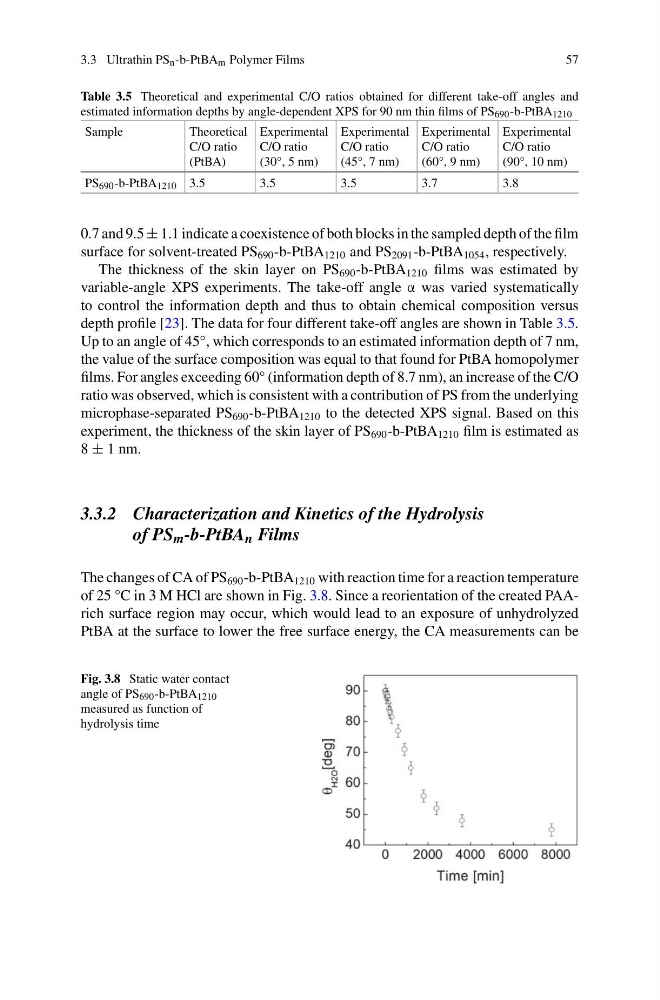
The changes of CA of PS 690 -b-PtBA 1210 with reaction time for a reaction temperature
of 25 °C in 3 M HCl are shown in Fig. 3.8. Since a reorientation of the created PAArich surface region may occur, which would lead to an exposure of unhydrolyzed
PtBA at the surface to lower the free surface energy, the CA measurements can be
Fig. 3.8 Static water contact
angle of PS 690 -b-PtBA 1210
measured as function of
hydrolysis time
57
Table 3.5 Theoretical and experimental C/O ratios obtained for different take-off angles and
estimated information depths by angle-dependent XPS for 90 nm thin films of PS 690 -b-PtBA 1210
Sample
Theoretical
C/O ratio
(PtBA)
Experimental
C/O ratio
(30°, 5 nm)
Experimental
C/O ratio
(45°, 7 nm)
Experimental
C/O ratio
(60°, 9 nm)
Experimental
C/O ratio
(90°, 10 nm)
PS 690 -b-PtBA 1210 3.5
3.5
3.5
3.7
3.8
0.7 and 9.5 ± 1.1 indicate a coexistence of both blocks in the sampled depth of the film
surface for solvent-treated PS 690 -b-PtBA 1210 and PS 2091 -b-PtBA 1054 , respectively.
The thickness of the skin layer on PS 690 -b-PtBA 1210 films was estimated by
variable-angle XPS experiments. The take-off angle α was varied systematically
to control the information depth and thus to obtain chemical composition versus
depth profile [23]. The data for four different take-off angles are shown in Table 3.5.
Up to an angle of 45°, which corresponds to an estimated information depth of 7 nm,
the value of the surface composition was equal to that found for PtBA homopolymer
films. For angles exceeding 60° (information depth of 8.7 nm), an increase of the C/O
ratio was observed, which is consistent with a contribution of PS from the underlying
microphase-separated PS 690 -b-PtBA 1210 to the detected XPS signal. Based on this
experiment, the thickness of the skin layer of PS 690 -b-PtBA 1210 film is estimated as
8 ± 1 nm.
3.3.2 Characterization and Kinetics of the Hydrolysis
of PS m -b-PtBA n Films
The changes of CA of PS 690 -b-PtBA 1210 with reaction time for a reaction temperature
of 25 °C in 3 M HCl are shown in Fig. 3.8. Since a reorientation of the created PAArich surface region may occur, which would lead to an exposure of unhydrolyzed
PtBA at the surface to lower the free surface energy, the CA measurements can be
Fig. 3.8 Static water contact
angle of PS 690 -b-PtBA 1210
measured as function of
hydrolysis time