

56
3 Confinement Effects on the Reactivity in Ultrathin …
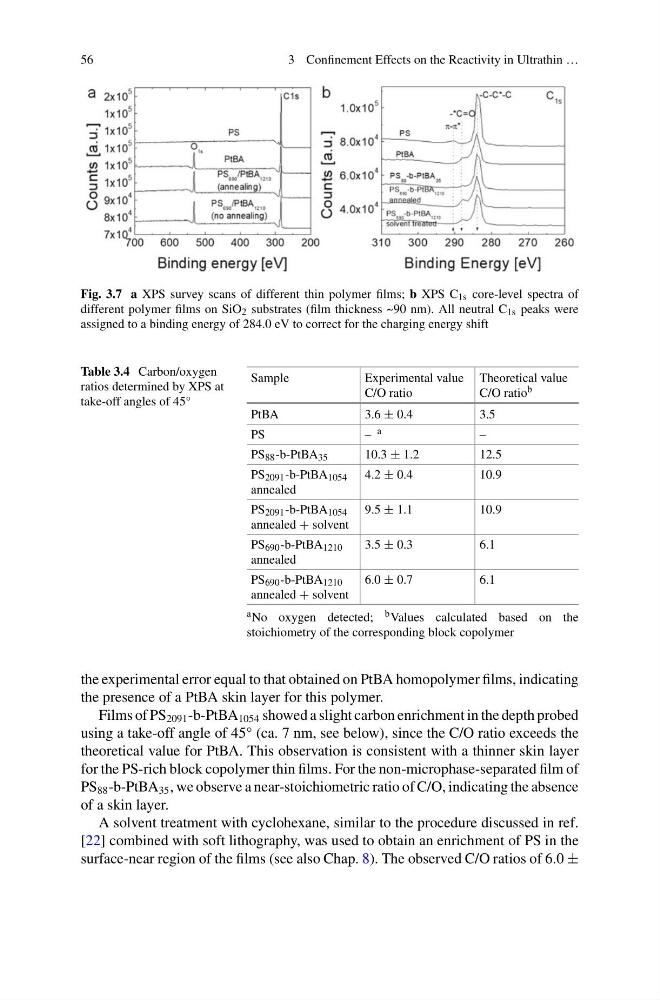
Fig. 3.7 a XPS survey scans of different thin polymer films; b XPS C 1s core-level spectra of
different polymer films on SiO 2 substrates (film thickness ~90 nm). All neutral C 1s peaks were
assigned to a binding energy of 284.0 eV to correct for the charging energy shift
Table 3.4 Carbon/oxygen
ratios determined by XPS at
take-off angles of 45°
Sample
Experimental value
C/O ratio
Theoretical value
C/O ratio b
PtBA
3.6 ± 0.4
3.5
PS
– a
–
PS 88 -b-PtBA 35
10.3 ± 1.2
12.5
PS 2091 -b-PtBA 1054
annealed
4.2 ± 0.4
10.9
PS 2091 -b-PtBA 1054
annealed + solvent
9.5 ± 1.1
10.9
PS 690 -b-PtBA 1210
annealed
3.5 ± 0.3
6.1
PS 690 -b-PtBA 1210
annealed + solvent
6.0 ± 0.7
6.1
a No oxygen detected; b Values calculated based on the
stoichiometry of the corresponding block copolymer
the experimental error equal to that obtained on PtBA homopolymer films, indicating
the presence of a PtBA skin layer for this polymer.
Films of PS 2091 -b-PtBA 1054 showed a slight carbon enrichment in the depth probed
using a take-off angle of 45° (ca. 7 nm, see below), since the C/O ratio exceeds the
theoretical value for PtBA. This observation is consistent with a thinner skin layer
for the PS-rich block copolymer thin films. For the non-microphase-separated film of
PS 88 -b-PtBA 35 , we observe a near-stoichiometric ratio of C/O, indicating the absence
of a skin layer.
A solvent treatment with cyclohexane, similar to the procedure discussed in ref.
[22] combined with soft lithography, was used to obtain an enrichment of PS in the
surface-near region of the films (see also Chap. 8). The observed C/O ratios of 6.0 ±
3 Confinement Effects on the Reactivity in Ultrathin …
Fig. 3.7 a XPS survey scans of different thin polymer films; b XPS C 1s core-level spectra of
different polymer films on SiO 2 substrates (film thickness ~90 nm). All neutral C 1s peaks were
assigned to a binding energy of 284.0 eV to correct for the charging energy shift
Table 3.4 Carbon/oxygen
ratios determined by XPS at
take-off angles of 45°
Sample
Experimental value
C/O ratio
Theoretical value
C/O ratio b
PtBA
3.6 ± 0.4
3.5
PS
– a
–
PS 88 -b-PtBA 35
10.3 ± 1.2
12.5
PS 2091 -b-PtBA 1054
annealed
4.2 ± 0.4
10.9
PS 2091 -b-PtBA 1054
annealed + solvent
9.5 ± 1.1
10.9
PS 690 -b-PtBA 1210
annealed
3.5 ± 0.3
6.1
PS 690 -b-PtBA 1210
annealed + solvent
6.0 ± 0.7
6.1
a No oxygen detected; b Values calculated based on the
stoichiometry of the corresponding block copolymer
the experimental error equal to that obtained on PtBA homopolymer films, indicating
the presence of a PtBA skin layer for this polymer.
Films of PS 2091 -b-PtBA 1054 showed a slight carbon enrichment in the depth probed
using a take-off angle of 45° (ca. 7 nm, see below), since the C/O ratio exceeds the
theoretical value for PtBA. This observation is consistent with a thinner skin layer
for the PS-rich block copolymer thin films. For the non-microphase-separated film of
PS 88 -b-PtBA 35 , we observe a near-stoichiometric ratio of C/O, indicating the absence
of a skin layer.
A solvent treatment with cyclohexane, similar to the procedure discussed in ref.
[22] combined with soft lithography, was used to obtain an enrichment of PS in the
surface-near region of the films (see also Chap. 8). The observed C/O ratios of 6.0 ±