

2.3 Patterned Organic and Polymeric Films for Tailored (Bio)Interfaces
35
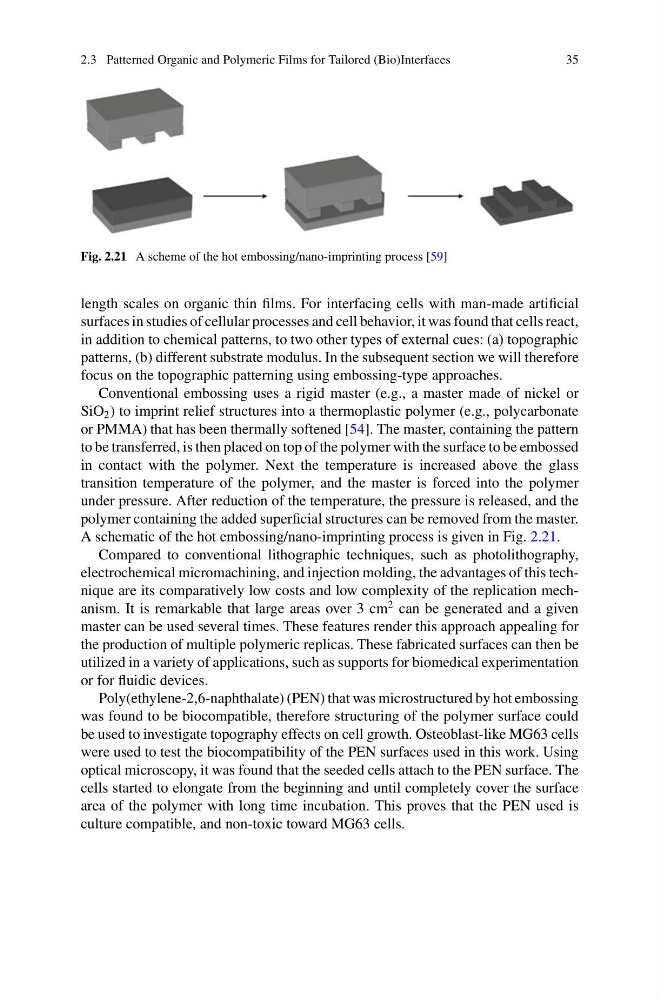
Fig. 2.21 A scheme of the hot embossing/nano-imprinting process [59]
length scales on organic thin films. For interfacing cells with man-made artificial
surfaces in studies of cellular processes and cell behavior, it was found that cells react,
in addition to chemical patterns, to two other types of external cues: (a) topographic
patterns, (b) different substrate modulus. In the subsequent section we will therefore
focus on the topographic patterning using embossing-type approaches.
Conventional embossing uses a rigid master (e.g., a master made of nickel or
SiO 2 ) to imprint relief structures into a thermoplastic polymer (e.g., polycarbonate
or PMMA) that has been thermally softened [54]. The master, containing the pattern
to be transferred, is then placed on top of the polymer with the surface to be embossed
in contact with the polymer. Next the temperature is increased above the glass
transition temperature of the polymer, and the master is forced into the polymer
under pressure. After reduction of the temperature, the pressure is released, and the
polymer containing the added superficial structures can be removed from the master.
A schematic of the hot embossing/nano-imprinting process is given in Fig. 2.21.
Compared to conventional lithographic techniques, such as photolithography,
electrochemical micromachining, and injection molding, the advantages of this technique are its comparatively low costs and low complexity of the replication mechanism. It is remarkable that large areas over 3 cm
2 can be generated and a given
master can be used several times. These features render this approach appealing for
the production of multiple polymeric replicas. These fabricated surfaces can then be
utilized in a variety of applications, such as supports for biomedical experimentation
or for fluidic devices.
Poly(ethylene-2,6-naphthalate) (PEN) that was microstructured by hot embossing
was found to be biocompatible, therefore structuring of the polymer surface could
be used to investigate topography effects on cell growth. Osteoblast-like MG63 cells
were used to test the biocompatibility of the PEN surfaces used in this work. Using
optical microscopy, it was found that the seeded cells attach to the PEN surface. The
cells started to elongate from the beginning and until completely cover the surface
area of the polymer with long time incubation. This proves that the PEN used is
culture compatible, and non-toxic toward MG63 cells.
35
Fig. 2.21 A scheme of the hot embossing/nano-imprinting process [59]
length scales on organic thin films. For interfacing cells with man-made artificial
surfaces in studies of cellular processes and cell behavior, it was found that cells react,
in addition to chemical patterns, to two other types of external cues: (a) topographic
patterns, (b) different substrate modulus. In the subsequent section we will therefore
focus on the topographic patterning using embossing-type approaches.
Conventional embossing uses a rigid master (e.g., a master made of nickel or
SiO 2 ) to imprint relief structures into a thermoplastic polymer (e.g., polycarbonate
or PMMA) that has been thermally softened [54]. The master, containing the pattern
to be transferred, is then placed on top of the polymer with the surface to be embossed
in contact with the polymer. Next the temperature is increased above the glass
transition temperature of the polymer, and the master is forced into the polymer
under pressure. After reduction of the temperature, the pressure is released, and the
polymer containing the added superficial structures can be removed from the master.
A schematic of the hot embossing/nano-imprinting process is given in Fig. 2.21.
Compared to conventional lithographic techniques, such as photolithography,
electrochemical micromachining, and injection molding, the advantages of this technique are its comparatively low costs and low complexity of the replication mechanism. It is remarkable that large areas over 3 cm
2 can be generated and a given
master can be used several times. These features render this approach appealing for
the production of multiple polymeric replicas. These fabricated surfaces can then be
utilized in a variety of applications, such as supports for biomedical experimentation
or for fluidic devices.
Poly(ethylene-2,6-naphthalate) (PEN) that was microstructured by hot embossing
was found to be biocompatible, therefore structuring of the polymer surface could
be used to investigate topography effects on cell growth. Osteoblast-like MG63 cells
were used to test the biocompatibility of the PEN surfaces used in this work. Using
optical microscopy, it was found that the seeded cells attach to the PEN surface. The
cells started to elongate from the beginning and until completely cover the surface
area of the polymer with long time incubation. This proves that the PEN used is
culture compatible, and non-toxic toward MG63 cells.