

36
2 Surface Reactions and Fabrication of Bioreactive Platforms …
2.3.4 Self-assembled Block Copolymer Patterns
As mentioned above, length scales in the millimeter to sub-micrometer range are
covered by established optical lithography and soft lithography approaches. However,
the fabrication of structures at organic or polymeric surfaces in the 10–100 nm
range, which is difficult to access in a highly parallel manner, is widely recognized as a requirement for future applications in many fields. While serial lithographic processes, such as e-beam lithography, can in principle provide access to
biologically relevant patterns, the fabrication of the corresponding platforms would
benefit from new approaches to address this issue at least in parts in a highly parallel
manner. In this context, nanometer scale patterns based on self-assembly have been
considered as alternatives to replace or complement high-resolution lithographic
technologies, such as X-ray, electron beam, and interference lithography to enable
a variety of nano(bio)technologies. In particular, block copolymers have recently
received much attention, not only thanks to the scale of the microdomains, their
various chemical and physical properties but also due to the convenient size and shape
tenability of microdomains afforded by simply changing their molecular masses and
compositions.
2.3.4.1 Definition of Block Copolymers
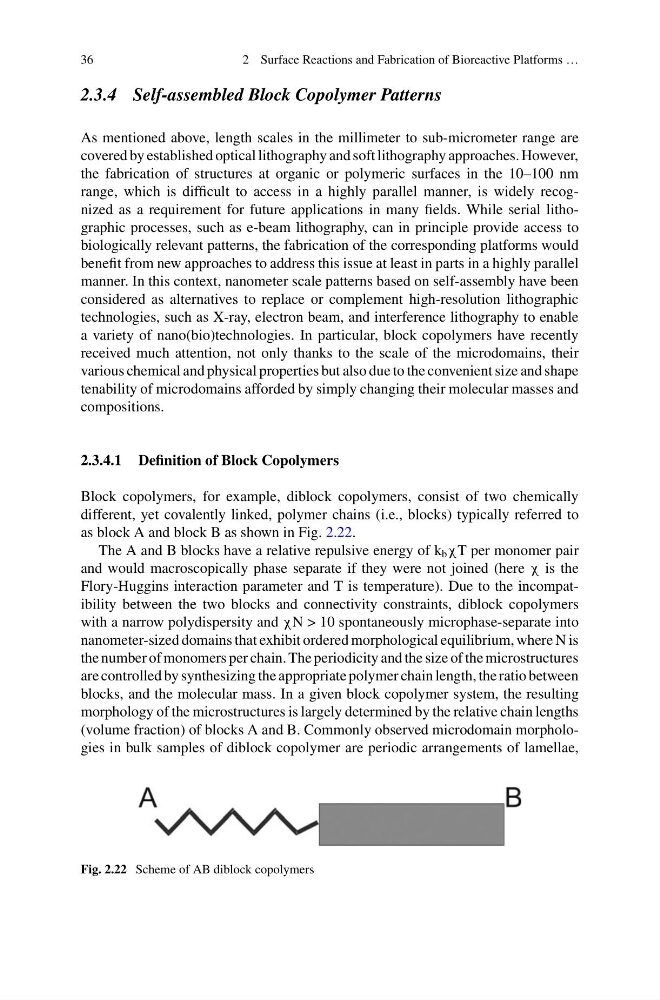
Block copolymers, for example, diblock copolymers, consist of two chemically
different, yet covalently linked, polymer chains (i.e., blocks) typically referred to
as block A and block B as shown in Fig. 2.22.
The A and B blocks have a relative repulsive energy of k b χT per monomer pair
and would macroscopically phase separate if they were not joined (here χ is the
Flory-Huggins interaction parameter and T is temperature). Due to the incompatibility between the two blocks and connectivity constraints, diblock copolymers
with a narrow polydispersity and χN > 10 spontaneously microphase-separate into
nanometer-sized domains that exhibit ordered morphological equilibrium, where N is
the number of monomers per chain. The periodicity and the size of the microstructures
are controlled by synthesizing the appropriate polymer chain length, the ratio between
blocks, and the molecular mass. In a given block copolymer system, the resulting
morphology of the microstructures is largely determined by the relative chain lengths
(volume fraction) of blocks A and B. Commonly observed microdomain morphologies in bulk samples of diblock copolymer are periodic arrangements of lamellae,
Fig. 2.22 Scheme of AB diblock copolymers
2 Surface Reactions and Fabrication of Bioreactive Platforms …
2.3.4 Self-assembled Block Copolymer Patterns
As mentioned above, length scales in the millimeter to sub-micrometer range are
covered by established optical lithography and soft lithography approaches. However,
the fabrication of structures at organic or polymeric surfaces in the 10–100 nm
range, which is difficult to access in a highly parallel manner, is widely recognized as a requirement for future applications in many fields. While serial lithographic processes, such as e-beam lithography, can in principle provide access to
biologically relevant patterns, the fabrication of the corresponding platforms would
benefit from new approaches to address this issue at least in parts in a highly parallel
manner. In this context, nanometer scale patterns based on self-assembly have been
considered as alternatives to replace or complement high-resolution lithographic
technologies, such as X-ray, electron beam, and interference lithography to enable
a variety of nano(bio)technologies. In particular, block copolymers have recently
received much attention, not only thanks to the scale of the microdomains, their
various chemical and physical properties but also due to the convenient size and shape
tenability of microdomains afforded by simply changing their molecular masses and
compositions.
2.3.4.1 Definition of Block Copolymers
Block copolymers, for example, diblock copolymers, consist of two chemically
different, yet covalently linked, polymer chains (i.e., blocks) typically referred to
as block A and block B as shown in Fig. 2.22.
The A and B blocks have a relative repulsive energy of k b χT per monomer pair
and would macroscopically phase separate if they were not joined (here χ is the
Flory-Huggins interaction parameter and T is temperature). Due to the incompatibility between the two blocks and connectivity constraints, diblock copolymers
with a narrow polydispersity and χN > 10 spontaneously microphase-separate into
nanometer-sized domains that exhibit ordered morphological equilibrium, where N is
the number of monomers per chain. The periodicity and the size of the microstructures
are controlled by synthesizing the appropriate polymer chain length, the ratio between
blocks, and the molecular mass. In a given block copolymer system, the resulting
morphology of the microstructures is largely determined by the relative chain lengths
(volume fraction) of blocks A and B. Commonly observed microdomain morphologies in bulk samples of diblock copolymer are periodic arrangements of lamellae,
Fig. 2.22 Scheme of AB diblock copolymers