

2.3 Patterned Organic and Polymeric Films for Tailored (Bio)Interfaces
31
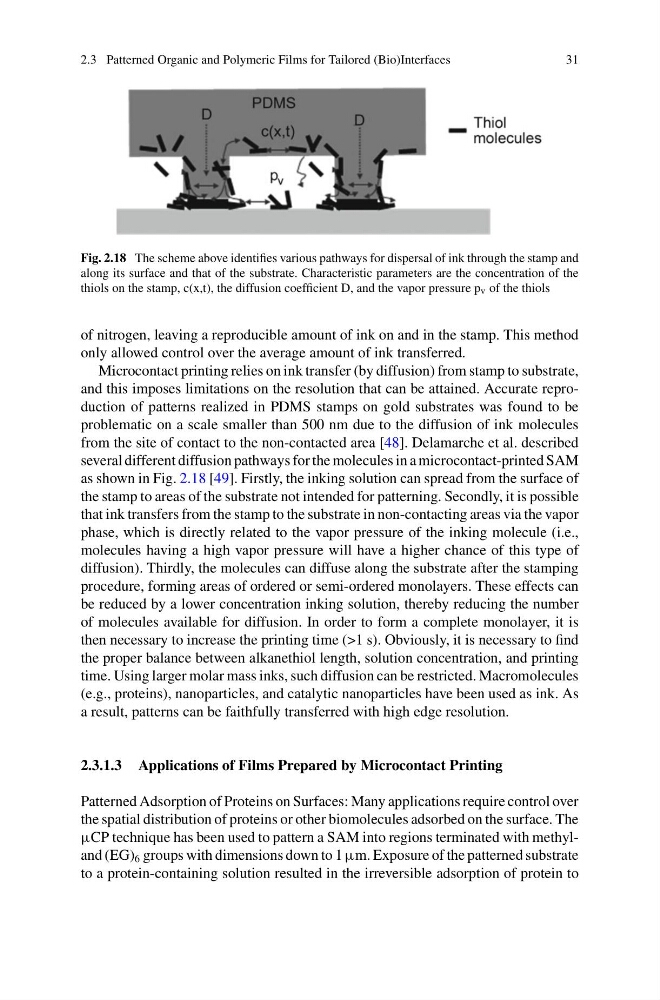
Fig. 2.18 The scheme above identifies various pathways for dispersal of ink through the stamp and
along its surface and that of the substrate. Characteristic parameters are the concentration of the
thiols on the stamp, c(x,t), the diffusion coefficient D, and the vapor pressure p v of the thiols
of nitrogen, leaving a reproducible amount of ink on and in the stamp. This method
only allowed control over the average amount of ink transferred.
Microcontact printing relies on ink transfer (by diffusion) from stamp to substrate,
and this imposes limitations on the resolution that can be attained. Accurate reproduction of patterns realized in PDMS stamps on gold substrates was found to be
problematic on a scale smaller than 500 nm due to the diffusion of ink molecules
from the site of contact to the non-contacted area [48]. Delamarche et al. described
several different diffusion pathways for the molecules in a microcontact-printed SAM
as shown in Fig. 2.18 [49]. Firstly, the inking solution can spread from the surface of
the stamp to areas of the substrate not intended for patterning. Secondly, it is possible
that ink transfers from the stamp to the substrate in non-contacting areas via the vapor
phase, which is directly related to the vapor pressure of the inking molecule (i.e.,
molecules having a high vapor pressure will have a higher chance of this type of
diffusion). Thirdly, the molecules can diffuse along the substrate after the stamping
procedure, forming areas of ordered or semi-ordered monolayers. These effects can
be reduced by a lower concentration inking solution, thereby reducing the number
of molecules available for diffusion. In order to form a complete monolayer, it is
then necessary to increase the printing time (>1 s). Obviously, it is necessary to find
the proper balance between alkanethiol length, solution concentration, and printing
time. Using larger molar mass inks, such diffusion can be restricted. Macromolecules
(e.g., proteins), nanoparticles, and catalytic nanoparticles have been used as ink. As
a result, patterns can be faithfully transferred with high edge resolution.
2.3.1.3 Applications of Films Prepared by Microcontact Printing
Patterned Adsorption of Proteins on Surfaces: Many applications require control over
the spatial distribution of proteins or other biomolecules adsorbed on the surface. The
μCP technique has been used to pattern a SAM into regions terminated with methyland (EG) 6 groups with dimensions down to 1 μm. Exposure of the patterned substrate
to a protein-containing solution resulted in the irreversible adsorption of protein to
31
Fig. 2.18 The scheme above identifies various pathways for dispersal of ink through the stamp and
along its surface and that of the substrate. Characteristic parameters are the concentration of the
thiols on the stamp, c(x,t), the diffusion coefficient D, and the vapor pressure p v of the thiols
of nitrogen, leaving a reproducible amount of ink on and in the stamp. This method
only allowed control over the average amount of ink transferred.
Microcontact printing relies on ink transfer (by diffusion) from stamp to substrate,
and this imposes limitations on the resolution that can be attained. Accurate reproduction of patterns realized in PDMS stamps on gold substrates was found to be
problematic on a scale smaller than 500 nm due to the diffusion of ink molecules
from the site of contact to the non-contacted area [48]. Delamarche et al. described
several different diffusion pathways for the molecules in a microcontact-printed SAM
as shown in Fig. 2.18 [49]. Firstly, the inking solution can spread from the surface of
the stamp to areas of the substrate not intended for patterning. Secondly, it is possible
that ink transfers from the stamp to the substrate in non-contacting areas via the vapor
phase, which is directly related to the vapor pressure of the inking molecule (i.e.,
molecules having a high vapor pressure will have a higher chance of this type of
diffusion). Thirdly, the molecules can diffuse along the substrate after the stamping
procedure, forming areas of ordered or semi-ordered monolayers. These effects can
be reduced by a lower concentration inking solution, thereby reducing the number
of molecules available for diffusion. In order to form a complete monolayer, it is
then necessary to increase the printing time (>1 s). Obviously, it is necessary to find
the proper balance between alkanethiol length, solution concentration, and printing
time. Using larger molar mass inks, such diffusion can be restricted. Macromolecules
(e.g., proteins), nanoparticles, and catalytic nanoparticles have been used as ink. As
a result, patterns can be faithfully transferred with high edge resolution.
2.3.1.3 Applications of Films Prepared by Microcontact Printing
Patterned Adsorption of Proteins on Surfaces: Many applications require control over
the spatial distribution of proteins or other biomolecules adsorbed on the surface. The
μCP technique has been used to pattern a SAM into regions terminated with methyland (EG) 6 groups with dimensions down to 1 μm. Exposure of the patterned substrate
to a protein-containing solution resulted in the irreversible adsorption of protein to