

30
2 Surface Reactions and Fabrication of Bioreactive Platforms …
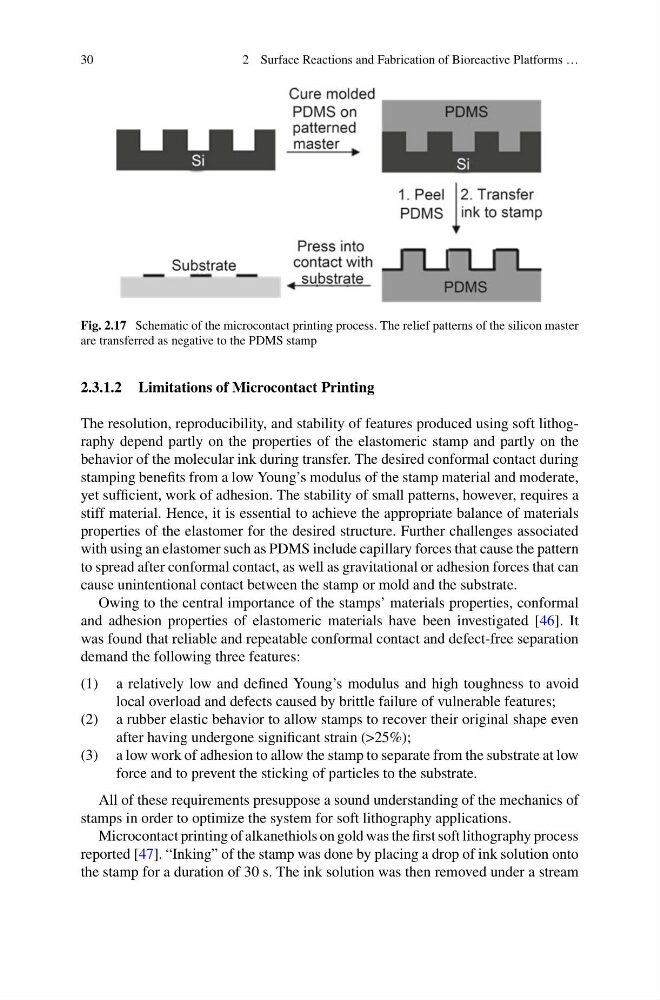
Fig. 2.17 Schematic of the microcontact printing process. The relief patterns of the silicon master
are transferred as negative to the PDMS stamp
2.3.1.2 Limitations of Microcontact Printing
The resolution, reproducibility, and stability of features produced using soft lithography depend partly on the properties of the elastomeric stamp and partly on the
behavior of the molecular ink during transfer. The desired conformal contact during
stamping benefits from a low Young’s modulus of the stamp material and moderate,
yet sufficient, work of adhesion. The stability of small patterns, however, requires a
stiff material. Hence, it is essential to achieve the appropriate balance of materials
properties of the elastomer for the desired structure. Further challenges associated
with using an elastomer such as PDMS include capillary forces that cause the pattern
to spread after conformal contact, as well as gravitational or adhesion forces that can
cause unintentional contact between the stamp or mold and the substrate.
Owing to the central importance of the stamps’ materials properties, conformal
and adhesion properties of elastomeric materials have been investigated [46]. It
was found that reliable and repeatable conformal contact and defect-free separation
demand the following three features:
(1) a relatively low and defined Young’s modulus and high toughness to avoid
local overload and defects caused by brittle failure of vulnerable features;
(2) a rubber elastic behavior to allow stamps to recover their original shape even
after having undergone significant strain (>25%);
(3) a low work of adhesion to allow the stamp to separate from the substrate at low
force and to prevent the sticking of particles to the substrate.
All of these requirements presuppose a sound understanding of the mechanics of
stamps in order to optimize the system for soft lithography applications.
Microcontact printing of alkanethiols on gold was the first soft lithography process
reported [47]. “Inking” of the stamp was done by placing a drop of ink solution onto
the stamp for a duration of 30 s. The ink solution was then removed under a stream
2 Surface Reactions and Fabrication of Bioreactive Platforms …
Fig. 2.17 Schematic of the microcontact printing process. The relief patterns of the silicon master
are transferred as negative to the PDMS stamp
2.3.1.2 Limitations of Microcontact Printing
The resolution, reproducibility, and stability of features produced using soft lithography depend partly on the properties of the elastomeric stamp and partly on the
behavior of the molecular ink during transfer. The desired conformal contact during
stamping benefits from a low Young’s modulus of the stamp material and moderate,
yet sufficient, work of adhesion. The stability of small patterns, however, requires a
stiff material. Hence, it is essential to achieve the appropriate balance of materials
properties of the elastomer for the desired structure. Further challenges associated
with using an elastomer such as PDMS include capillary forces that cause the pattern
to spread after conformal contact, as well as gravitational or adhesion forces that can
cause unintentional contact between the stamp or mold and the substrate.
Owing to the central importance of the stamps’ materials properties, conformal
and adhesion properties of elastomeric materials have been investigated [46]. It
was found that reliable and repeatable conformal contact and defect-free separation
demand the following three features:
(1) a relatively low and defined Young’s modulus and high toughness to avoid
local overload and defects caused by brittle failure of vulnerable features;
(2) a rubber elastic behavior to allow stamps to recover their original shape even
after having undergone significant strain (>25%);
(3) a low work of adhesion to allow the stamp to separate from the substrate at low
force and to prevent the sticking of particles to the substrate.
All of these requirements presuppose a sound understanding of the mechanics of
stamps in order to optimize the system for soft lithography applications.
Microcontact printing of alkanethiols on gold was the first soft lithography process
reported [47]. “Inking” of the stamp was done by placing a drop of ink solution onto
the stamp for a duration of 30 s. The ink solution was then removed under a stream