

2.2 Surface Reactions of Organic and Polymeric Films
17
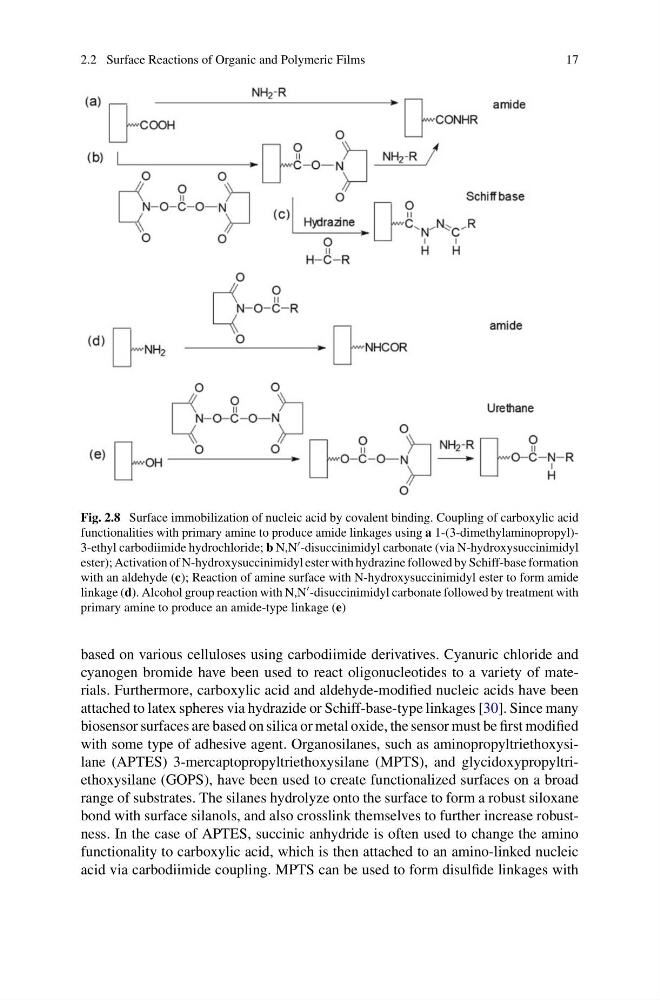
Fig. 2.8 Surface immobilization of nucleic acid by covalent binding. Coupling of carboxylic acid
functionalities with primary amine to produce amide linkages using a 1-(3-dimethylaminopropyl)3-ethyl carbodiimide hydrochloride; b N,N -disuccinimidyl carbonate (via N-hydroxysuccinimidyl
ester); Activation of N-hydroxysuccinimidyl ester with hydrazine followed by Schiff-base formation
with an aldehyde (c); Reaction of amine surface with N-hydroxysuccinimidyl ester to form amide
linkage (d). Alcohol group reaction with N,N -disuccinimidyl carbonate followed by treatment with
primary amine to produce an amide-type linkage (e)
based on various celluloses using carbodiimide derivatives. Cyanuric chloride and
cyanogen bromide have been used to react oligonucleotides to a variety of materials. Furthermore, carboxylic acid and aldehyde-modified nucleic acids have been
attached to latex spheres via hydrazide or Schiff-base-type linkages [30]. Since many
biosensor surfaces are based on silica or metal oxide, the sensor must be first modified
with some type of adhesive agent. Organosilanes, such as aminopropyltriethoxysilane (APTES) 3-mercaptopropyltriethoxysilane (MPTS), and glycidoxypropyltriethoxysilane (GOPS), have been used to create functionalized surfaces on a broad
range of substrates. The silanes hydrolyze onto the surface to form a robust siloxane
bond with surface silanols, and also crosslink themselves to further increase robustness. In the case of APTES, succinic anhydride is often used to change the amino
functionality to carboxylic acid, which is then attached to an amino-linked nucleic
acid via carbodiimide coupling. MPTS can be used to form disulfide linkages with
17
Fig. 2.8 Surface immobilization of nucleic acid by covalent binding. Coupling of carboxylic acid
functionalities with primary amine to produce amide linkages using a 1-(3-dimethylaminopropyl)3-ethyl carbodiimide hydrochloride; b N,N -disuccinimidyl carbonate (via N-hydroxysuccinimidyl
ester); Activation of N-hydroxysuccinimidyl ester with hydrazine followed by Schiff-base formation
with an aldehyde (c); Reaction of amine surface with N-hydroxysuccinimidyl ester to form amide
linkage (d). Alcohol group reaction with N,N -disuccinimidyl carbonate followed by treatment with
primary amine to produce an amide-type linkage (e)
based on various celluloses using carbodiimide derivatives. Cyanuric chloride and
cyanogen bromide have been used to react oligonucleotides to a variety of materials. Furthermore, carboxylic acid and aldehyde-modified nucleic acids have been
attached to latex spheres via hydrazide or Schiff-base-type linkages [30]. Since many
biosensor surfaces are based on silica or metal oxide, the sensor must be first modified
with some type of adhesive agent. Organosilanes, such as aminopropyltriethoxysilane (APTES) 3-mercaptopropyltriethoxysilane (MPTS), and glycidoxypropyltriethoxysilane (GOPS), have been used to create functionalized surfaces on a broad
range of substrates. The silanes hydrolyze onto the surface to form a robust siloxane
bond with surface silanols, and also crosslink themselves to further increase robustness. In the case of APTES, succinic anhydride is often used to change the amino
functionality to carboxylic acid, which is then attached to an amino-linked nucleic
acid via carbodiimide coupling. MPTS can be used to form disulfide linkages with