

18
2 Surface Reactions and Fabrication of Bioreactive Platforms …
thiol-containing biomolecules. GOPS has been employed in schemes using long
polyether chains to provide greater distance and flexibility between the surface and
the nucleic acid probe, which is very important for the preparation of biosensors.
Antibody Immobilization on SAMs: SAMs provide an unprecedented opportunity to engineer sensor surfaces with a wide spectrum of designed properties, in
particular by conjugating suitable antibodies or fragments thereof. This strategy
enables one to conveniently tune molecular recognition via structurally well-defined
functional assemblies and the control of functional groups density. Yu et al. have
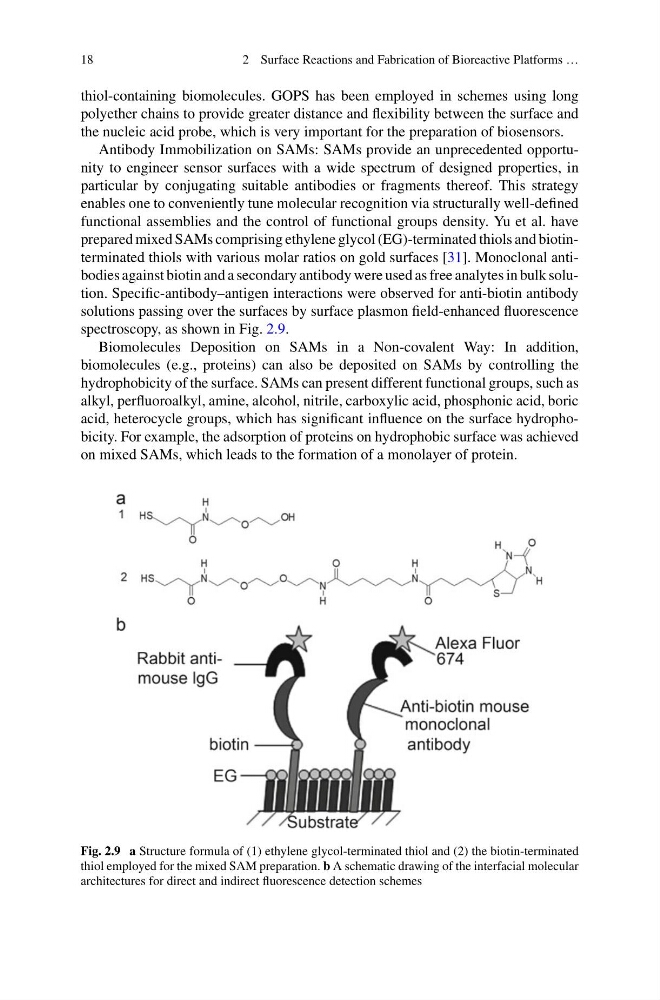
prepared mixed SAMs comprising ethylene glycol (EG)-terminated thiols and biotinterminated thiols with various molar ratios on gold surfaces [31]. Monoclonal antibodies against biotin and a secondary antibody were used as free analytes in bulk solution. Specific-antibody–antigen interactions were observed for anti-biotin antibody
solutions passing over the surfaces by surface plasmon field-enhanced fluorescence
spectroscopy, as shown in Fig. 2.9.
Biomolecules Deposition on SAMs in a Non-covalent Way: In addition,
biomolecules (e.g., proteins) can also be deposited on SAMs by controlling the
hydrophobicity of the surface. SAMs can present different functional groups, such as
alkyl, perfluoroalkyl, amine, alcohol, nitrile, carboxylic acid, phosphonic acid, boric
acid, heterocycle groups, which has significant influence on the surface hydrophobicity. For example, the adsorption of proteins on hydrophobic surface was achieved
on mixed SAMs, which leads to the formation of a monolayer of protein.
Fig. 2.9 a Structure formula of (1) ethylene glycol-terminated thiol and (2) the biotin-terminated
thiol employed for the mixed SAM preparation. b A schematic drawing of the interfacial molecular
architectures for direct and indirect fluorescence detection schemes
2 Surface Reactions and Fabrication of Bioreactive Platforms …
thiol-containing biomolecules. GOPS has been employed in schemes using long
polyether chains to provide greater distance and flexibility between the surface and
the nucleic acid probe, which is very important for the preparation of biosensors.
Antibody Immobilization on SAMs: SAMs provide an unprecedented opportunity to engineer sensor surfaces with a wide spectrum of designed properties, in
particular by conjugating suitable antibodies or fragments thereof. This strategy
enables one to conveniently tune molecular recognition via structurally well-defined
functional assemblies and the control of functional groups density. Yu et al. have
prepared mixed SAMs comprising ethylene glycol (EG)-terminated thiols and biotinterminated thiols with various molar ratios on gold surfaces [31]. Monoclonal antibodies against biotin and a secondary antibody were used as free analytes in bulk solution. Specific-antibody–antigen interactions were observed for anti-biotin antibody
solutions passing over the surfaces by surface plasmon field-enhanced fluorescence
spectroscopy, as shown in Fig. 2.9.
Biomolecules Deposition on SAMs in a Non-covalent Way: In addition,
biomolecules (e.g., proteins) can also be deposited on SAMs by controlling the
hydrophobicity of the surface. SAMs can present different functional groups, such as
alkyl, perfluoroalkyl, amine, alcohol, nitrile, carboxylic acid, phosphonic acid, boric
acid, heterocycle groups, which has significant influence on the surface hydrophobicity. For example, the adsorption of proteins on hydrophobic surface was achieved
on mixed SAMs, which leads to the formation of a monolayer of protein.
Fig. 2.9 a Structure formula of (1) ethylene glycol-terminated thiol and (2) the biotin-terminated
thiol employed for the mixed SAM preparation. b A schematic drawing of the interfacial molecular
architectures for direct and indirect fluorescence detection schemes