

10
2 Surface Reactions and Fabrication of Bioreactive Platforms …
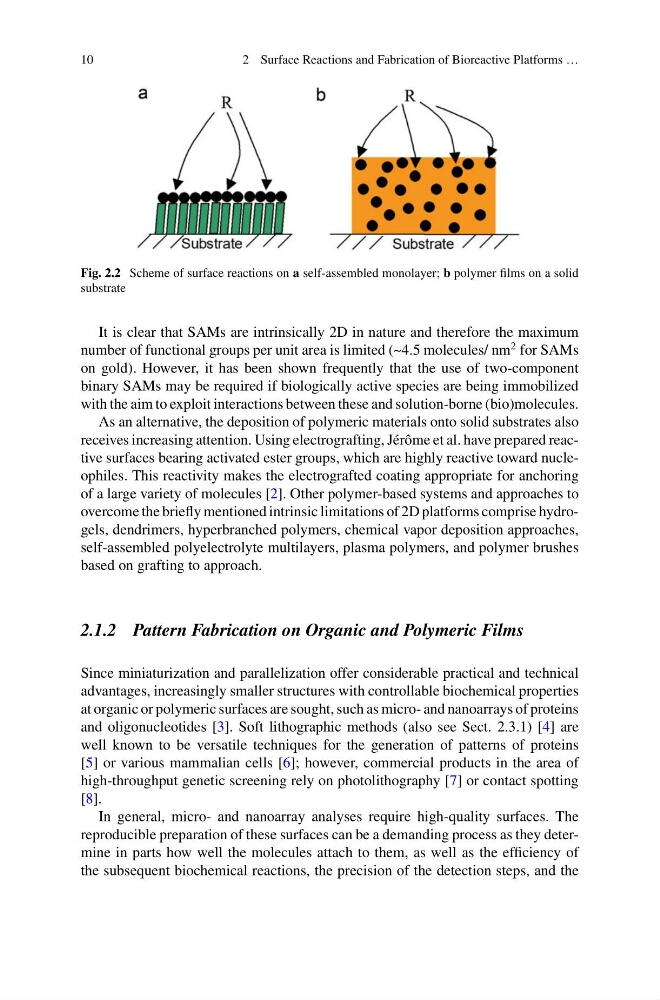
Fig. 2.2 Scheme of surface reactions on a self-assembled monolayer; b polymer films on a solid
substrate
It is clear that SAMs are intrinsically 2D in nature and therefore the maximum
number of functional groups per unit area is limited (~4.5 molecules/ nm
2 for SAMs
on gold). However, it has been shown frequently that the use of two-component
binary SAMs may be required if biologically active species are being immobilized
with the aim to exploit interactions between these and solution-borne (bio)molecules.
As an alternative, the deposition of polymeric materials onto solid substrates also
receives increasing attention. Using electrografting, Jérôme et al. have prepared reactive surfaces bearing activated ester groups, which are highly reactive toward nucleophiles. This reactivity makes the electrografted coating appropriate for anchoring
of a large variety of molecules [2]. Other polymer-based systems and approaches to
overcome the briefly mentioned intrinsic limitations of 2D platforms comprise hydrogels, dendrimers, hyperbranched polymers, chemical vapor deposition approaches,
self-assembled polyelectrolyte multilayers, plasma polymers, and polymer brushes
based on grafting to approach.
2.1.2 Pattern Fabrication on Organic and Polymeric Films
Since miniaturization and parallelization offer considerable practical and technical
advantages, increasingly smaller structures with controllable biochemical properties
at organic or polymeric surfaces are sought, such as micro- and nanoarrays of proteins
and oligonucleotides [3]. Soft lithographic methods (also see Sect. 2.3.1) [4] are
well known to be versatile techniques for the generation of patterns of proteins
[5] or various mammalian cells [6]; however, commercial products in the area of
high-throughput genetic screening rely on photolithography [7] or contact spotting
[8].
In general, micro- and nanoarray analyses require high-quality surfaces. The
reproducible preparation of these surfaces can be a demanding process as they determine in parts how well the molecules attach to them, as well as the efficiency of
the subsequent biochemical reactions, the precision of the detection steps, and the
2 Surface Reactions and Fabrication of Bioreactive Platforms …
Fig. 2.2 Scheme of surface reactions on a self-assembled monolayer; b polymer films on a solid
substrate
It is clear that SAMs are intrinsically 2D in nature and therefore the maximum
number of functional groups per unit area is limited (~4.5 molecules/ nm
2 for SAMs
on gold). However, it has been shown frequently that the use of two-component
binary SAMs may be required if biologically active species are being immobilized
with the aim to exploit interactions between these and solution-borne (bio)molecules.
As an alternative, the deposition of polymeric materials onto solid substrates also
receives increasing attention. Using electrografting, Jérôme et al. have prepared reactive surfaces bearing activated ester groups, which are highly reactive toward nucleophiles. This reactivity makes the electrografted coating appropriate for anchoring
of a large variety of molecules [2]. Other polymer-based systems and approaches to
overcome the briefly mentioned intrinsic limitations of 2D platforms comprise hydrogels, dendrimers, hyperbranched polymers, chemical vapor deposition approaches,
self-assembled polyelectrolyte multilayers, plasma polymers, and polymer brushes
based on grafting to approach.
2.1.2 Pattern Fabrication on Organic and Polymeric Films
Since miniaturization and parallelization offer considerable practical and technical
advantages, increasingly smaller structures with controllable biochemical properties
at organic or polymeric surfaces are sought, such as micro- and nanoarrays of proteins
and oligonucleotides [3]. Soft lithographic methods (also see Sect. 2.3.1) [4] are
well known to be versatile techniques for the generation of patterns of proteins
[5] or various mammalian cells [6]; however, commercial products in the area of
high-throughput genetic screening rely on photolithography [7] or contact spotting
[8].
In general, micro- and nanoarray analyses require high-quality surfaces. The
reproducible preparation of these surfaces can be a demanding process as they determine in parts how well the molecules attach to them, as well as the efficiency of
the subsequent biochemical reactions, the precision of the detection steps, and the