

2.1 Introduction: Bioreactive Platforms and Biointerfaces via Organic …
11
quality of the resulting data. In studies of cell biology and implant–host response,
a detailed understanding of how surface structures of biomaterials translate into
specific cellular responses [9] is another important area of investigation that benefits from well-defined patterns containing biological functionality at length scales
comparable to those of substructures present on the surfaces of cells, i.e., from the
micrometer to the sub-100 nm range.
As mentioned, the spatially controlled deposition of proteins and other
biomolecules on reactive substrates on the nanometer scale is critical for basic biological research involving cell biology [10] and for a number of applications, such
as high-throughput genomic arrays (e.g., microarrays) and combinatorial library
screening [11]. Genomic arrays comprise ordered array of elements on a planar
substrate on the scale of 10–100 μm, which allows the specific binding of genes
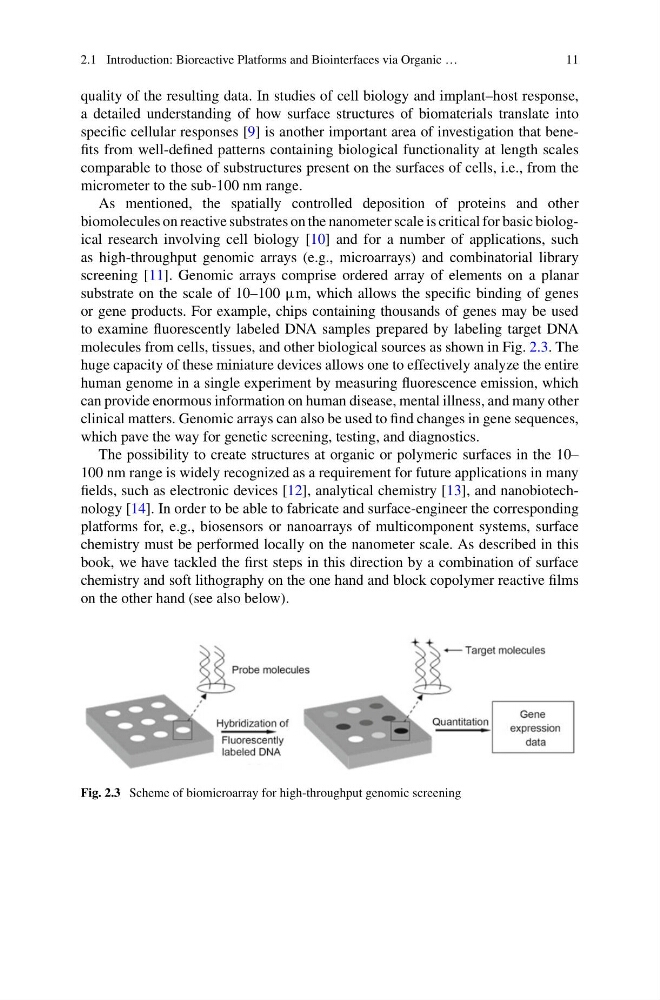
or gene products. For example, chips containing thousands of genes may be used
to examine fluorescently labeled DNA samples prepared by labeling target DNA
molecules from cells, tissues, and other biological sources as shown in Fig. 2.3. The
huge capacity of these miniature devices allows one to effectively analyze the entire
human genome in a single experiment by measuring fluorescence emission, which
can provide enormous information on human disease, mental illness, and many other
clinical matters. Genomic arrays can also be used to find changes in gene sequences,
which pave the way for genetic screening, testing, and diagnostics.
The possibility to create structures at organic or polymeric surfaces in the 10–
100 nm range is widely recognized as a requirement for future applications in many
fields, such as electronic devices [12], analytical chemistry [13], and nanobiotechnology [14]. In order to be able to fabricate and surface-engineer the corresponding
platforms for, e.g., biosensors or nanoarrays of multicomponent systems, surface
chemistry must be performed locally on the nanometer scale. As described in this
book, we have tackled the first steps in this direction by a combination of surface
chemistry and soft lithography on the one hand and block copolymer reactive films
on the other hand (see also below).
Fig. 2.3 Scheme of biomicroarray for high-throughput genomic screening
11
quality of the resulting data. In studies of cell biology and implant–host response,
a detailed understanding of how surface structures of biomaterials translate into
specific cellular responses [9] is another important area of investigation that benefits from well-defined patterns containing biological functionality at length scales
comparable to those of substructures present on the surfaces of cells, i.e., from the
micrometer to the sub-100 nm range.
As mentioned, the spatially controlled deposition of proteins and other
biomolecules on reactive substrates on the nanometer scale is critical for basic biological research involving cell biology [10] and for a number of applications, such
as high-throughput genomic arrays (e.g., microarrays) and combinatorial library
screening [11]. Genomic arrays comprise ordered array of elements on a planar
substrate on the scale of 10–100 μm, which allows the specific binding of genes
or gene products. For example, chips containing thousands of genes may be used
to examine fluorescently labeled DNA samples prepared by labeling target DNA
molecules from cells, tissues, and other biological sources as shown in Fig. 2.3. The
huge capacity of these miniature devices allows one to effectively analyze the entire
human genome in a single experiment by measuring fluorescence emission, which
can provide enormous information on human disease, mental illness, and many other
clinical matters. Genomic arrays can also be used to find changes in gene sequences,
which pave the way for genetic screening, testing, and diagnostics.
The possibility to create structures at organic or polymeric surfaces in the 10–
100 nm range is widely recognized as a requirement for future applications in many
fields, such as electronic devices [12], analytical chemistry [13], and nanobiotechnology [14]. In order to be able to fabricate and surface-engineer the corresponding
platforms for, e.g., biosensors or nanoarrays of multicomponent systems, surface
chemistry must be performed locally on the nanometer scale. As described in this
book, we have tackled the first steps in this direction by a combination of surface
chemistry and soft lithography on the one hand and block copolymer reactive films
on the other hand (see also below).
Fig. 2.3 Scheme of biomicroarray for high-throughput genomic screening