

2.1 Introduction: Bioreactive Platforms and Biointerfaces via Organic …
9
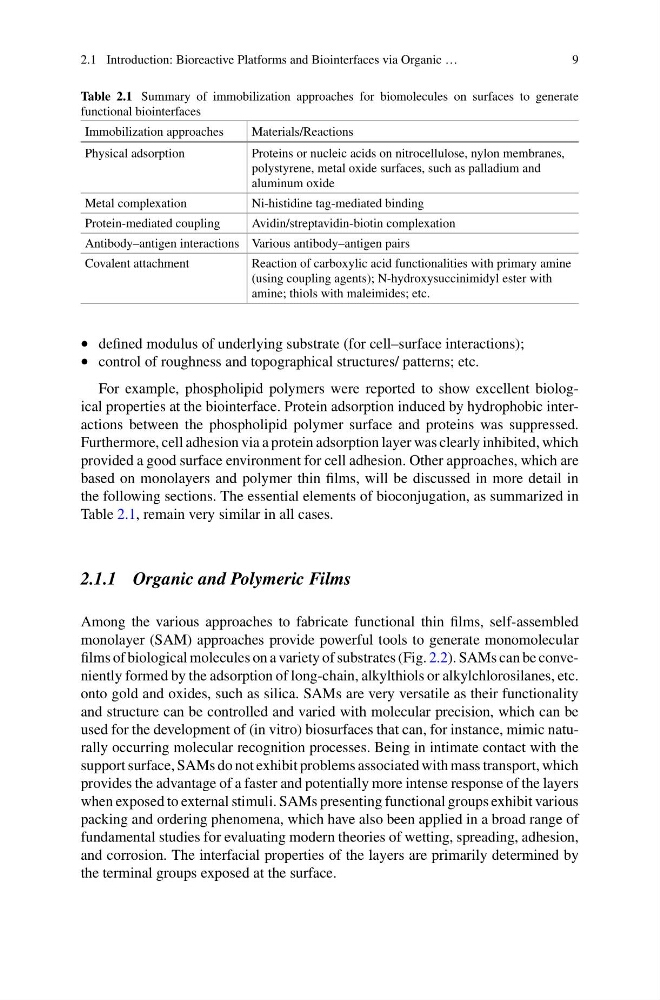
Table 2.1 Summary of immobilization approaches for biomolecules on surfaces to generate
functional biointerfaces
Immobilization approaches
Materials/Reactions
Physical adsorption
Proteins or nucleic acids on nitrocellulose, nylon membranes,
polystyrene, metal oxide surfaces, such as palladium and
aluminum oxide
Metal complexation
Ni-histidine tag-mediated binding
Protein-mediated coupling
Avidin/streptavidin-biotin complexation
Antibody–antigen interactions Various antibody–antigen pairs
Covalent attachment
Reaction of carboxylic acid functionalities with primary amine
(using coupling agents); N-hydroxysuccinimidyl ester with
amine; thiols with maleimides; etc.
• defined modulus of underlying substrate (for cell–surface interactions);
• control of roughness and topographical structures/ patterns; etc.
For example, phospholipid polymers were reported to show excellent biological properties at the biointerface. Protein adsorption induced by hydrophobic interactions between the phospholipid polymer surface and proteins was suppressed.
Furthermore, cell adhesion via a protein adsorption layer was clearly inhibited, which
provided a good surface environment for cell adhesion. Other approaches, which are
based on monolayers and polymer thin films, will be discussed in more detail in
the following sections. The essential elements of bioconjugation, as summarized in
Table 2.1, remain very similar in all cases.
2.1.1 Organic and Polymeric Films
Among the various approaches to fabricate functional thin films, self-assembled
monolayer (SAM) approaches provide powerful tools to generate monomolecular
films of biological molecules on a variety of substrates (Fig. 2.2). SAMs can be conveniently formed by the adsorption of long-chain, alkylthiols or alkylchlorosilanes, etc.
onto gold and oxides, such as silica. SAMs are very versatile as their functionality
and structure can be controlled and varied with molecular precision, which can be
used for the development of (in vitro) biosurfaces that can, for instance, mimic naturally occurring molecular recognition processes. Being in intimate contact with the
support surface, SAMs do not exhibit problems associated with mass transport, which
provides the advantage of a faster and potentially more intense response of the layers
when exposed to external stimuli. SAMs presenting functional groups exhibit various
packing and ordering phenomena, which have also been applied in a broad range of
fundamental studies for evaluating modern theories of wetting, spreading, adhesion,
and corrosion. The interfacial properties of the layers are primarily determined by
the terminal groups exposed at the surface.
9
Table 2.1 Summary of immobilization approaches for biomolecules on surfaces to generate
functional biointerfaces
Immobilization approaches
Materials/Reactions
Physical adsorption
Proteins or nucleic acids on nitrocellulose, nylon membranes,
polystyrene, metal oxide surfaces, such as palladium and
aluminum oxide
Metal complexation
Ni-histidine tag-mediated binding
Protein-mediated coupling
Avidin/streptavidin-biotin complexation
Antibody–antigen interactions Various antibody–antigen pairs
Covalent attachment
Reaction of carboxylic acid functionalities with primary amine
(using coupling agents); N-hydroxysuccinimidyl ester with
amine; thiols with maleimides; etc.
• defined modulus of underlying substrate (for cell–surface interactions);
• control of roughness and topographical structures/ patterns; etc.
For example, phospholipid polymers were reported to show excellent biological properties at the biointerface. Protein adsorption induced by hydrophobic interactions between the phospholipid polymer surface and proteins was suppressed.
Furthermore, cell adhesion via a protein adsorption layer was clearly inhibited, which
provided a good surface environment for cell adhesion. Other approaches, which are
based on monolayers and polymer thin films, will be discussed in more detail in
the following sections. The essential elements of bioconjugation, as summarized in
Table 2.1, remain very similar in all cases.
2.1.1 Organic and Polymeric Films
Among the various approaches to fabricate functional thin films, self-assembled
monolayer (SAM) approaches provide powerful tools to generate monomolecular
films of biological molecules on a variety of substrates (Fig. 2.2). SAMs can be conveniently formed by the adsorption of long-chain, alkylthiols or alkylchlorosilanes, etc.
onto gold and oxides, such as silica. SAMs are very versatile as their functionality
and structure can be controlled and varied with molecular precision, which can be
used for the development of (in vitro) biosurfaces that can, for instance, mimic naturally occurring molecular recognition processes. Being in intimate contact with the
support surface, SAMs do not exhibit problems associated with mass transport, which
provides the advantage of a faster and potentially more intense response of the layers
when exposed to external stimuli. SAMs presenting functional groups exhibit various
packing and ordering phenomena, which have also been applied in a broad range of
fundamental studies for evaluating modern theories of wetting, spreading, adhesion,
and corrosion. The interfacial properties of the layers are primarily determined by
the terminal groups exposed at the surface.