

8
2 Surface Reactions and Fabrication of Bioreactive Platforms …
and self-assembled films, can be distinctively different from reactions occurring in
solution. Very often reaction rates are found to be reduced. Only in isolated cases
enhanced rates have been reported. These observations can be attributed to confinement effects in the ultrathin organic films because the functional groups or molecules
involved in these reactions are packed densely at the surface. Steric effects, among
others, may therefore result in higher apparent energy barriers than found in solution.
A diversity of organic or polymeric surfaces has been investigated as biofunctional
interfacial architectures for their use as affinity coatings in genomics, proteomics,
and biosensors for biomedical purposes [1]. With respect to the structural and functional properties of the organic or polymeric films surface, biomimetic films can
be constructed such as so-called tethered bilayer membranes, which can mimic a
biomembrane to the extent that functional units, e.g., membrane channels or receptors can be incorporated as mono or multilayers, or in the form of thin (polymeric)
films. These different surface coatings allow, e.g., for the construction of microarrays
for the fabrication of gene and protein chips.
Organic or polymeric surfaces can also be designed to serve as biointerfaces
between the biological environment and man-made materials, which is central to
biology and medicine and crucial in research relating to implants, biosensors, drug
delivery, proteomics, and many other fields. In particular, biointerfaces play an
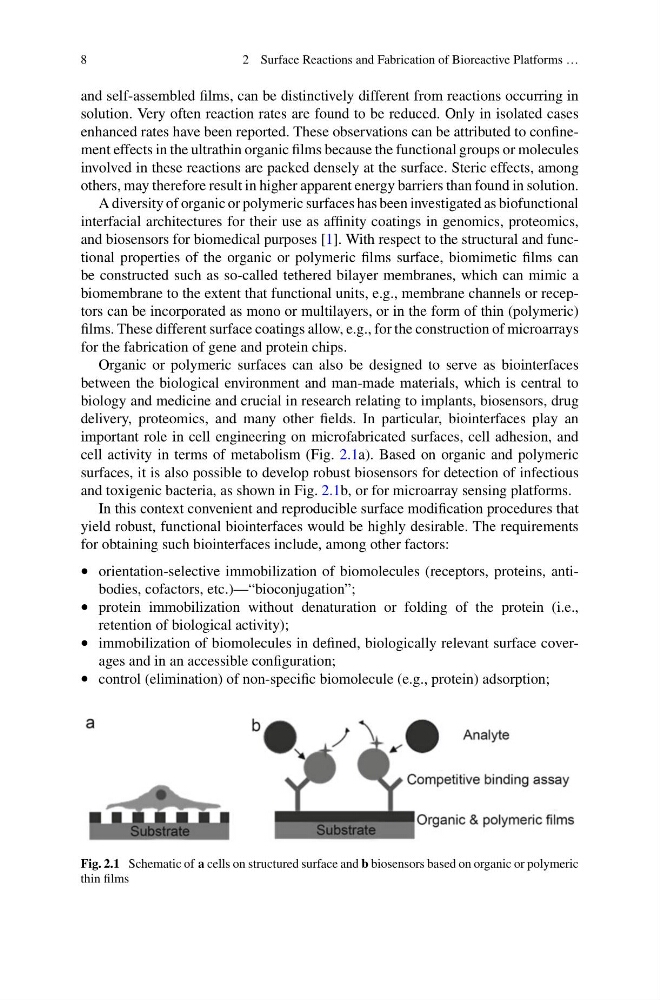
important role in cell engineering on microfabricated surfaces, cell adhesion, and
cell activity in terms of metabolism (Fig. 2.1a). Based on organic and polymeric
surfaces, it is also possible to develop robust biosensors for detection of infectious
and toxigenic bacteria, as shown in Fig. 2.1b, or for microarray sensing platforms.
In this context convenient and reproducible surface modification procedures that
yield robust, functional biointerfaces would be highly desirable. The requirements
for obtaining such biointerfaces include, among other factors:
• orientation-selective immobilization of biomolecules (receptors, proteins, antibodies, cofactors, etc.)—“bioconjugation”;
• protein immobilization without denaturation or folding of the protein (i.e.,
retention of biological activity);
• immobilization of biomolecules in defined, biologically relevant surface coverages and in an accessible configuration;
• control (elimination) of non-specific biomolecule (e.g., protein) adsorption;
Fig. 2.1 Schematic of a cells on structured surface and b biosensors based on organic or polymeric
thin films
2 Surface Reactions and Fabrication of Bioreactive Platforms …
and self-assembled films, can be distinctively different from reactions occurring in
solution. Very often reaction rates are found to be reduced. Only in isolated cases
enhanced rates have been reported. These observations can be attributed to confinement effects in the ultrathin organic films because the functional groups or molecules
involved in these reactions are packed densely at the surface. Steric effects, among
others, may therefore result in higher apparent energy barriers than found in solution.
A diversity of organic or polymeric surfaces has been investigated as biofunctional
interfacial architectures for their use as affinity coatings in genomics, proteomics,
and biosensors for biomedical purposes [1]. With respect to the structural and functional properties of the organic or polymeric films surface, biomimetic films can
be constructed such as so-called tethered bilayer membranes, which can mimic a
biomembrane to the extent that functional units, e.g., membrane channels or receptors can be incorporated as mono or multilayers, or in the form of thin (polymeric)
films. These different surface coatings allow, e.g., for the construction of microarrays
for the fabrication of gene and protein chips.
Organic or polymeric surfaces can also be designed to serve as biointerfaces
between the biological environment and man-made materials, which is central to
biology and medicine and crucial in research relating to implants, biosensors, drug
delivery, proteomics, and many other fields. In particular, biointerfaces play an
important role in cell engineering on microfabricated surfaces, cell adhesion, and
cell activity in terms of metabolism (Fig. 2.1a). Based on organic and polymeric
surfaces, it is also possible to develop robust biosensors for detection of infectious
and toxigenic bacteria, as shown in Fig. 2.1b, or for microarray sensing platforms.
In this context convenient and reproducible surface modification procedures that
yield robust, functional biointerfaces would be highly desirable. The requirements
for obtaining such biointerfaces include, among other factors:
• orientation-selective immobilization of biomolecules (receptors, proteins, antibodies, cofactors, etc.)—“bioconjugation”;
• protein immobilization without denaturation or folding of the protein (i.e.,
retention of biological activity);
• immobilization of biomolecules in defined, biologically relevant surface coverages and in an accessible configuration;
• control (elimination) of non-specific biomolecule (e.g., protein) adsorption;
Fig. 2.1 Schematic of a cells on structured surface and b biosensors based on organic or polymeric
thin films