

178
9 Bioinspired Hierarchically Structured Polymer Interfaces …
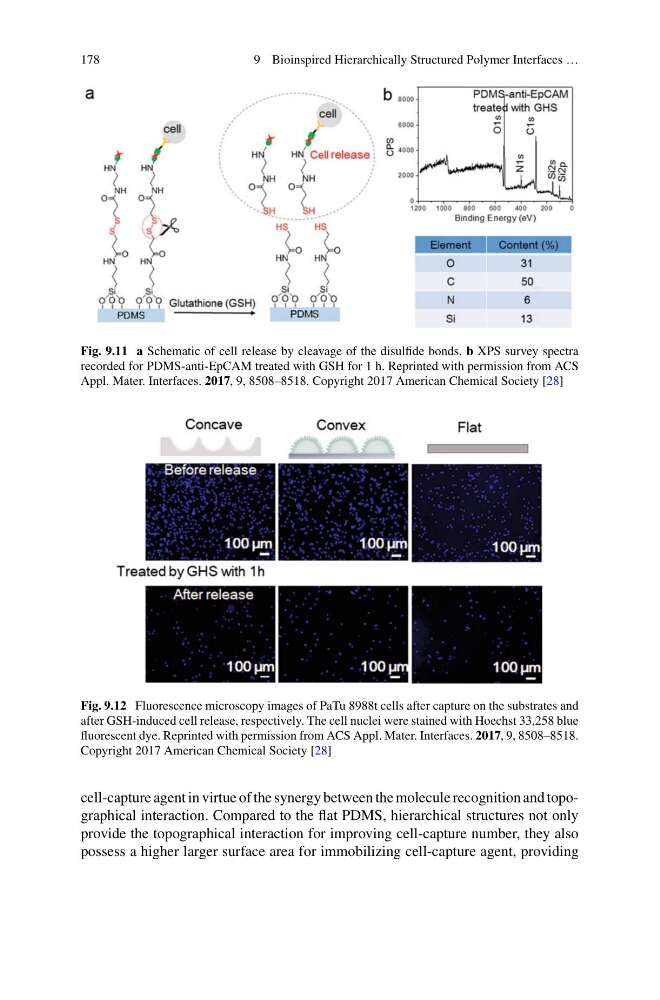
Fig. 9.11 a Schematic of cell release by cleavage of the disulfide bonds. b XPS survey spectra
recorded for PDMS-anti-EpCAM treated with GSH for 1 h. Reprinted with permission from ACS
Appl. Mater. Interfaces. 2017, 9, 8508–8518. Copyright 2017 American Chemical Society [28]
Fig. 9.12 Fluorescence microscopy images of PaTu 8988t cells after capture on the substrates and
after GSH-induced cell release, respectively. The cell nuclei were stained with Hoechst 33,258 blue
fluorescent dye. Reprinted with permission from ACS Appl. Mater. Interfaces. 2017, 9, 8508–8518.
Copyright 2017 American Chemical Society [28]
cell-capture agent in virtue of the synergy between the molecule recognition and topographical interaction. Compared to the flat PDMS, hierarchical structures not only
provide the topographical interaction for improving cell-capture number, they also
possess a higher larger surface area for immobilizing cell-capture agent, providing
9 Bioinspired Hierarchically Structured Polymer Interfaces …
Fig. 9.11 a Schematic of cell release by cleavage of the disulfide bonds. b XPS survey spectra
recorded for PDMS-anti-EpCAM treated with GSH for 1 h. Reprinted with permission from ACS
Appl. Mater. Interfaces. 2017, 9, 8508–8518. Copyright 2017 American Chemical Society [28]
Fig. 9.12 Fluorescence microscopy images of PaTu 8988t cells after capture on the substrates and
after GSH-induced cell release, respectively. The cell nuclei were stained with Hoechst 33,258 blue
fluorescent dye. Reprinted with permission from ACS Appl. Mater. Interfaces. 2017, 9, 8508–8518.
Copyright 2017 American Chemical Society [28]
cell-capture agent in virtue of the synergy between the molecule recognition and topographical interaction. Compared to the flat PDMS, hierarchical structures not only
provide the topographical interaction for improving cell-capture number, they also
possess a higher larger surface area for immobilizing cell-capture agent, providing