

176
9 Bioinspired Hierarchically Structured Polymer Interfaces …
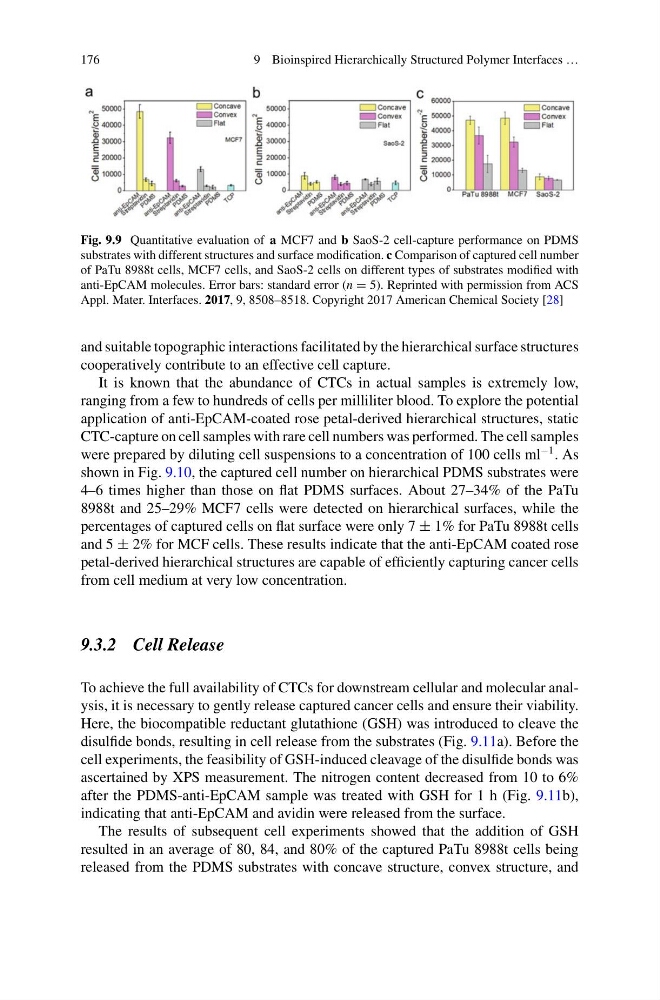
Fig. 9.9 Quantitative evaluation of a MCF7 and b SaoS-2 cell-capture performance on PDMS
substrates with different structures and surface modification. c Comparison of captured cell number
of PaTu 8988t cells, MCF7 cells, and SaoS-2 cells on different types of substrates modified with
anti-EpCAM molecules. Error bars: standard error (n = 5). Reprinted with permission from ACS
Appl. Mater. Interfaces. 2017, 9, 8508–8518. Copyright 2017 American Chemical Society [28]
and suitable topographic interactions facilitated by the hierarchical surface structures
cooperatively contribute to an effective cell capture.
It is known that the abundance of CTCs in actual samples is extremely low,
ranging from a few to hundreds of cells per milliliter blood. To explore the potential
application of anti-EpCAM-coated rose petal-derived hierarchical structures, static
CTC-capture on cell samples with rare cell numbers was performed. The cell samples
were prepared by diluting cell suspensions to a concentration of 100 cells ml
−1 . As
shown in Fig. 9.10, the captured cell number on hierarchical PDMS substrates were
4–6 times higher than those on flat PDMS surfaces. About 27–34% of the PaTu
8988t and 25–29% MCF7 cells were detected on hierarchical surfaces, while the
percentages of captured cells on flat surface were only 7 ± 1% for PaTu 8988t cells
and 5 ± 2% for MCF cells. These results indicate that the anti-EpCAM coated rose
petal-derived hierarchical structures are capable of efficiently capturing cancer cells
from cell medium at very low concentration.
9.3.2 Cell Release
To achieve the full availability of CTCs for downstream cellular and molecular analysis, it is necessary to gently release captured cancer cells and ensure their viability.
Here, the biocompatible reductant glutathione (GSH) was introduced to cleave the
disulfide bonds, resulting in cell release from the substrates (Fig. 9.11a). Before the
cell experiments, the feasibility of GSH-induced cleavage of the disulfide bonds was
ascertained by XPS measurement. The nitrogen content decreased from 10 to 6%
after the PDMS-anti-EpCAM sample was treated with GSH for 1 h (Fig. 9.11b),
indicating that anti-EpCAM and avidin were released from the surface.
The results of subsequent cell experiments showed that the addition of GSH
resulted in an average of 80, 84, and 80% of the captured PaTu 8988t cells being
released from the PDMS substrates with concave structure, convex structure, and
9 Bioinspired Hierarchically Structured Polymer Interfaces …
Fig. 9.9 Quantitative evaluation of a MCF7 and b SaoS-2 cell-capture performance on PDMS
substrates with different structures and surface modification. c Comparison of captured cell number
of PaTu 8988t cells, MCF7 cells, and SaoS-2 cells on different types of substrates modified with
anti-EpCAM molecules. Error bars: standard error (n = 5). Reprinted with permission from ACS
Appl. Mater. Interfaces. 2017, 9, 8508–8518. Copyright 2017 American Chemical Society [28]
and suitable topographic interactions facilitated by the hierarchical surface structures
cooperatively contribute to an effective cell capture.
It is known that the abundance of CTCs in actual samples is extremely low,
ranging from a few to hundreds of cells per milliliter blood. To explore the potential
application of anti-EpCAM-coated rose petal-derived hierarchical structures, static
CTC-capture on cell samples with rare cell numbers was performed. The cell samples
were prepared by diluting cell suspensions to a concentration of 100 cells ml
−1 . As
shown in Fig. 9.10, the captured cell number on hierarchical PDMS substrates were
4–6 times higher than those on flat PDMS surfaces. About 27–34% of the PaTu
8988t and 25–29% MCF7 cells were detected on hierarchical surfaces, while the
percentages of captured cells on flat surface were only 7 ± 1% for PaTu 8988t cells
and 5 ± 2% for MCF cells. These results indicate that the anti-EpCAM coated rose
petal-derived hierarchical structures are capable of efficiently capturing cancer cells
from cell medium at very low concentration.
9.3.2 Cell Release
To achieve the full availability of CTCs for downstream cellular and molecular analysis, it is necessary to gently release captured cancer cells and ensure their viability.
Here, the biocompatible reductant glutathione (GSH) was introduced to cleave the
disulfide bonds, resulting in cell release from the substrates (Fig. 9.11a). Before the
cell experiments, the feasibility of GSH-induced cleavage of the disulfide bonds was
ascertained by XPS measurement. The nitrogen content decreased from 10 to 6%
after the PDMS-anti-EpCAM sample was treated with GSH for 1 h (Fig. 9.11b),
indicating that anti-EpCAM and avidin were released from the surface.
The results of subsequent cell experiments showed that the addition of GSH
resulted in an average of 80, 84, and 80% of the captured PaTu 8988t cells being
released from the PDMS substrates with concave structure, convex structure, and