

170
9 Bioinspired Hierarchically Structured Polymer Interfaces …
9.2.2 Chemical Modification of Anti-EpCAM
on Hierarchically Structured PDMS Surface
Prior to the surface modification, the PDMS substrates were treated with O 2 plasma
(Plasma Prep2, Gala, Gabler Labor Instrumente GmbH, Germany) for 3 min. The
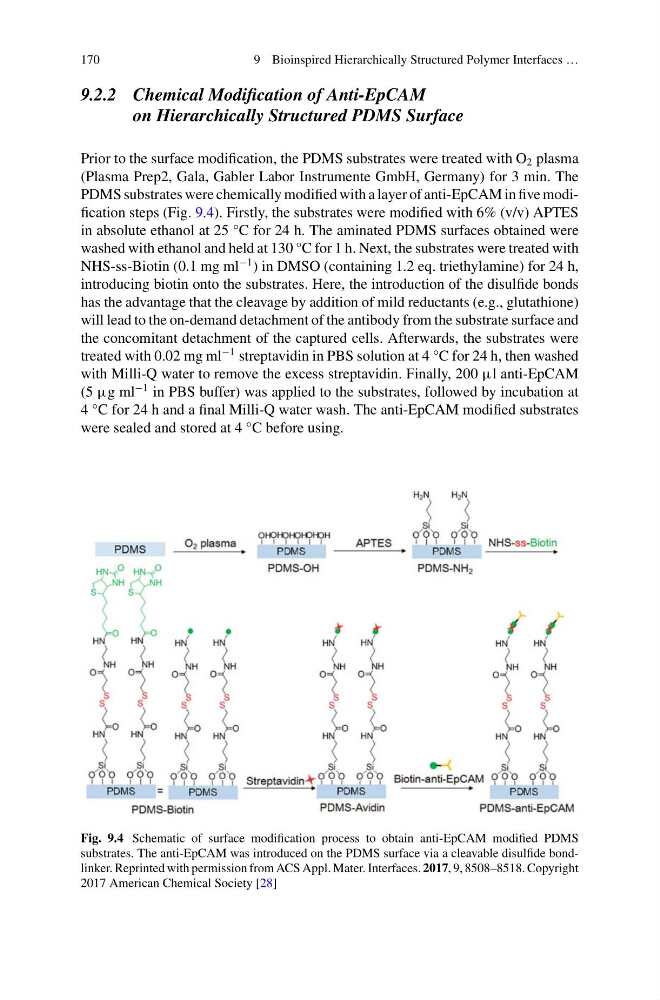
PDMS substrates were chemically modified with a layer of anti-EpCAM in five modification steps (Fig. 9.4). Firstly, the substrates were modified with 6% (v/v) APTES
in absolute ethanol at 25 °C for 24 h. The aminated PDMS surfaces obtained were
washed with ethanol and held at 130 °C for 1 h. Next, the substrates were treated with
NHS-ss-Biotin (0.1 mg ml
−1 ) in DMSO (containing 1.2 eq. triethylamine) for 24 h,
introducing biotin onto the substrates. Here, the introduction of the disulfide bonds
has the advantage that the cleavage by addition of mild reductants (e.g., glutathione)
will lead to the on-demand detachment of the antibody from the substrate surface and
the concomitant detachment of the captured cells. Afterwards, the substrates were
treated with 0.02 mg ml
−1 streptavidin in PBS solution at 4 °C for 24 h, then washed
with Milli-Q water to remove the excess streptavidin. Finally, 200 μl anti-EpCAM
(5 μg ml
−1 in PBS buffer) was applied to the substrates, followed by incubation at
4 °C for 24 h and a final Milli-Q water wash. The anti-EpCAM modified substrates
were sealed and stored at 4 °C before using.
Fig. 9.4 Schematic of surface modification process to obtain anti-EpCAM modified PDMS
substrates. The anti-EpCAM was introduced on the PDMS surface via a cleavable disulfide bondlinker. Reprinted with permission from ACS Appl. Mater. Interfaces. 2017, 9, 8508–8518. Copyright
2017 American Chemical Society [28]
9 Bioinspired Hierarchically Structured Polymer Interfaces …
9.2.2 Chemical Modification of Anti-EpCAM
on Hierarchically Structured PDMS Surface
Prior to the surface modification, the PDMS substrates were treated with O 2 plasma
(Plasma Prep2, Gala, Gabler Labor Instrumente GmbH, Germany) for 3 min. The
PDMS substrates were chemically modified with a layer of anti-EpCAM in five modification steps (Fig. 9.4). Firstly, the substrates were modified with 6% (v/v) APTES
in absolute ethanol at 25 °C for 24 h. The aminated PDMS surfaces obtained were
washed with ethanol and held at 130 °C for 1 h. Next, the substrates were treated with
NHS-ss-Biotin (0.1 mg ml
−1 ) in DMSO (containing 1.2 eq. triethylamine) for 24 h,
introducing biotin onto the substrates. Here, the introduction of the disulfide bonds
has the advantage that the cleavage by addition of mild reductants (e.g., glutathione)
will lead to the on-demand detachment of the antibody from the substrate surface and
the concomitant detachment of the captured cells. Afterwards, the substrates were
treated with 0.02 mg ml
−1 streptavidin in PBS solution at 4 °C for 24 h, then washed
with Milli-Q water to remove the excess streptavidin. Finally, 200 μl anti-EpCAM
(5 μg ml
−1 in PBS buffer) was applied to the substrates, followed by incubation at
4 °C for 24 h and a final Milli-Q water wash. The anti-EpCAM modified substrates
were sealed and stored at 4 °C before using.
Fig. 9.4 Schematic of surface modification process to obtain anti-EpCAM modified PDMS
substrates. The anti-EpCAM was introduced on the PDMS surface via a cleavable disulfide bondlinker. Reprinted with permission from ACS Appl. Mater. Interfaces. 2017, 9, 8508–8518. Copyright
2017 American Chemical Society [28]