

7.4 Strategy C: Local Deprotection of PS 690 -b-PtBA 1210 Films
141
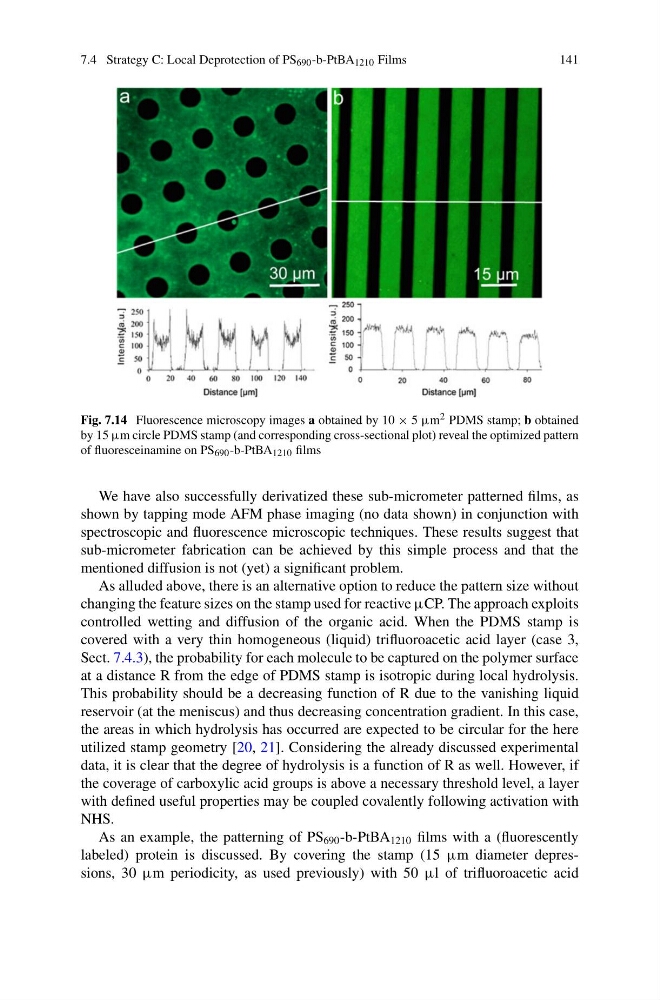
Fig. 7.14 Fluorescence microscopy images a obtained by 10 × 5 μm 2 PDMS stamp; b obtained
by 15 μm circle PDMS stamp (and corresponding cross-sectional plot) reveal the optimized pattern
of fluoresceinamine on PS 690 -b-PtBA 1210 films
We have also successfully derivatized these sub-micrometer patterned films, as
shown by tapping mode AFM phase imaging (no data shown) in conjunction with
spectroscopic and fluorescence microscopic techniques. These results suggest that
sub-micrometer fabrication can be achieved by this simple process and that the
mentioned diffusion is not (yet) a significant problem.
As alluded above, there is an alternative option to reduce the pattern size without
changing the feature sizes on the stamp used for reactive μCP. The approach exploits
controlled wetting and diffusion of the organic acid. When the PDMS stamp is
covered with a very thin homogeneous (liquid) trifluoroacetic acid layer (case 3,
Sect. 7.4.3), the probability for each molecule to be captured on the polymer surface
at a distance R from the edge of PDMS stamp is isotropic during local hydrolysis.
This probability should be a decreasing function of R due to the vanishing liquid
reservoir (at the meniscus) and thus decreasing concentration gradient. In this case,
the areas in which hydrolysis has occurred are expected to be circular for the here
utilized stamp geometry [20, 21]. Considering the already discussed experimental
data, it is clear that the degree of hydrolysis is a function of R as well. However, if
the coverage of carboxylic acid groups is above a necessary threshold level, a layer
with defined useful properties may be coupled covalently following activation with
NHS.
As an example, the patterning of PS 690 -b-PtBA 1210 films with a (fluorescently
labeled) protein is discussed. By covering the stamp (15 μm diameter depressions, 30 μm periodicity, as used previously) with 50 μl of trifluoroacetic acid
141
Fig. 7.14 Fluorescence microscopy images a obtained by 10 × 5 μm 2 PDMS stamp; b obtained
by 15 μm circle PDMS stamp (and corresponding cross-sectional plot) reveal the optimized pattern
of fluoresceinamine on PS 690 -b-PtBA 1210 films
We have also successfully derivatized these sub-micrometer patterned films, as
shown by tapping mode AFM phase imaging (no data shown) in conjunction with
spectroscopic and fluorescence microscopic techniques. These results suggest that
sub-micrometer fabrication can be achieved by this simple process and that the
mentioned diffusion is not (yet) a significant problem.
As alluded above, there is an alternative option to reduce the pattern size without
changing the feature sizes on the stamp used for reactive μCP. The approach exploits
controlled wetting and diffusion of the organic acid. When the PDMS stamp is
covered with a very thin homogeneous (liquid) trifluoroacetic acid layer (case 3,
Sect. 7.4.3), the probability for each molecule to be captured on the polymer surface
at a distance R from the edge of PDMS stamp is isotropic during local hydrolysis.
This probability should be a decreasing function of R due to the vanishing liquid
reservoir (at the meniscus) and thus decreasing concentration gradient. In this case,
the areas in which hydrolysis has occurred are expected to be circular for the here
utilized stamp geometry [20, 21]. Considering the already discussed experimental
data, it is clear that the degree of hydrolysis is a function of R as well. However, if
the coverage of carboxylic acid groups is above a necessary threshold level, a layer
with defined useful properties may be coupled covalently following activation with
NHS.
As an example, the patterning of PS 690 -b-PtBA 1210 films with a (fluorescently
labeled) protein is discussed. By covering the stamp (15 μm diameter depressions, 30 μm periodicity, as used previously) with 50 μl of trifluoroacetic acid