

140
7 Reactive μCP on Ultrathin Block Copolymer Films …
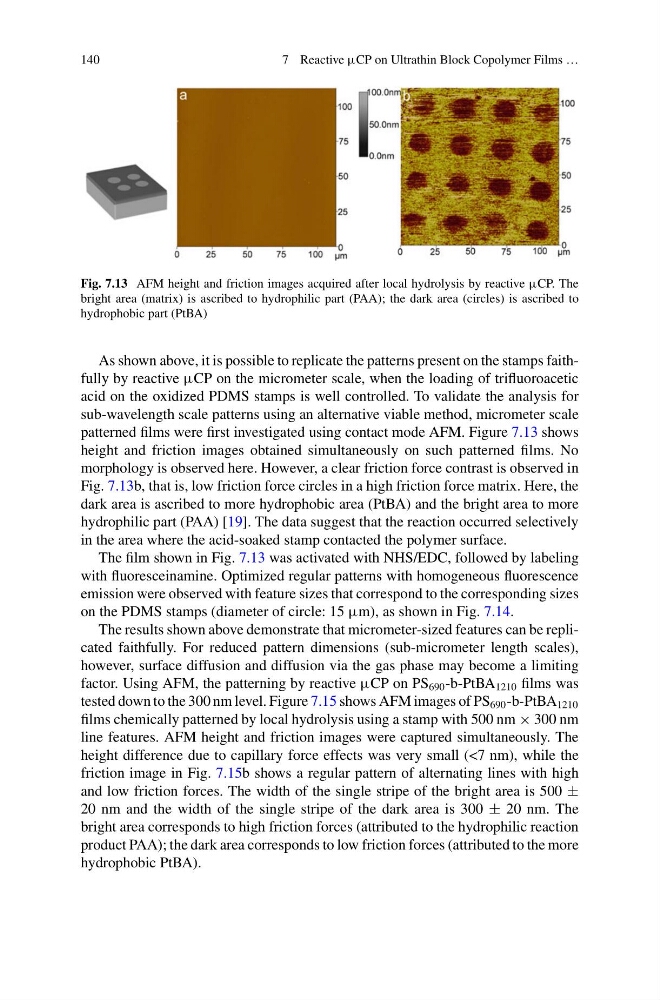
Fig. 7.13 AFM height and friction images acquired after local hydrolysis by reactive μCP. The
bright area (matrix) is ascribed to hydrophilic part (PAA); the dark area (circles) is ascribed to
hydrophobic part (PtBA)
As shown above, it is possible to replicate the patterns present on the stamps faithfully by reactive μCP on the micrometer scale, when the loading of trifluoroacetic
acid on the oxidized PDMS stamps is well controlled. To validate the analysis for
sub-wavelength scale patterns using an alternative viable method, micrometer scale
patterned films were first investigated using contact mode AFM. Figure 7.13 shows
height and friction images obtained simultaneously on such patterned films. No
morphology is observed here. However, a clear friction force contrast is observed in
Fig. 7.13b, that is, low friction force circles in a high friction force matrix. Here, the
dark area is ascribed to more hydrophobic area (PtBA) and the bright area to more
hydrophilic part (PAA) [19]. The data suggest that the reaction occurred selectively
in the area where the acid-soaked stamp contacted the polymer surface.
The film shown in Fig. 7.13 was activated with NHS/EDC, followed by labeling
with fluoresceinamine. Optimized regular patterns with homogeneous fluorescence
emission were observed with feature sizes that correspond to the corresponding sizes
on the PDMS stamps (diameter of circle: 15 μm), as shown in Fig. 7.14.
The results shown above demonstrate that micrometer-sized features can be replicated faithfully. For reduced pattern dimensions (sub-micrometer length scales),
however, surface diffusion and diffusion via the gas phase may become a limiting
factor. Using AFM, the patterning by reactive μCP on PS 690 -b-PtBA 1210 films was
tested down to the 300 nm level. Figure 7.15 shows AFM images of PS 690 -b-PtBA 1210
films chemically patterned by local hydrolysis using a stamp with 500 nm × 300 nm
line features. AFM height and friction images were captured simultaneously. The
height difference due to capillary force effects was very small (<7 nm), while the
friction image in Fig. 7.15b shows a regular pattern of alternating lines with high
and low friction forces. The width of the single stripe of the bright area is 500 ±
20 nm and the width of the single stripe of the dark area is 300 ± 20 nm. The
bright area corresponds to high friction forces (attributed to the hydrophilic reaction
product PAA); the dark area corresponds to low friction forces (attributed to the more
hydrophobic PtBA).
7 Reactive μCP on Ultrathin Block Copolymer Films …
Fig. 7.13 AFM height and friction images acquired after local hydrolysis by reactive μCP. The
bright area (matrix) is ascribed to hydrophilic part (PAA); the dark area (circles) is ascribed to
hydrophobic part (PtBA)
As shown above, it is possible to replicate the patterns present on the stamps faithfully by reactive μCP on the micrometer scale, when the loading of trifluoroacetic
acid on the oxidized PDMS stamps is well controlled. To validate the analysis for
sub-wavelength scale patterns using an alternative viable method, micrometer scale
patterned films were first investigated using contact mode AFM. Figure 7.13 shows
height and friction images obtained simultaneously on such patterned films. No
morphology is observed here. However, a clear friction force contrast is observed in
Fig. 7.13b, that is, low friction force circles in a high friction force matrix. Here, the
dark area is ascribed to more hydrophobic area (PtBA) and the bright area to more
hydrophilic part (PAA) [19]. The data suggest that the reaction occurred selectively
in the area where the acid-soaked stamp contacted the polymer surface.
The film shown in Fig. 7.13 was activated with NHS/EDC, followed by labeling
with fluoresceinamine. Optimized regular patterns with homogeneous fluorescence
emission were observed with feature sizes that correspond to the corresponding sizes
on the PDMS stamps (diameter of circle: 15 μm), as shown in Fig. 7.14.
The results shown above demonstrate that micrometer-sized features can be replicated faithfully. For reduced pattern dimensions (sub-micrometer length scales),
however, surface diffusion and diffusion via the gas phase may become a limiting
factor. Using AFM, the patterning by reactive μCP on PS 690 -b-PtBA 1210 films was
tested down to the 300 nm level. Figure 7.15 shows AFM images of PS 690 -b-PtBA 1210
films chemically patterned by local hydrolysis using a stamp with 500 nm × 300 nm
line features. AFM height and friction images were captured simultaneously. The
height difference due to capillary force effects was very small (<7 nm), while the
friction image in Fig. 7.15b shows a regular pattern of alternating lines with high
and low friction forces. The width of the single stripe of the bright area is 500 ±
20 nm and the width of the single stripe of the dark area is 300 ± 20 nm. The
bright area corresponds to high friction forces (attributed to the hydrophilic reaction
product PAA); the dark area corresponds to low friction forces (attributed to the more
hydrophobic PtBA).