

7.4 Strategy C: Local Deprotection of PS 690 -b-PtBA 1210 Films
139
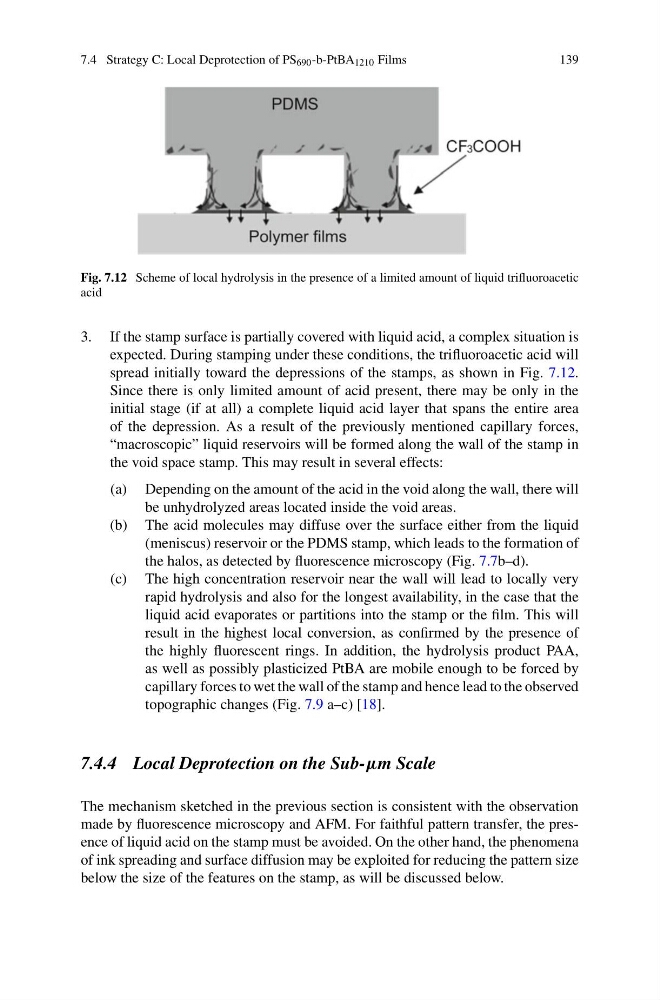
Fig. 7.12 Scheme of local hydrolysis in the presence of a limited amount of liquid trifluoroacetic
acid
3. If the stamp surface is partially covered with liquid acid, a complex situation is
expected. During stamping under these conditions, the trifluoroacetic acid will
spread initially toward the depressions of the stamps, as shown in Fig. 7.12.
Since there is only limited amount of acid present, there may be only in the
initial stage (if at all) a complete liquid acid layer that spans the entire area
of the depression. As a result of the previously mentioned capillary forces,
“macroscopic” liquid reservoirs will be formed along the wall of the stamp in
the void space stamp. This may result in several effects:
(a) Depending on the amount of the acid in the void along the wall, there will
be unhydrolyzed areas located inside the void areas.
(b) The acid molecules may diffuse over the surface either from the liquid
(meniscus) reservoir or the PDMS stamp, which leads to the formation of
the halos, as detected by fluorescence microscopy (Fig. 7.7b–d).
(c) The high concentration reservoir near the wall will lead to locally very
rapid hydrolysis and also for the longest availability, in the case that the
liquid acid evaporates or partitions into the stamp or the film. This will
result in the highest local conversion, as confirmed by the presence of
the highly fluorescent rings. In addition, the hydrolysis product PAA,
as well as possibly plasticized PtBA are mobile enough to be forced by
capillary forces to wet the wall of the stamp and hence lead to the observed
topographic changes (Fig. 7.9 a–c) [18].
7.4.4 Local Deprotection on the Sub-µm Scale
The mechanism sketched in the previous section is consistent with the observation
made by fluorescence microscopy and AFM. For faithful pattern transfer, the presence of liquid acid on the stamp must be avoided. On the other hand, the phenomena
of ink spreading and surface diffusion may be exploited for reducing the pattern size
below the size of the features on the stamp, as will be discussed below.
139
Fig. 7.12 Scheme of local hydrolysis in the presence of a limited amount of liquid trifluoroacetic
acid
3. If the stamp surface is partially covered with liquid acid, a complex situation is
expected. During stamping under these conditions, the trifluoroacetic acid will
spread initially toward the depressions of the stamps, as shown in Fig. 7.12.
Since there is only limited amount of acid present, there may be only in the
initial stage (if at all) a complete liquid acid layer that spans the entire area
of the depression. As a result of the previously mentioned capillary forces,
“macroscopic” liquid reservoirs will be formed along the wall of the stamp in
the void space stamp. This may result in several effects:
(a) Depending on the amount of the acid in the void along the wall, there will
be unhydrolyzed areas located inside the void areas.
(b) The acid molecules may diffuse over the surface either from the liquid
(meniscus) reservoir or the PDMS stamp, which leads to the formation of
the halos, as detected by fluorescence microscopy (Fig. 7.7b–d).
(c) The high concentration reservoir near the wall will lead to locally very
rapid hydrolysis and also for the longest availability, in the case that the
liquid acid evaporates or partitions into the stamp or the film. This will
result in the highest local conversion, as confirmed by the presence of
the highly fluorescent rings. In addition, the hydrolysis product PAA,
as well as possibly plasticized PtBA are mobile enough to be forced by
capillary forces to wet the wall of the stamp and hence lead to the observed
topographic changes (Fig. 7.9 a–c) [18].
7.4.4 Local Deprotection on the Sub-µm Scale
The mechanism sketched in the previous section is consistent with the observation
made by fluorescence microscopy and AFM. For faithful pattern transfer, the presence of liquid acid on the stamp must be avoided. On the other hand, the phenomena
of ink spreading and surface diffusion may be exploited for reducing the pattern size
below the size of the features on the stamp, as will be discussed below.