

132
7 Reactive μCP on Ultrathin Block Copolymer Films …
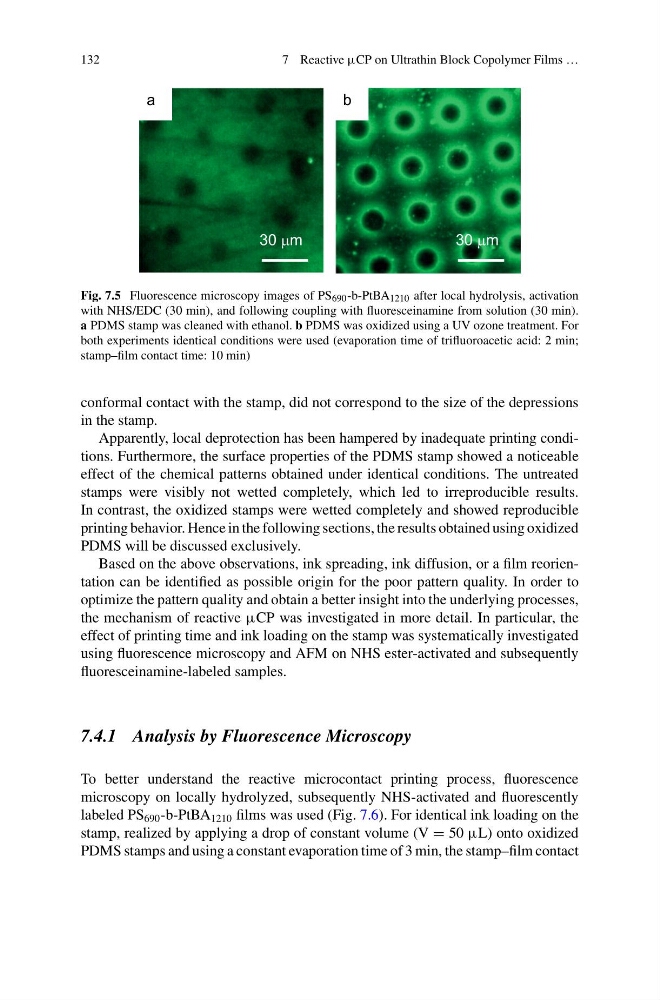
Fig. 7.5 Fluorescence microscopy images of PS 690 -b-PtBA 1210 after local hydrolysis, activation
with NHS/EDC (30 min), and following coupling with fluoresceinamine from solution (30 min).
a PDMS stamp was cleaned with ethanol. b PDMS was oxidized using a UV ozone treatment. For
both experiments identical conditions were used (evaporation time of trifluoroacetic acid: 2 min;
stamp–film contact time: 10 min)
conformal contact with the stamp, did not correspond to the size of the depressions
in the stamp.
Apparently, local deprotection has been hampered by inadequate printing conditions. Furthermore, the surface properties of the PDMS stamp showed a noticeable
effect of the chemical patterns obtained under identical conditions. The untreated
stamps were visibly not wetted completely, which led to irreproducible results.
In contrast, the oxidized stamps were wetted completely and showed reproducible
printing behavior. Hence in the following sections, the results obtained using oxidized
PDMS will be discussed exclusively.
Based on the above observations, ink spreading, ink diffusion, or a film reorientation can be identified as possible origin for the poor pattern quality. In order to
optimize the pattern quality and obtain a better insight into the underlying processes,
the mechanism of reactive μCP was investigated in more detail. In particular, the
effect of printing time and ink loading on the stamp was systematically investigated
using fluorescence microscopy and AFM on NHS ester-activated and subsequently
fluoresceinamine-labeled samples.
7.4.1 Analysis by Fluorescence Microscopy
To better understand the reactive microcontact printing process, fluorescence
microscopy on locally hydrolyzed, subsequently NHS-activated and fluorescently
labeled PS 690 -b-PtBA 1210 films was used (Fig. 7.6). For identical ink loading on the
stamp, realized by applying a drop of constant volume (V = 50 μL) onto oxidized
PDMS stamps and using a constant evaporation time of 3 min, the stamp–film contact
7 Reactive μCP on Ultrathin Block Copolymer Films …
Fig. 7.5 Fluorescence microscopy images of PS 690 -b-PtBA 1210 after local hydrolysis, activation
with NHS/EDC (30 min), and following coupling with fluoresceinamine from solution (30 min).
a PDMS stamp was cleaned with ethanol. b PDMS was oxidized using a UV ozone treatment. For
both experiments identical conditions were used (evaporation time of trifluoroacetic acid: 2 min;
stamp–film contact time: 10 min)
conformal contact with the stamp, did not correspond to the size of the depressions
in the stamp.
Apparently, local deprotection has been hampered by inadequate printing conditions. Furthermore, the surface properties of the PDMS stamp showed a noticeable
effect of the chemical patterns obtained under identical conditions. The untreated
stamps were visibly not wetted completely, which led to irreproducible results.
In contrast, the oxidized stamps were wetted completely and showed reproducible
printing behavior. Hence in the following sections, the results obtained using oxidized
PDMS will be discussed exclusively.
Based on the above observations, ink spreading, ink diffusion, or a film reorientation can be identified as possible origin for the poor pattern quality. In order to
optimize the pattern quality and obtain a better insight into the underlying processes,
the mechanism of reactive μCP was investigated in more detail. In particular, the
effect of printing time and ink loading on the stamp was systematically investigated
using fluorescence microscopy and AFM on NHS ester-activated and subsequently
fluoresceinamine-labeled samples.
7.4.1 Analysis by Fluorescence Microscopy
To better understand the reactive microcontact printing process, fluorescence
microscopy on locally hydrolyzed, subsequently NHS-activated and fluorescently
labeled PS 690 -b-PtBA 1210 films was used (Fig. 7.6). For identical ink loading on the
stamp, realized by applying a drop of constant volume (V = 50 μL) onto oxidized
PDMS stamps and using a constant evaporation time of 3 min, the stamp–film contact