

7.3 Strategy B: Local Passivation of PS 690 -b-PtBA 1210 Films
131
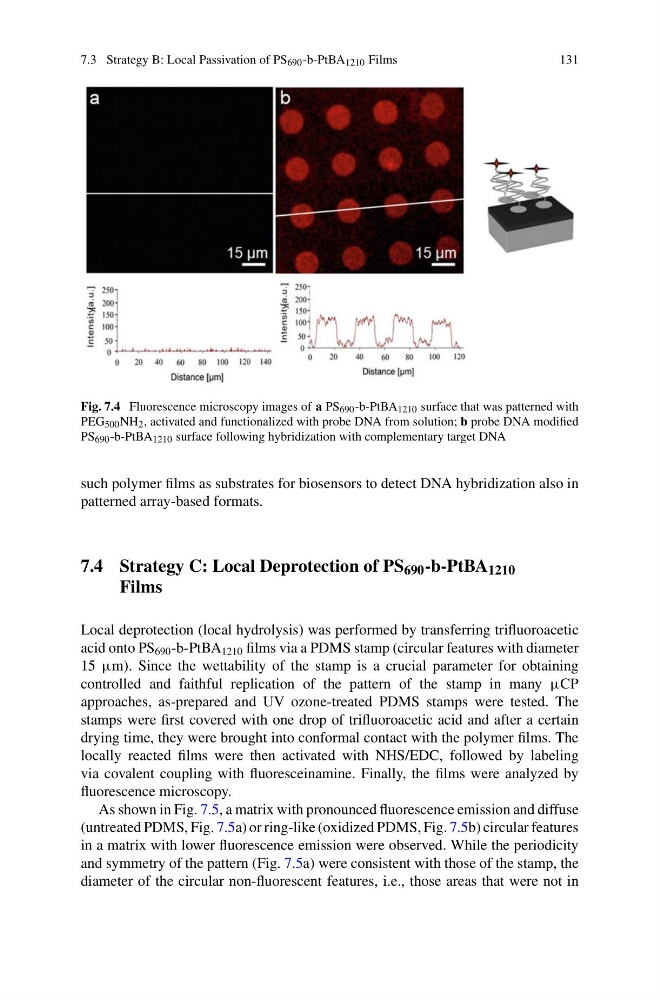
Fig. 7.4 Fluorescence microscopy images of a PS 690 -b-PtBA 1210 surface that was patterned with
PEG 500 NH 2 , activated and functionalized with probe DNA from solution; b probe DNA modified
PS 690 -b-PtBA 1210 surface following hybridization with complementary target DNA
such polymer films as substrates for biosensors to detect DNA hybridization also in
patterned array-based formats.
7.4 Strategy C: Local Deprotection of PS 690 -b-PtBA 1210
Films
Local deprotection (local hydrolysis) was performed by transferring trifluoroacetic
acid onto PS 690 -b-PtBA 1210 films via a PDMS stamp (circular features with diameter
15 μm). Since the wettability of the stamp is a crucial parameter for obtaining
controlled and faithful replication of the pattern of the stamp in many μCP
approaches, as-prepared and UV ozone-treated PDMS stamps were tested. The
stamps were first covered with one drop of trifluoroacetic acid and after a certain
drying time, they were brought into conformal contact with the polymer films. The
locally reacted films were then activated with NHS/EDC, followed by labeling
via covalent coupling with fluoresceinamine. Finally, the films were analyzed by
fluorescence microscopy.
As shown in Fig. 7.5, a matrix with pronounced fluorescence emission and diffuse
(untreated PDMS, Fig. 7.5a) or ring-like (oxidized PDMS, Fig. 7.5b) circular features
in a matrix with lower fluorescence emission were observed. While the periodicity
and symmetry of the pattern (Fig. 7.5a) were consistent with those of the stamp, the
diameter of the circular non-fluorescent features, i.e., those areas that were not in
131
Fig. 7.4 Fluorescence microscopy images of a PS 690 -b-PtBA 1210 surface that was patterned with
PEG 500 NH 2 , activated and functionalized with probe DNA from solution; b probe DNA modified
PS 690 -b-PtBA 1210 surface following hybridization with complementary target DNA
such polymer films as substrates for biosensors to detect DNA hybridization also in
patterned array-based formats.
7.4 Strategy C: Local Deprotection of PS 690 -b-PtBA 1210
Films
Local deprotection (local hydrolysis) was performed by transferring trifluoroacetic
acid onto PS 690 -b-PtBA 1210 films via a PDMS stamp (circular features with diameter
15 μm). Since the wettability of the stamp is a crucial parameter for obtaining
controlled and faithful replication of the pattern of the stamp in many μCP
approaches, as-prepared and UV ozone-treated PDMS stamps were tested. The
stamps were first covered with one drop of trifluoroacetic acid and after a certain
drying time, they were brought into conformal contact with the polymer films. The
locally reacted films were then activated with NHS/EDC, followed by labeling
via covalent coupling with fluoresceinamine. Finally, the films were analyzed by
fluorescence microscopy.
As shown in Fig. 7.5, a matrix with pronounced fluorescence emission and diffuse
(untreated PDMS, Fig. 7.5a) or ring-like (oxidized PDMS, Fig. 7.5b) circular features
in a matrix with lower fluorescence emission were observed. While the periodicity
and symmetry of the pattern (Fig. 7.5a) were consistent with those of the stamp, the
diameter of the circular non-fluorescent features, i.e., those areas that were not in