

100
5 Tailored Biointerfaces via Derivatization of Polystyrene-b-Poly …
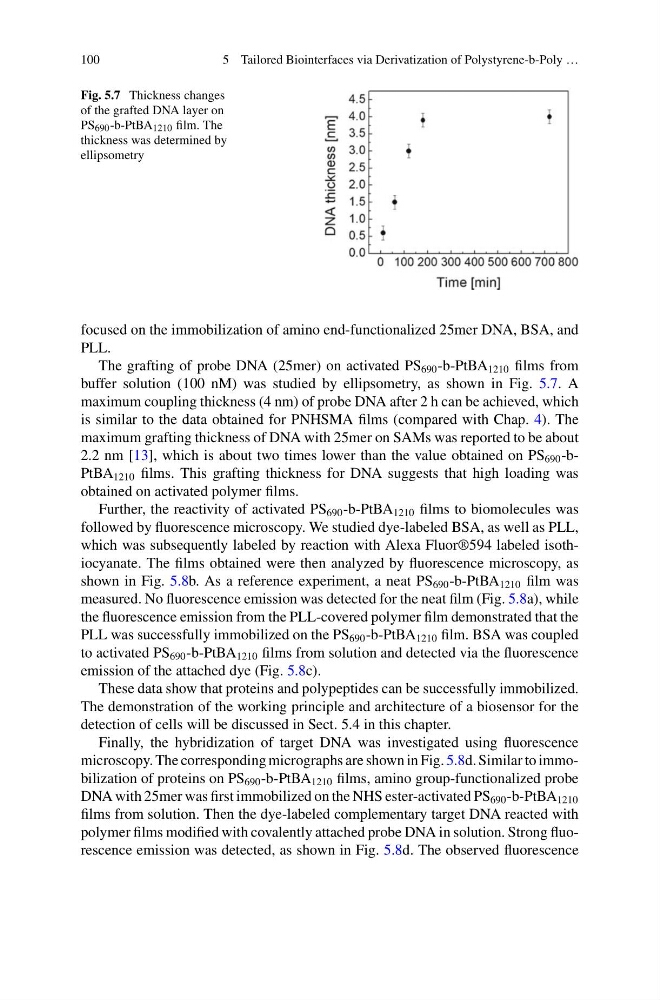
Fig. 5.7 Thickness changes
of the grafted DNA layer on
PS 690 -b-PtBA 1210 film. The
thickness was determined by
ellipsometry
focused on the immobilization of amino end-functionalized 25mer DNA, BSA, and
PLL.
The grafting of probe DNA (25mer) on activated PS 690 -b-PtBA 1210 films from
buffer solution (100 nM) was studied by ellipsometry, as shown in Fig. 5.7. A
maximum coupling thickness (4 nm) of probe DNA after 2 h can be achieved, which
is similar to the data obtained for PNHSMA films (compared with Chap. 4). The
maximum grafting thickness of DNA with 25mer on SAMs was reported to be about
2.2 nm [13], which is about two times lower than the value obtained on PS 690 -bPtBA 1210 films. This grafting thickness for DNA suggests that high loading was
obtained on activated polymer films.
Further, the reactivity of activated PS 690 -b-PtBA 1210 films to biomolecules was
followed by fluorescence microscopy. We studied dye-labeled BSA, as well as PLL,
which was subsequently labeled by reaction with Alexa Fluor®594 labeled isothiocyanate. The films obtained were then analyzed by fluorescence microscopy, as
shown in Fig. 5.8b. As a reference experiment, a neat PS 690 -b-PtBA 1210 film was
measured. No fluorescence emission was detected for the neat film (Fig. 5.8a), while
the fluorescence emission from the PLL-covered polymer film demonstrated that the
PLL was successfully immobilized on the PS 690 -b-PtBA 1210 film. BSA was coupled
to activated PS 690 -b-PtBA 1210 films from solution and detected via the fluorescence
emission of the attached dye (Fig. 5.8c).
These data show that proteins and polypeptides can be successfully immobilized.
The demonstration of the working principle and architecture of a biosensor for the
detection of cells will be discussed in Sect. 5.4 in this chapter.
Finally, the hybridization of target DNA was investigated using fluorescence
microscopy. The corresponding micrographs are shown in Fig. 5.8d. Similar to immobilization of proteins on PS 690 -b-PtBA 1210 films, amino group-functionalized probe
DNA with 25mer was first immobilized on the NHS ester-activated PS 690 -b-PtBA 1210
films from solution. Then the dye-labeled complementary target DNA reacted with
polymer films modified with covalently attached probe DNA in solution. Strong fluorescence emission was detected, as shown in Fig. 5.8d. The observed fluorescence
5 Tailored Biointerfaces via Derivatization of Polystyrene-b-Poly …
Fig. 5.7 Thickness changes
of the grafted DNA layer on
PS 690 -b-PtBA 1210 film. The
thickness was determined by
ellipsometry
focused on the immobilization of amino end-functionalized 25mer DNA, BSA, and
PLL.
The grafting of probe DNA (25mer) on activated PS 690 -b-PtBA 1210 films from
buffer solution (100 nM) was studied by ellipsometry, as shown in Fig. 5.7. A
maximum coupling thickness (4 nm) of probe DNA after 2 h can be achieved, which
is similar to the data obtained for PNHSMA films (compared with Chap. 4). The
maximum grafting thickness of DNA with 25mer on SAMs was reported to be about
2.2 nm [13], which is about two times lower than the value obtained on PS 690 -bPtBA 1210 films. This grafting thickness for DNA suggests that high loading was
obtained on activated polymer films.
Further, the reactivity of activated PS 690 -b-PtBA 1210 films to biomolecules was
followed by fluorescence microscopy. We studied dye-labeled BSA, as well as PLL,
which was subsequently labeled by reaction with Alexa Fluor®594 labeled isothiocyanate. The films obtained were then analyzed by fluorescence microscopy, as
shown in Fig. 5.8b. As a reference experiment, a neat PS 690 -b-PtBA 1210 film was
measured. No fluorescence emission was detected for the neat film (Fig. 5.8a), while
the fluorescence emission from the PLL-covered polymer film demonstrated that the
PLL was successfully immobilized on the PS 690 -b-PtBA 1210 film. BSA was coupled
to activated PS 690 -b-PtBA 1210 films from solution and detected via the fluorescence
emission of the attached dye (Fig. 5.8c).
These data show that proteins and polypeptides can be successfully immobilized.
The demonstration of the working principle and architecture of a biosensor for the
detection of cells will be discussed in Sect. 5.4 in this chapter.
Finally, the hybridization of target DNA was investigated using fluorescence
microscopy. The corresponding micrographs are shown in Fig. 5.8d. Similar to immobilization of proteins on PS 690 -b-PtBA 1210 films, amino group-functionalized probe
DNA with 25mer was first immobilized on the NHS ester-activated PS 690 -b-PtBA 1210
films from solution. Then the dye-labeled complementary target DNA reacted with
polymer films modified with covalently attached probe DNA in solution. Strong fluorescence emission was detected, as shown in Fig. 5.8d. The observed fluorescence