

5.2 Investigation of the Surface Chemistry of PS 690 -b-PtBA 1210 Films
99
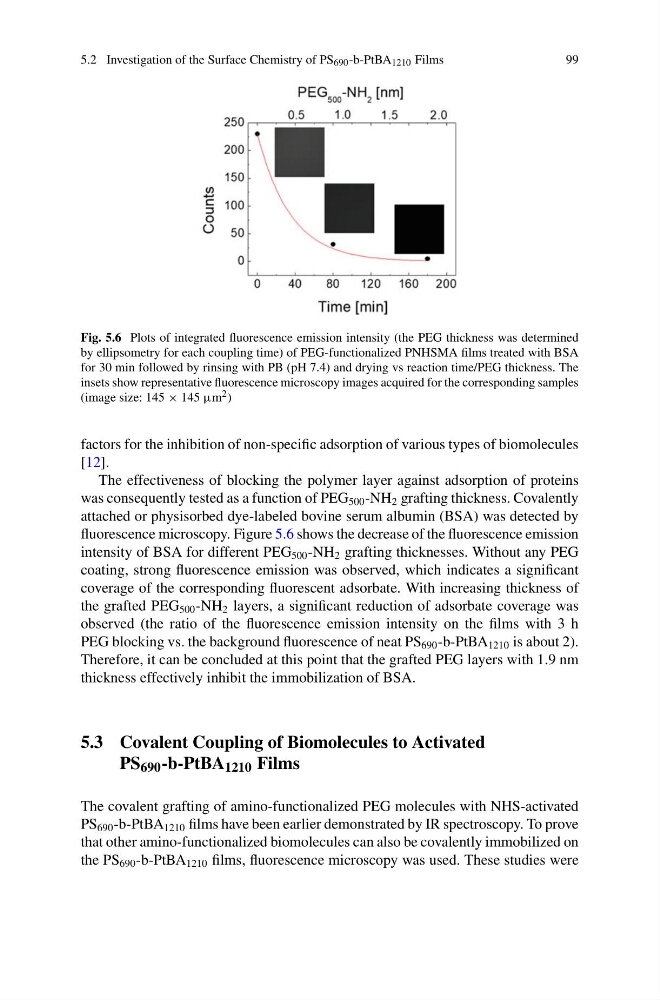
Fig. 5.6 Plots of integrated fluorescence emission intensity (the PEG thickness was determined
by ellipsometry for each coupling time) of PEG-functionalized PNHSMA films treated with BSA
for 30 min followed by rinsing with PB (pH 7.4) and drying vs reaction time/PEG thickness. The
insets show representative fluorescence microscopy images acquired for the corresponding samples
(image size: 145 × 145 μm 2 )
factors for the inhibition of non-specific adsorption of various types of biomolecules
[12].
The effectiveness of blocking the polymer layer against adsorption of proteins
was consequently tested as a function of PEG 500 -NH 2 grafting thickness. Covalently
attached or physisorbed dye-labeled bovine serum albumin (BSA) was detected by
fluorescence microscopy. Figure 5.6 shows the decrease of the fluorescence emission
intensity of BSA for different PEG 500 -NH 2 grafting thicknesses. Without any PEG
coating, strong fluorescence emission was observed, which indicates a significant
coverage of the corresponding fluorescent adsorbate. With increasing thickness of
the grafted PEG 500 -NH 2 layers, a significant reduction of adsorbate coverage was
observed (the ratio of the fluorescence emission intensity on the films with 3 h
PEG blocking vs. the background fluorescence of neat PS 690 -b-PtBA 1210 is about 2).
Therefore, it can be concluded at this point that the grafted PEG layers with 1.9 nm
thickness effectively inhibit the immobilization of BSA.
5.3 Covalent Coupling of Biomolecules to Activated
PS 690 -b-PtBA 1210 Films
The covalent grafting of amino-functionalized PEG molecules with NHS-activated
PS 690 -b-PtBA 1210 films have been earlier demonstrated by IR spectroscopy. To prove
that other amino-functionalized biomolecules can also be covalently immobilized on
the PS 690 -b-PtBA 1210 films, fluorescence microscopy was used. These studies were
99
Fig. 5.6 Plots of integrated fluorescence emission intensity (the PEG thickness was determined
by ellipsometry for each coupling time) of PEG-functionalized PNHSMA films treated with BSA
for 30 min followed by rinsing with PB (pH 7.4) and drying vs reaction time/PEG thickness. The
insets show representative fluorescence microscopy images acquired for the corresponding samples
(image size: 145 × 145 μm 2 )
factors for the inhibition of non-specific adsorption of various types of biomolecules
[12].
The effectiveness of blocking the polymer layer against adsorption of proteins
was consequently tested as a function of PEG 500 -NH 2 grafting thickness. Covalently
attached or physisorbed dye-labeled bovine serum albumin (BSA) was detected by
fluorescence microscopy. Figure 5.6 shows the decrease of the fluorescence emission
intensity of BSA for different PEG 500 -NH 2 grafting thicknesses. Without any PEG
coating, strong fluorescence emission was observed, which indicates a significant
coverage of the corresponding fluorescent adsorbate. With increasing thickness of
the grafted PEG 500 -NH 2 layers, a significant reduction of adsorbate coverage was
observed (the ratio of the fluorescence emission intensity on the films with 3 h
PEG blocking vs. the background fluorescence of neat PS 690 -b-PtBA 1210 is about 2).
Therefore, it can be concluded at this point that the grafted PEG layers with 1.9 nm
thickness effectively inhibit the immobilization of BSA.
5.3 Covalent Coupling of Biomolecules to Activated
PS 690 -b-PtBA 1210 Films
The covalent grafting of amino-functionalized PEG molecules with NHS-activated
PS 690 -b-PtBA 1210 films have been earlier demonstrated by IR spectroscopy. To prove
that other amino-functionalized biomolecules can also be covalently immobilized on
the PS 690 -b-PtBA 1210 films, fluorescence microscopy was used. These studies were